How to Write Your First MarQi Cloud Infrastructure Automation Script
May 3, 2026
The MarQi Cloud SDK Guide: Integrating Cloud Resources Into Your Application
May 4, 2026
MarQi Cloud Webhooks and Events: How to Build Event-Driven Infrastructure
In today’s fast-paced digital landscape, the way organizations handle data and events is critical to their success. As businesses move towards more agile and responsive systems, event-driven architectures are becoming increasingly popular. At MarQi Cloud, we recognize the importance of integrating webhooks and events into your cloud infrastructure. This article explores how to build an event-driven infrastructure using MarQi Cloud’s robust services.
Understanding Event-Driven Architecture
Event-driven architecture (EDA) is a software architecture pattern that revolves around the production, detection, consumption of, and reaction to events. An event can be defined as a significant change in state, such as a user action or a system-generated notification. EDA promotes a decoupled system where different components can communicate asynchronously, enhancing scalability and flexibility.
Benefits of Event-Driven Architecture
- Scalability: EDA allows components to scale independently, enabling organizations to manage varying loads efficiently.
- Flexibility: Components can evolve independently without impacting the entire system, allowing for more rapid development and deployment.
- Responsiveness: EDA enables real-time processing of data and events, leading to quicker responses and enhanced user experiences.
What are Webhooks?
Webhooks are user-defined HTTP callbacks that trigger events in real-time. They are used to send data from one application to another as soon as an event occurs, eliminating the need for continuous polling. This immediate notification helps systems respond faster to changes.
How Webhooks Work
When a specific event occurs in a source application, it sends an HTTP POST request to a configured URL (the webhook). This request usually contains a payload of data related to the event. The receiving application can then process this data as needed, allowing for seamless integrations and automation.
Building an Event-Driven Infrastructure with MarQi Cloud
At MarQi Cloud, we provide enterprise-grade cloud infrastructure equipped to support event-driven architectures. Here’s how you can effectively build your event-driven infrastructure using our services.
1. Choose Your Hybrid Cloud Model
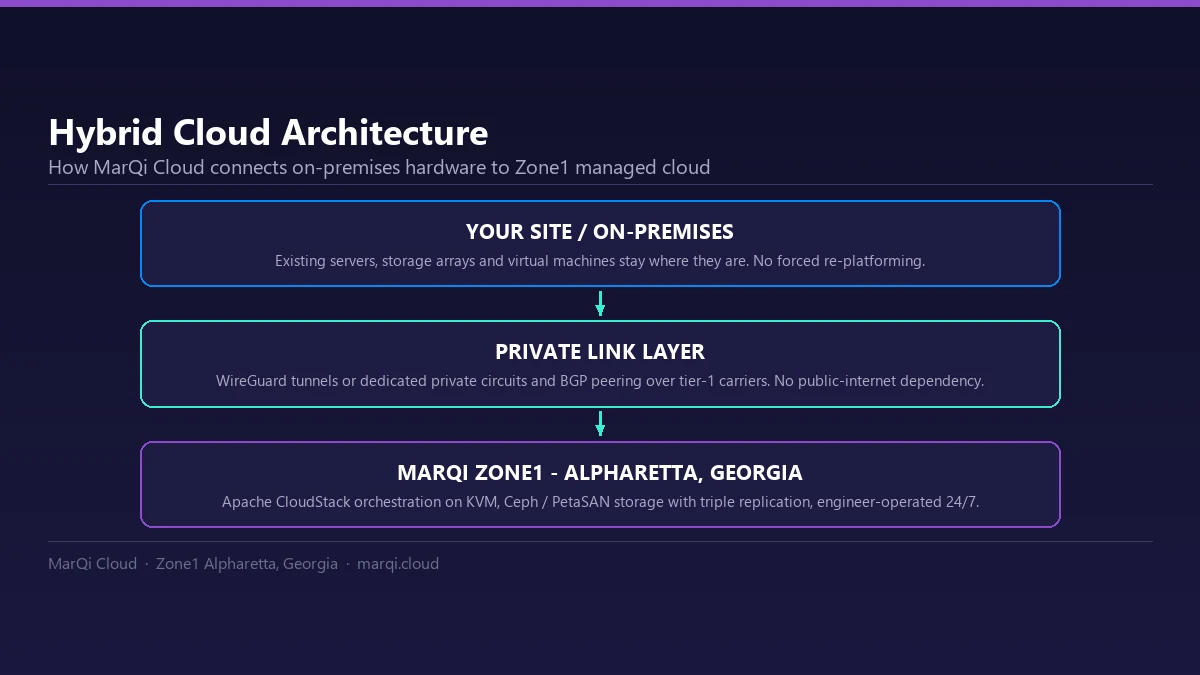
MarQi Cloud offers flexible hybrid cloud deployment models that allow you to tailor your infrastructure according to your business needs. You can choose between public, private, or a combination of both to create a secure and performant environment.
2. Implement Scalable Compute and Storage Resources
Utilize our scalable compute and storage resources to handle varying workloads efficiently. MarQi Cloud’s infrastructure allows you to scale your resources up or down based on demand, ensuring optimal performance and cost-efficiency.
3. Set Up Webhooks
To set up webhooks, define the events you want to monitor. For instance, if you are using a payment processing service, you can configure webhooks to notify your application whenever a payment is completed. Here’s a general process to set up webhooks:
- Identify the event source (e.g., a payment gateway).
- Define the webhook URL where the data will be sent.
- Configure the event notification settings in the source application.
4. Design Event Handlers
Once the webhooks are set up, create event handlers within your application to process incoming events. These handlers will receive the HTTP requests from the webhooks and execute predefined actions based on the event data.
5. Ensure Business Continuity and Disaster Recovery
Implement business continuity and disaster recovery solutions to safeguard your event-driven infrastructure. MarQi Cloud provides robust backup and recovery options to ensure your data is secure and available when needed.
6. Monitor and Optimize Performance
Continuously monitor your event-driven architecture to identify performance bottlenecks and optimize resource allocation. Use MarQi Cloud’s performance monitoring tools to gain insights into your application’s responsiveness and make adjustments as necessary.
Use Cases for Webhooks and Events
Webhooks and events can be applied in various scenarios across different industries. Here are some common use cases:
1. E-commerce Platforms
In e-commerce, webhooks can be used to notify merchants about order updates, inventory changes, or customer actions, allowing for real-time processing and improved customer experiences.
2. Financial Services
Financial institutions can utilize webhooks to trigger notifications for transactions, account updates, or fraud alerts, ensuring timely responses to critical events.
3. IoT Applications
In the Internet of Things (IoT), devices can send event notifications to cloud applications, enabling real-time data processing and automated responses.
Challenges in Implementing Event-Driven Architecture
While an event-driven architecture offers numerous benefits, there are challenges to consider:
1. Complexity
Implementing an event-driven architecture can introduce complexity, particularly in managing multiple components and ensuring they communicate effectively.
2. Debugging and Monitoring
Tracking events across distributed systems can complicate debugging and monitoring efforts, requiring advanced tools and strategies.
3. Security Concerns
Webhooks can pose security risks if not properly secured. It’s essential to implement authentication and validation mechanisms to protect against unauthorized access.
Best Practices for Using Webhooks
To effectively utilize webhooks and events, consider the following best practices:
1. Secure Your Webhooks
Implement security measures such as secret tokens, IP whitelisting, and HTTPS to protect your webhook endpoints.
2. Handle Retries and Failures
Design your event handlers to manage retries in case of failures or timeouts. Consider implementing a dead letter queue for unprocessed events.
3. Document Your Webhooks
Provide clear documentation for your webhook endpoints, including the expected payload and response formats, to facilitate integrations with other systems.
Conclusion
Building an event-driven infrastructure using MarQi Cloud’s webhooks and events can significantly enhance your organization’s responsiveness and agility. By leveraging our enterprise-grade cloud services, you can create a robust and scalable architecture that meets your business needs. Embrace the power of events and webhooks to transform your applications and stay ahead in the competitive landscape.
FAQ
1. What is a webhook?
A webhook is an HTTP callback that allows one application to send real-time data to another when a specific event occurs.
2. How do webhooks differ from APIs?
Webhooks are event-driven, meaning they send data automatically when events occur, while APIs typically require polling for data.
3. Can I use webhooks with any application?
Not all applications support webhooks; you need to confirm that the application you are using provides webhook functionality.
4. What security measures should I implement for webhooks?
Consider using secret tokens, IP whitelisting, and HTTPS to secure your webhook endpoints.
5. How do I test webhooks?
You can use tools like Postman or webhook testing services to simulate events and test your webhook endpoints.
6. What happens if my webhook fails?
You should implement retry logic and consider using a dead letter queue to handle failed webhook events.
7. How can I monitor webhook activity?
Use logging and monitoring tools to track webhook requests and responses for performance insights.
8. Are webhooks suitable for all types of applications?
Webhooks are particularly useful for applications that require real-time data processing, but may not be necessary for all applications.
9. Can I use webhooks for batch processing?
Webhooks are typically designed for real-time notifications and may not be optimal for batch processing scenarios.
10. How do I set up a webhook in MarQi Cloud?
To set up a webhook in MarQi Cloud, define the event source, configure the webhook URL, and set the event notification settings in the source application.