
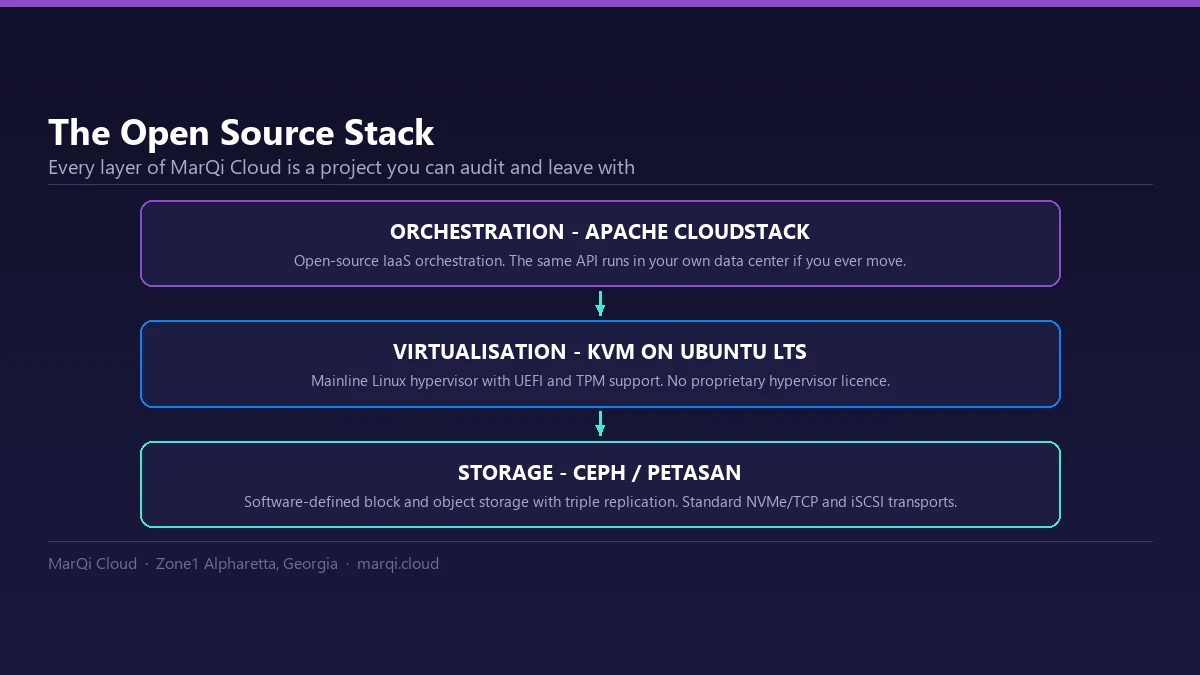
What the MarQi Cloud infrastructure layer covers
Infrastructure at MarQi Cloud is split into three engineering domains that are documented separately: the network fabric that carries traffic between zones and out to the internet, the storage architecture that keeps volumes and objects durable, and the compute platform that runs the virtual machines and bare metal hosts themselves. Each layer is built on open source software rather than proprietary appliances, which is what makes it possible to publish how it works instead of describing it in marketing terms.
Where the hardware lives
Production capacity runs from Zone1 in Alpharetta, Georgia, at 190 Bluegrass Valley Pkwy, inside the facility MarQi Cloud operates in partnership with Digital Ignition. Being in the north Atlanta metro rather than a distant hyperscaler region is the reason latency to businesses across Georgia and the wider Southeast stays low. Customers who want to place their own hardware in the same building use colocation and BYO hardware, and it lands on the same fabric as the cloud side.
How the layers fit together
A virtual machine created on the compute platform gets its disk from the storage cluster, its addressing and isolation from the network fabric, and its outbound path through the same Tier-1 connectivity used by colocation customers. That is what allows a single hybrid cloud VPC to contain both rented virtual machines and hardware a customer owns. Snapshots and backups, VPN and load balancing, and monitoring are part of the platform rather than separately metered add-ons, and there are no egress fees on traffic leaving the platform.
Reading further
If you are evaluating the platform, pricing shows what a VM costs and what is included, our zones describes the physical footprint, and getting started walks through provisioning. Engineering questions can go straight to the team at support@marqi.cloud or +1 770-369-9321.
Frequently asked questions
What are the three infrastructure layers?
The network fabric that carries traffic between zones and out to the internet, the storage architecture that keeps volumes and objects durable, and the compute platform that runs virtual machines and bare metal hosts. Each is documented separately because each is built on open source rather than a proprietary appliance.
Can colocated hardware use the same infrastructure as rented VMs?
Yes. Equipment racked in a zone lands on the same fabric as the cloud side, which is what allows a single hybrid VPC to contain both rented virtual machines and hardware you own.
Are backups, VPN and monitoring separate products?
No. Snapshots and backups, VPN and load balancing, and monitoring are part of the platform rather than separately metered add-ons, and there are no egress fees on traffic leaving it.
Why does the physical location matter?
Production capacity runs from Zone1 in Alpharetta, Georgia, in the north Atlanta metro rather than a distant hyperscaler region. That shortens the physical path traffic travels to businesses across Georgia and the Southeast — the part of latency no software tuning removes.
Related engineering articles
- Why Enterprise Cloud Architecture Should Be Designed for the Next Decade
- The Complete Guide to Cloud Infrastructure Decommissioning & Data Sanitization
- How Cloud Provider Transparency in Incident Communication Builds Trust
- Why Workload-Specific Cloud Instance Selection Outperforms General-Purpose Options
- The Complete Guide to Building a Multi-Year Cloud Infrastructure Roadmap for Enterprise Growth
- How Cloud Infrastructure Drives Digital Transformation in Traditional Industries
- Why MarQi Cloud’s Engineering Team Prioritizes Customer Outcomes
- How Cloud Infrastructure Supports Bring Your Own Device Policies Securely
Browse the full archive: Cloud Infrastructure (384)