
Southeast GPU hosting, from a Georgia data center
Most GPU capacity in the United States sits in a handful of very large markets, which means teams in Georgia and the wider Southeast either ship data a long way or accept whatever latency the nearest hyperscale region offers. Our GPU capacity runs from our Alpharetta, GA facility, inside the Atlanta metro — close enough that training data staged on your own hardware does not cross the country to reach a GPU, and close enough to visit.
For teams already colocating in Atlanta, that proximity is the point: your storage and our GPUs can sit on the same fabric rather than talking over the public internet. See colocation and BYO hardware and our zones.
Dedicated GPU clusters, not shared slices
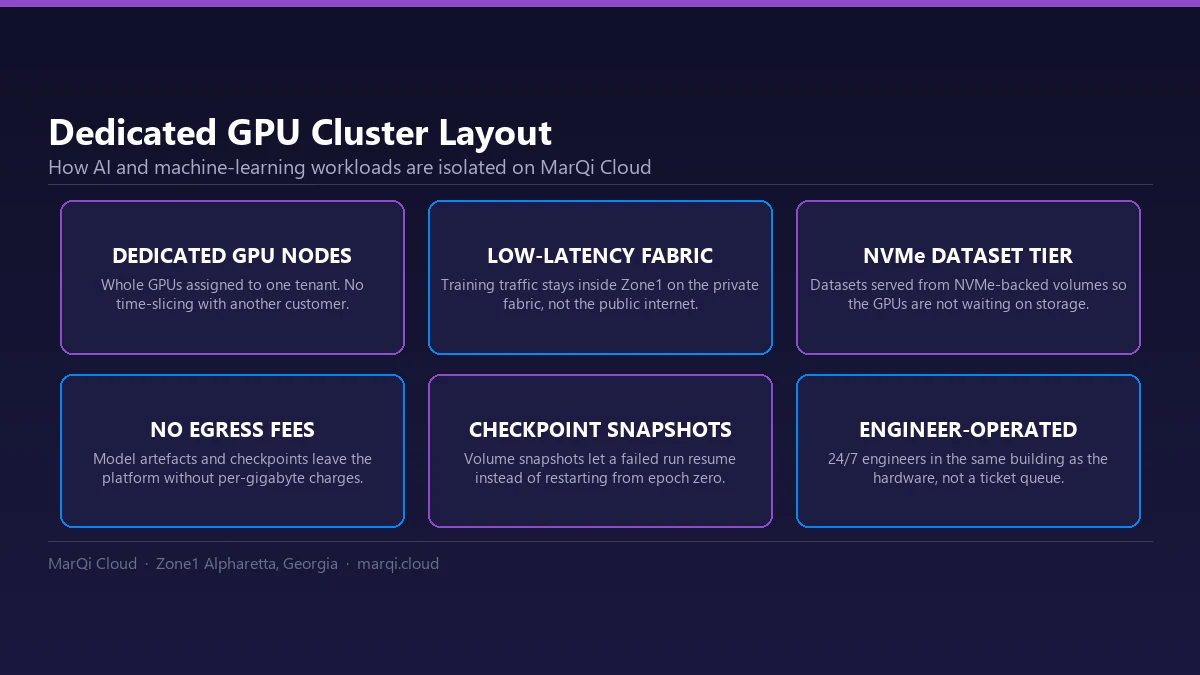
A GPU cluster solution is only useful if the cards are actually yours for the duration. We allocate dedicated GPUs with PCIe passthrough rather than time-slicing a card between tenants, so throughput does not move because someone else started a job. For multi-GPU training, interconnect and data-path bandwidth matter as much as the cards themselves — a cluster that starves its GPUs is an expensive way to wait.
Training and inference have different shapes
Training is throughput-bound and tolerant of latency: you want maximum sustained utilisation and enough storage bandwidth to keep the pipeline fed. Inference is the opposite — modest compute, but tail latency determines whether the product feels responsive. Sizing one deployment for both usually means overpaying for training capacity that sits idle, or under-serving inference at peak. We size them separately, and the low-latency path in front of inference is described under network fabric.
| Dimension | Training | Inference |
|---|---|---|
| What it is bound by | Throughput | Tail latency |
| Latency tolerance | Tolerant of latency | Tail latency determines whether the product feels responsive |
| Compute profile | Maximum sustained utilisation | Modest compute |
| Storage requirement | Enough bandwidth to keep the pipeline fed | Low-latency path in front of inference |
| Risk of sizing one deployment for both | Overpaying for training capacity that sits idle | Under-serving inference at peak |
Cooling is the constraint nobody quotes
Modern accelerators are thermally limited long before they are compute limited, and a card that throttles is a card you are paying full price for at reduced output. Our facility runs both air and liquid cooling for GPU-dense deployments, which is what makes sustained training runs viable rather than merely possible.
Transparent pricing, no egress penalty
GPU hosting bills are frequently dominated by things that are not the GPU: data transfer to get training sets in, transfer to get checkpoints out, and storage charged at a premium tier. We do not charge egress fees, and block storage for datasets and checkpoints is priced on capacity — see storage architecture and pricing. If you are comparing against a hyperscaler quote, include the transfer line; it is often where the difference is.
Benchmark before you commit
The right way to choose GPU infrastructure is to run your own workload on it — not a synthetic benchmark, and not a spec sheet comparison. If you are still deciding between a data-center card and a consumer one, our A100 vs RTX 4090 comparison for deep learning sets out the memory, interconnect and board power differences first. We will give you access to benchmark against your real training or inference job, on the configuration you would actually buy, before there is a contract.
Bring your own GPUs
If you already own accelerators, you do not have to rent ours to use our facility. Rack your cards with us and connect them to our storage and network under colocation, or run a mixed estate where your hardware and our cloud share one VPC — see hybrid cloud. Either way our engineers can operate it for you under managed services.
Ready to size a cluster? Talk to an engineer.
AI training infrastructure: what a training run actually needs
A GPU on its own is not AI training infrastructure. A training run is bounded by whichever of four things runs out first, and the GPU is only one of them.
| Layer | What it decides | How MarQi Cloud handles it |
|---|---|---|
| GPU | Throughput per step | Dedicated GPU clusters — not shared slices |
| Storage | Whether the GPU waits for data | NVMe-backed block storage over NVMe/TCP or iSCSI |
| Network | Checkpoint and dataset movement | Tier-1 fabric; private circuits available |
| Cost model | Whether the budget survives the run | No egress fees; published unit pricing |
GPU hosting Georgia and Atlanta teams can visit
GPU nodes run in Zone1, Alpharetta, GA — Atlanta metro. For teams in the Southeast US that removes the long-haul hop between where the data is produced and where it is trained on, and it means the hardware is reachable by the same engineers who operate it.
GPU server hosting and GPU cloud pricing
Compute, memory and storage are published at flat unit rates — $2 per vCPU, $2 per GB of RAM and $0.13 per GB of enterprise SSD storage per month, with no egress fees. GPU nodes are quoted individually because the right card, count and interconnect depend on the workload; we do not publish a single GPU rate that would be wrong for most people. Tell us the model and the training or inference target and you get a figure for that build.
Service levels and credits
Availability for GPU compute is committed per service, not as a single blended figure across an account. Compute, block storage, network and connectivity, VPN and load balancing, and colocation power and space are each covered separately. Availability is calculated per calendar month as the percentage of minutes during which the service was available, and an unavailability period starts at the earlier of our monitoring detecting it or you opening a ticket.
When we miss a commitment the remedy is a tiered service credit against the affected service. The specific commitment that applies to your services is stated in your order or agreement with us; if you are evaluating us and need the figures before you sign, ask an engineer and we will put them in writing. The full framework — covered services, how availability is measured, exclusions and the credit mechanism — is published in our Service Level Agreement.
Frequently asked questions
Does MarQi Cloud offer dedicated GPU servers for AI and machine learning?
Yes. MarQi Cloud provides dedicated GPU clusters for machine learning, deep learning, and high-performance AI compute. Every GPU node is fully dedicated — no shared environments, no noisy neighbors. GPU and NVMe storage devices use direct PCIe hardware passthrough, delivering full silicon performance to your workloads with no virtualization overhead. PCI passthrough is a kernel and hypervisor capability rather than a MarQi Cloud one; libvirt documents the PCI topology and passthrough model it depends on.
What does no GPU oversubscription mean?
GPU oversubscription means a provider allocates the same GPU resources to multiple tenants expecting they won't all use them simultaneously — similar to airline overbooking. MarQi Cloud does not oversubscribe GPU resources. The GPU allocation you reserve is guaranteed to be available at full capacity whenever your workload runs.
Does MarQi Cloud charge egress fees on GPU workload data transfers?
No. MarQi Cloud does not charge egress fees on any plan. Data movement between your GPU nodes, storage layer, and other parts of your environment generates no per-gigabyte charge. For AI and ML teams running iterative training pipelines that move large datasets repeatedly, this eliminates a major cost line that compounds on hyperscaler platforms.
What cooling systems support high-density GPU deployments?
MarQi Cloud Zone 1 supports both air and liquid cooling for high-density GPU deployments. Liquid cooling delivers higher thermal stability for sustained high-density workloads — enabling longer training runs without thermal throttling. The facility accommodates configurations including NVIDIA DGX, HGX, and custom GPU cluster builds. DGX and HGX are NVIDIA reference platforms rather than MarQi Cloud products, and NVIDIA documents both: DGX and HGX.
Can GPU clusters connect to my existing VMs and storage at MarQi Cloud?
Yes. MarQi Cloud GPU clusters are hybrid-ready by design. Your dedicated GPU nodes operate within the same MarQi Cloud ecosystem as your virtual machines, bare metal servers, and Ceph storage — connected over private VLANs with high-performance networking. This allows GPU training pipelines to access storage and databases without incurring egress fees or traversing the public internet.
What GPU hardware is available at MarQi Cloud?
MarQi Cloud offers dedicated GPU nodes with direct PCIe passthrough and NVMe storage. Specific GPU hardware availability including NVIDIA configurations can be discussed during a capacity scoping call. Our engineers provide architecture guidance for single-node deployments through large multi-GPU cluster designs.
Is there engineer support for GPU cluster architecture and configuration?
Yes. MarQi Cloud provides direct engineer-led support — not tier-1 scripts. Infrastructure engineers are available for GPU cluster architecture design, network topology planning, storage configuration, and ongoing operational support. For large GPU cluster deployments, we provide architecture guidance before provisioning begins.
Is MarQi Cloud a neocloud?
Neocloud is the industry term for a newer class of cloud providers built around GPU compute for AI rather than general-purpose hosting. MarQi Cloud fits the GPU side of that definition - dedicated, non-oversubscribed GPU clusters with PCIe passthrough and no egress fees - but it is not GPU-only: the same Zone1 data center in Alpharetta runs KVM compute on Apache CloudStack, Ceph block storage, private circuits and colocation, so a GPU cluster can sit next to the databases, storage and hardware it feeds.
RTX 4090 or A100 — which class of GPU should I rent for training?
The decision is usually made by memory, interconnect and precision rather than raw FLOPS. A data-center part such as the A100 carries HBM2 — about 1,555 GB/s of memory bandwidth on the 40 GB PCIe variant — and supports NVLink for multi-GPU training. A consumer RTX 4090 has 24 GB of GDDR6X and no NVLink. So a model that fits inside 24 GB and trains on a single card is often far cheaper on the consumer part, while anything that has to shard across GPUs, stream large batches or hold a big optimizer state will be bound by memory capacity and interconnect rather than by compute. Specific GPU hardware at MarQi Cloud, including NVIDIA configurations, is scoped on a capacity call rather than listed. Those memory figures are NVIDIA's own: the A100 40GB PCIe product brief lists HBM2 memory and peak bandwidth of up to 1555 GB/s in its memory specification table.
Related engineering articles
- How Cloud TPU and GPU Instance Selection Impacts Machine Learning Training Time
- GPU Cloud, Dedicated GPU Cluster or GPU Colocation? A Cost and Fit Guide
- How Cloud GPU Infrastructure Powers Machine Learning Training at Enterprise Scale
- The Complete Guide to Cloud GPU Computing for AI Workloads
- Step-by-Step Guide to Setting Up a Cloud GPU for Deep Learning Projects
- Is Investing in Dedicated GPU Clusters Worth It for Startups?
- The Ultimate Guide to GPU Hosting in Atlanta
- AI Compute Infrastructure Planning Guide: Building a Robust Foundation for AI Deployments
Browse the full archive: GPU & AI Infrastructure (86)