
Networking & VPN
Private VPCs, WireGuard tunnels, and load balancing
Networking on MarQi Cloud is private by default. Your instances sit in an isolated VPC, you reach them through a WireGuard tunnel rather than an exposed public port, and traffic between our zones never touches the public internet. There are no egress fees on any of it.
Isolated VPCs
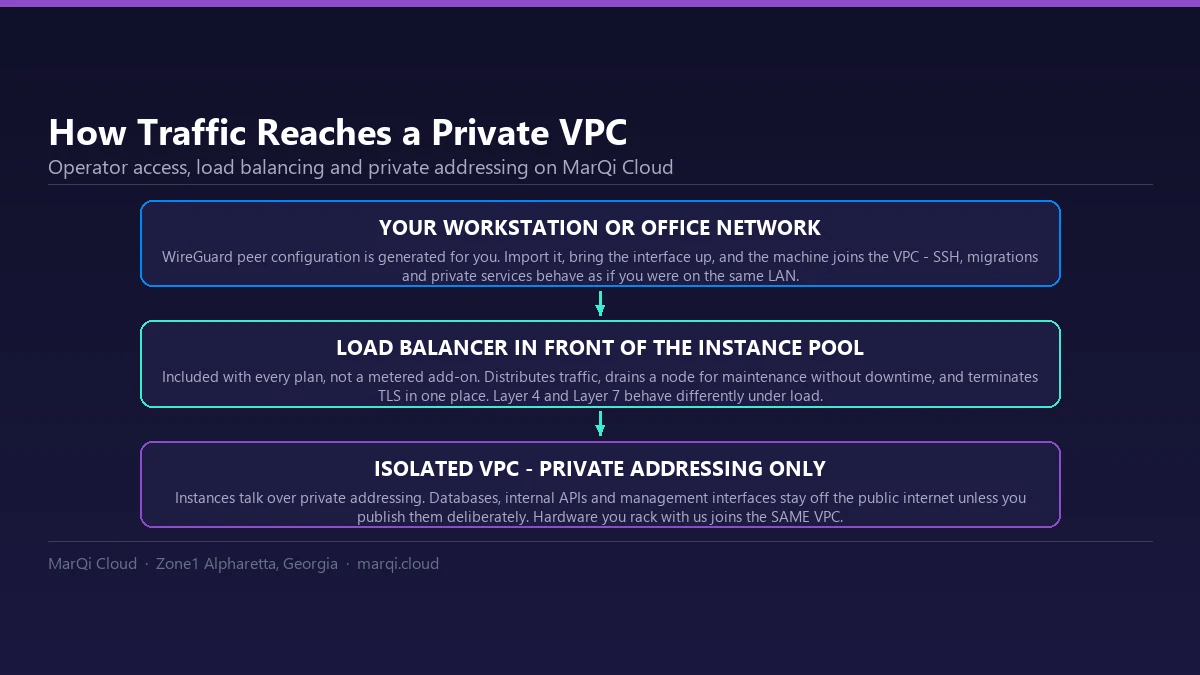
Every account gets its own virtual private cloud. Instances inside a VPC talk to each other over private addressing; nothing is reachable from outside unless you publish it deliberately. That means databases, internal APIs and management interfaces can stay entirely off the public internet while still being fully accessible to your team and your applications.
WireGuard VPN access
We use WireGuard for operator and site-to-site access. It is modern, fast, and small enough to audit — which fits how we build the rest of the platform. We generate the peer configuration for you; you import it, bring the interface up, and your workstation or office network joins the VPC. From there you can SSH, run migrations, and reach private services exactly as if you were on the same LAN.
Load balancers
A load balancer is included with every plan on our pricing page — it is not a metered add-on. Put one in front of a pool of instances to distribute traffic, drain a node for maintenance without downtime, and terminate TLS in one place. Layer 4 and Layer 7 behaviour differ meaningfully under load, and choosing correctly matters more than most teams expect.
| Item | What you pay |
|---|---|
| WireGuard VPN access | Included with every plan |
| Load balancer | Included with every plan, not a metered add-on |
| Data transfer out (egress) | Not metered and not billed per GB |
| Private circuits and BGP peering | Quoted per build |
| Compute the network runs on | USD 2 per vCPU and USD 2 per GB of RAM per month, plus USD 0.13 per GB of SSD storage per month (pricing) |
Connecting your own hardware
If you run servers of your own, they can join the same VPC as your MarQi Cloud instances rather than sitting behind a translation layer. That single-VPC model is the core of our hybrid cloud offering, and it is what makes a gradual migration possible instead of a big-bang cutover. Hardware you want physically close to our cloud can be racked with us through colocation and BYO hardware.
Dedicated circuits and BGP peering
When a tunnel over the internet is not enough — regulated workloads, latency-sensitive replication, or predictable throughput commitments — we design dedicated connectivity instead. That covers private circuits between your Atlanta-area sites and our zones, and BGP peering for organisations that bring their own address space. Details are on private circuits and peering.
The fabric underneath
Hosts have multiple NIC paths into redundant switching fabrics, and upstream capacity comes from tier-1 providers, so there is no single link whose failure takes your instances offline. Inter-zone traffic rides those backbones rather than the open internet and is encrypted in transit. The full design is documented under network fabric, and the geography is on our zones.
Getting set up
New to the platform? Start with getting started, which covers account creation through first VM and first tunnel. If you would rather have our engineers design and run the network for you, that is what managed services is for — or just talk to an engineer.
Frequently asked questions
Are my instances exposed to the public internet by default?
No. Networking is private by default. Every account gets an isolated VPC where instances talk to each other over private addressing, and nothing is reachable from outside unless you publish it deliberately. Databases, internal APIs and management interfaces can stay entirely off the public internet.
Which VPN technology is used?
WireGuard, for both operator access and site-to-site connectivity. It was chosen because it is modern, fast and small enough to audit, which fits the open source approach used across the rest of the platform.
Are load balancers an extra cost?
No. A load balancer is included with every plan, along with VPN, snapshots and backups, on virtual machine plans starting at 8 USD per month.
Can I connect hardware I own into the same private network?
Yes. Colocated hardware in the same zone joins the same fabric, so it sits inside your VPC alongside your virtual machines. For connectivity beyond the zone, dedicated circuits and BGP peering can be terminated directly into the VPC.
Related engineering articles
- The Ultimate Guide to Designing Edge Computing Networks with Cloud Backend
- Why Content Delivery at the Edge Enhances Global Application User Experience
- Why BGP Routing Optimization Enhances Multi-Provider Cloud Network Performance
- Eliminate Bandwidth Bottlenecks: Cloud Peering Architecture for High-Traffic Apps
- The Complete Guide to Cloud Network Throughput Testing and Optimization
- The Complete Guide to Private Cloud Networking and Microsegmentation
- Why Enterprises Use Private Circuits and Peering Services
- Low Latency Hosting for AI APIs in Atlanta: Optimizing Performance for Next-Gen Applications
Browse the full archive: Networking & Private Connectivity (46)