
Templates & Images
Ubuntu LTS and ready-to-run OS images for KVM
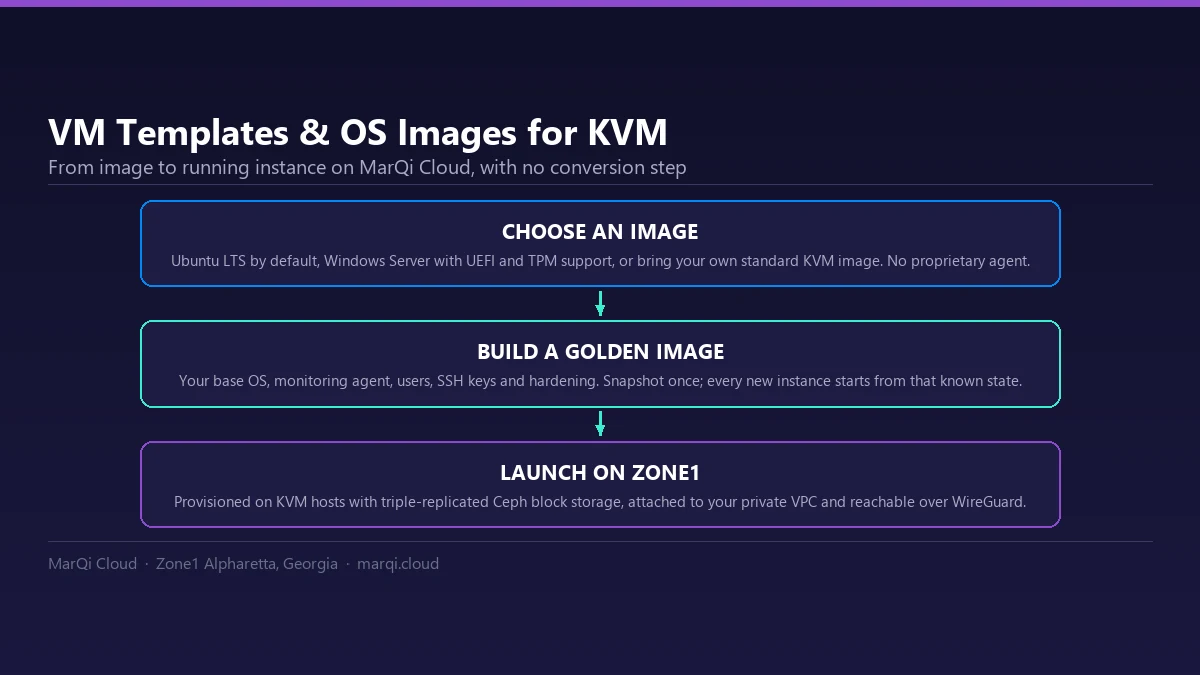
Launch faster with prepared virtual machine images instead of building every host from an installer ISO. MarQi Cloud templates run on the KVM hypervisor, use standard formats, and carry no proprietary agent — so an image you run here is an image you could run anywhere.
Ubuntu LTS as the default
We run Ubuntu LTS across our own hosts, and it is the default image we recommend for customer workloads. Long-term support releases give you a predictable five-year security window, which is the right trade for infrastructure that should be boring. Kernel and package updates come from upstream repositories, not a vendor fork.
Windows Server support
Our compute hosts provide UEFI and TPM support, which means modern Windows Server guests install and run properly rather than being coaxed along in legacy mode. If your estate is mixed, you do not need a second provider for the Windows half. See compute platform for the hardware detail.
Bring your own image
Because everything is standard KVM, you can bring a disk image you already trust — a hardened base built by your security team, an appliance from a vendor, or a machine you are lifting out of another provider. There is no conversion tax and no proprietary packaging step. This is the practical face of “no vendor lock-in”: the exit path exists on day one, not just in the marketing copy.
Golden images and repeatability
The most useful template is usually one you build yourself: your base OS, your monitoring agent, your users and SSH keys, your baseline hardening. Snapshot it once and every subsequent instance starts from the same known state. Combined with snapshots and backups, that gives you both a repeatable build and a rollback point.
What happens at launch
An instance created from a template is provisioned onto multi-core hosts with block storage from a triple-replicated Ceph/PetaSAN cluster, attached to your private VPC, and reachable over WireGuard — not over an exposed public port. The storage design is under storage architecture and the network side under networking and VPN.
GPU and specialised images
Workloads that need CUDA and a matched driver stack are better served by a purpose-built image than by bolting drivers onto a general-purpose one. For AI training and inference we run dedicated GPU capacity with PCIe passthrough — see GPUs for AI/ML.
Start here
Getting started takes you from account creation to a running VM, and pricing shows what each plan includes. If you need a specific distribution, version, or a custom base image prepared for your team, talk to an engineer — we build them.
Frequently asked questions
Which operating systems are available as templates?
Ubuntu LTS is the default and the distribution MarQi Cloud runs on its own hosts. Pre-built templates also cover other common Linux distributions and Windows Server versions, so you can launch from an image instead of an installer ISO.
Do templates include a proprietary agent?
No. Templates run on the KVM hypervisor and use standard image formats with no proprietary agent, so an image you run on MarQi Cloud is an image you could run elsewhere.
Can I upload my own image?
Yes. Bringing your own image is supported, which is how teams keep golden images and repeatable builds consistent between environments.
Why is Ubuntu LTS the recommended default?
Long-term support releases give a predictable five-year security window, and kernel and package updates come from upstream repositories rather than a vendor fork — which is the right trade for infrastructure that should be boring.
Related engineering articles
- Why Bare Metal Cloud Hosting Ensures Consistent Performance for Latency-Sensitive Applications
- Ultimate Guide to Optimize Cloud VPS Performance for High-Traffic Applications
- Why Bare Metal Private Cloud Delivers Maximum Performance for Compute-Intensive Workloads
- The Complete Guide to Migrating from Bare Metal to Virtualized Cloud Infrastructure
- The Complete Guide to Cloud Compute Density and Performance Benchmarking
- The Complete Guide to Cloud Compute Resource Planning for Business Workloads
- What Is Bare Metal Cloud and Why It Destroys Shared Hosting for Performance
- Why AI Needs Bare Metal Performance: Unlocking the Potential of Artificial Intelligence
Browse the full archive: Bare Metal & Compute (57)