
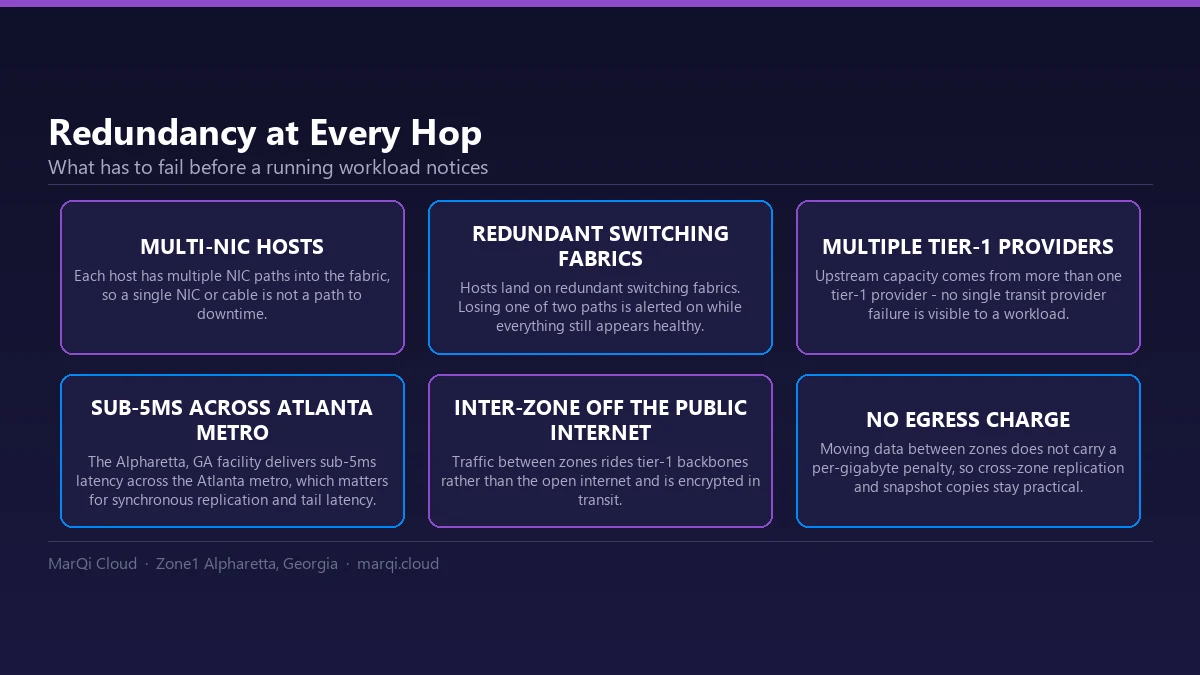
Redundancy at every hop
Each host has multiple NIC paths into redundant switching fabrics, and upstream capacity comes from multiple tier-1 providers. The design goal is that no single failure — a NIC, a cable, a switch, a transit provider — is visible to a running workload. We alert on degraded redundancy rather than waiting for an outage, because losing one of two paths is worth acting on while everything still appears healthy: see status and monitoring.
Low latency across the Atlanta metro
Our Alpharetta, GA facility delivers sub-5ms latency across the Atlanta metro. For latency-sensitive work — synchronous replication, interactive applications, AI inference where tail latency decides whether the product feels responsive — physical proximity is not a detail you can optimise around later. Zone locations are listed under our zones.
Inter-zone traffic once Zone2 is live
Once Zone2 is live, traffic between our zones will ride tier-1 backbones rather than the open internet and will be encrypted in transit. Once Zone2 is live, that is what will make cross-zone replication and snapshot copies practical rather than merely possible — and because we do not charge egress, moving data between zones will not carry a per-gigabyte penalty. See storage architecture and pricing.
Where your traffic enters
Customer workloads sit in private VPCs reached over WireGuard, with load balancing in front of instance pools — described under networking and VPN. Where a shared internet path is not acceptable, we design dedicated circuits and BGP peering instead: see private circuits and peering.
Connecting hardware you own
Equipment racked with us under colocation connects into the same fabric as our compute platform, which is what allows one VPC to span your hardware and our cloud — the model described under hybrid cloud.
Have a specific latency or throughput requirement? Talk to an engineer.
Tier-1 network providers: what the label means, and what it does not
A tier-1 network provider is one that reaches every destination on the public internet without buying transit from anyone else — it settles by peering, not by purchase. That matters to you for one reason: the fewer intermediaries between your packet and its destination, the fewer places a bad path can be introduced.
| Property | Tier-1 transit | Direct peering |
|---|---|---|
| Reach | Every destination on the internet | Only that network’s destinations |
| What it buys you | Guaranteed reachability | A shorter, more stable path |
| Typical use | General egress | High-volume or latency-sensitive partners |
The two are complements, not alternatives: transit guarantees you can reach everything, peering improves the paths that matter most to your traffic.
What a tier-1 network fabric does not promise
“Tier-1” describes the carrier’s settlement position, not your latency. A tier-1 upstream with a congested hand-off is worse than a well-placed regional path. This is why MarQi Cloud pairs tier-1 transit from Zone1 with private circuits and BGP peering for traffic where the path itself is the requirement. BGP is the interdomain routing protocol specified in RFC 4271.
Service levels and credits
Availability for the network fabric is committed per service, not as a single blended figure across an account. Compute, block storage, network and connectivity, VPN and load balancing, and colocation power and space are each covered separately. Availability is calculated per calendar month as the percentage of minutes during which the service was available, and an unavailability period starts at the earlier of our monitoring detecting it or you opening a ticket.
When we miss a commitment the remedy is a tiered service credit against the affected service. The specific commitment that applies to your services is stated in your order or agreement with us; if you are evaluating us and need the figures before you sign, ask an engineer and we will put them in writing. The full framework — covered services, how availability is measured, exclusions and the credit mechanism — is published in our Service Level Agreement.
Frequently asked questions
How is the network made redundant?
Each host has multiple NIC paths into redundant switching fabrics, and upstream capacity comes from more than one tier-1 provider. The design goal is that no single failure — a NIC, a cable, a switch or a transit provider — is visible to a running workload.
Does traffic between MarQi Cloud zones cross the public internet?
MarQi Cloud currently runs one zone (Zone1). Once Zone2 is live, inter-zone traffic will flow only over tier-1 providers and be encrypted in transit, so it will not touch the public internet. Instances inside a VPC also talk to each other over private addressing by default.
Why does being in the Atlanta metro matter for latency?
Zone1 sits in Alpharetta, Georgia, inside the Southeast tech corridor, rather than in a distant hyperscaler region. For businesses and users in Georgia and the wider Southeast that shortens the physical path traffic has to travel, which is the part of latency no software tuning can remove.
Are there egress fees on network traffic?
No. MarQi Cloud does not charge egress fees on traffic leaving the platform, between zones, or between your colocated hardware and your virtual machines.
Related engineering articles
- The Ultimate Guide to Designing Edge Computing Networks with Cloud Backend
- Why Content Delivery at the Edge Enhances Global Application User Experience
- Why BGP Routing Optimization Enhances Multi-Provider Cloud Network Performance
- Eliminate Bandwidth Bottlenecks: Cloud Peering Architecture for High-Traffic Apps
- The Complete Guide to Cloud Network Throughput Testing and Optimization
- The Complete Guide to Private Cloud Networking and Microsegmentation
- Why Enterprises Use Private Circuits and Peering Services
- Low Latency Hosting for AI APIs in Atlanta: Optimizing Performance for Next-Gen Applications
Browse the full archive: Networking & Private Connectivity (46)