
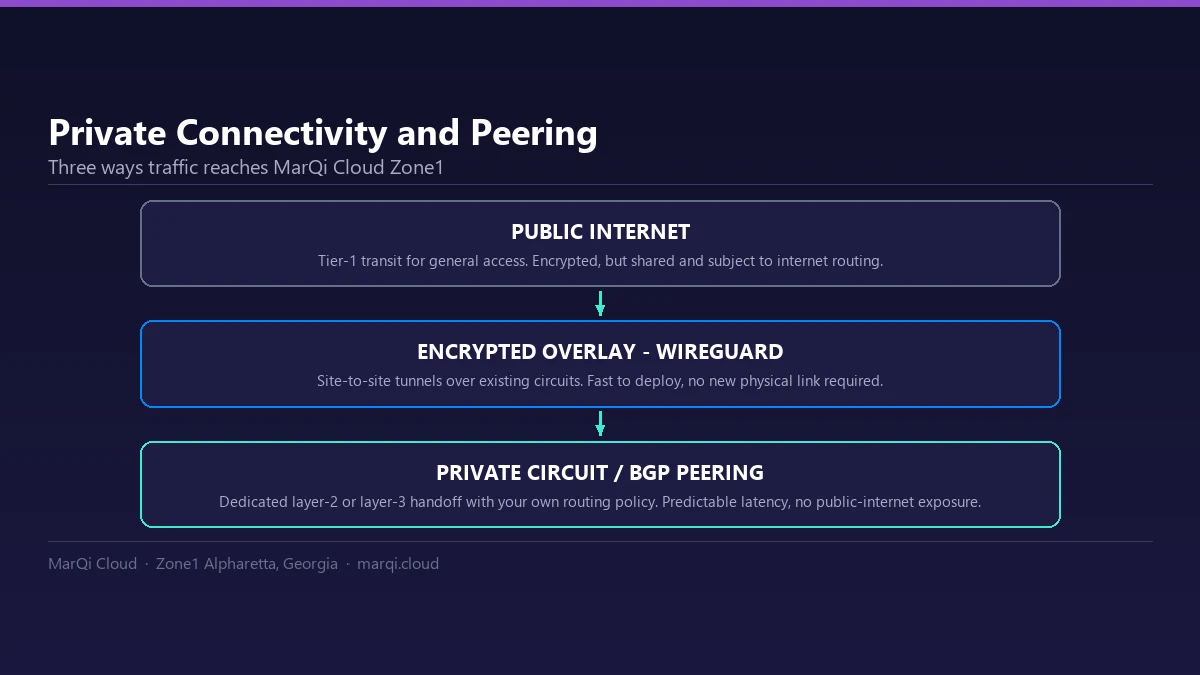
When a tunnel over the internet is not enough
A WireGuard tunnel is the right answer for most connectivity, and it is included with every plan. It stops being the right answer when you need throughput you can commit to, latency you can predict rather than hope for, or a path that regulators will accept. At that point you want dedicated connectivity between your sites and our zones.
Private circuits
A dedicated circuit gives you capacity that is not shared and a path that does not traverse the public internet. That matters for database replication between sites, for backup windows that must finish, and for any workload where a jittery path turns into a user-visible problem. We design the circuit around the traffic you actually have — engineers scope it, not a product catalogue.
MPLS, DIA, and dedicated fiber
The three usual options trade off differently. MPLS gives you class-of-service control across many sites and a carrier who owns the whole path, at a price that reflects that. Dedicated internet access is simpler and cheaper per megabit but leaves you sharing the internet's variability. Dark or dedicated fiber gives you the most control and the best latency floor, and makes sense once distance is short and volume is high. Which one is right depends on site count, distance, and how much of the path you need to control.
| Option | Path | Best fit | At MarQi Cloud |
|---|---|---|---|
| WireGuard VPN | Encrypted tunnel over the public internet | Remote access and small site-to-cloud links | Included with every plan |
| Dedicated internet access (DIA) | Dedicated port, public internet beyond it | Simpler setups where cost per megabit matters most | Scoped and quoted per design |
| MPLS | Carrier-owned private path | Many sites that need class-of-service control | Scoped and quoted per design |
| Dedicated fiber | Private fiber, no shared path | Short distances with high volume and the lowest latency floor | Scoped and quoted per design |
| BGP peering | Your own address space and routing | Your own AS, multi-homing, failover between providers | Available when you bring your own address space |
BGP peering
If you bring your own address space, peering with us lets you control routing rather than living behind our addressing. That is often a requirement for organisations running their own AS, operating multi-homed, or needing to fail traffic between providers on their own terms. Our upstream capacity comes from tier-1 providers — the design is described under network fabric.
Latency across the Atlanta metro
Our facility is in Alpharetta, GA, with sub-5ms latency across the Atlanta metro. For customers with hardware in the area — their own sites or racked with us under colocation — that turns a hybrid deployment from a compromise into a genuinely single environment. Zone locations are under our zones.
What it connects to
A circuit is only worth what it reaches. On our side that is the compute platform, per-zone block storage, and your private VPC — one environment spanning your hardware and ours, described under hybrid cloud. Day-to-day operation can sit with us under managed services.
Talk to an engineer with your site list, distances and throughput requirement and we will come back with a design rather than a brochure.
Service levels and credits
Availability for private circuits and peering is committed per service, not as a single blended figure across an account. Compute, block storage, network and connectivity, VPN and load balancing, and colocation power and space are each covered separately. Availability is calculated per calendar month as the percentage of minutes during which the service was available, and an unavailability period starts at the earlier of our monitoring detecting it or you opening a ticket.
When we miss a commitment the remedy is a tiered service credit against the affected service. The specific commitment that applies to your services is stated in your order or agreement with us; if you are evaluating us and need the figures before you sign, ask an engineer and we will put them in writing. The full framework — covered services, how availability is measured, exclusions and the credit mechanism — is published in our Service Level Agreement.
Frequently asked questions
What is a private circuit for cloud connectivity?
A private circuit is a dedicated network connection between your data center and a cloud provider's facility that bypasses the public internet entirely. Unlike standard internet connections, private circuits offer guaranteed bandwidth, predictable latency, and end-to-end security with no shared traffic. MarQi Cloud provides private circuit connectivity between your infrastructure and our Alpharetta, Georgia Zone 1 facility.
How does private circuit connectivity differ from a VPN?
A VPN encrypts traffic over the public internet — it adds security but not performance. A private circuit is a dedicated physical or logical path that never traverses public internet infrastructure at all, delivering lower and more consistent latency, higher reliability, and inherent security without the overhead of public-internet routing. MarQi Cloud supports both private circuits and WireGuard VPN depending on your connectivity requirements.
What is BGP peering and does MarQi Cloud support it?
BGP (Border Gateway Protocol) peering is a method by which two network operators exchange routing information directly, allowing traffic to flow between their networks without transiting third-party carriers. MarQi Cloud engineers provide BGP and peering configuration assistance — we help design your routing policy, configure peering sessions, and validate your network topology against your performance and redundancy requirements.
What redundancy does MarQi Cloud provide for private circuits?
MarQi Cloud provides redundant upstream connections with automatic failover. Your private circuit connectivity is backed by multiple upstream providers, ensuring always-on connectivity even if a single upstream experiences an outage. Our engineers monitor circuit health 24/7 and respond to path failures before they impact your workloads.
Are private circuit connections between my data center and MarQi Cloud encrypted?
Yes. MarQi Cloud builds encrypted inter-zone tunnels for all private circuit and peering connections. Security is built into every data transfer path — not configured as an optional add-on. All inter-zone traffic between your infrastructure and ours uses encrypted channels regardless of circuit type.
Where is MarQi Cloud's network connectivity facility?
MarQi Cloud Zone 1 is in Alpharetta, Georgia. The facility connects to Tier-1 carriers with redundant upstreams, serving enterprises in the Atlanta metro area and nationally across the United States. Zone 2 is under construction for expanded geographic reach and redundancy.
Does MarQi Cloud charge egress fees on private circuit traffic?
No. MarQi Cloud does not charge egress fees on any plan, including private circuit and peering connections. Data movement between your infrastructure, our zones, and the internet generates no per-gigabyte charge. Zero egress fees is a permanent pricing commitment across all connectivity services.
Related engineering articles
- The Ultimate Guide to Designing Edge Computing Networks with Cloud Backend
- Why Content Delivery at the Edge Enhances Global Application User Experience
- Why BGP Routing Optimization Enhances Multi-Provider Cloud Network Performance
- Eliminate Bandwidth Bottlenecks: Cloud Peering Architecture for High-Traffic Apps
- The Complete Guide to Cloud Network Throughput Testing and Optimization
- The Complete Guide to Private Cloud Networking and Microsegmentation
- Why Enterprises Use Private Circuits and Peering Services
- Low Latency Hosting for AI APIs in Atlanta: Optimizing Performance for Next-Gen Applications
Browse the full archive: Networking & Private Connectivity (46)