




What MarQi Cloud runs
Everything below runs on the same open source foundation — KVM for compute, Ceph/PetaSAN for storage, WireGuard for private access — operated by the engineers who built it, from our own facility in Alpharetta, GA.
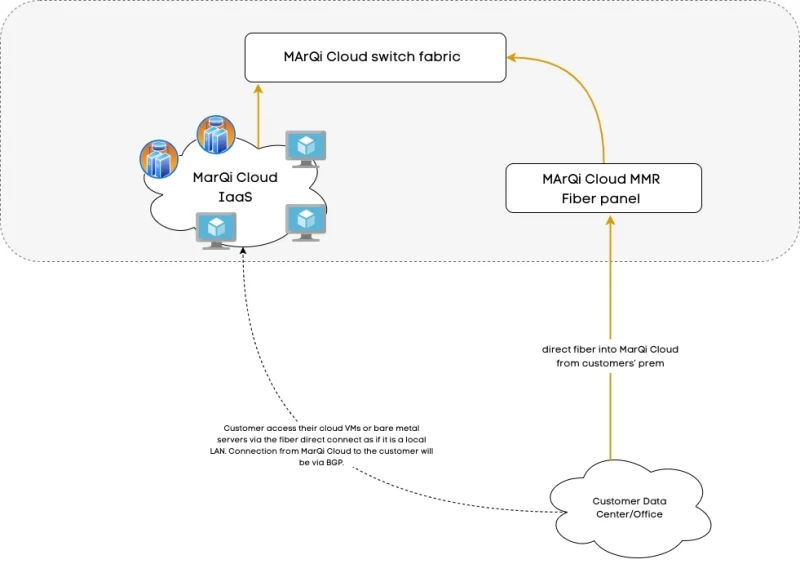
Hybrid cloud. Your existing hardware and our cloud in a single VPC, so migration happens one tier at a time instead of as a cutover. See hybrid cloud services.
Colocation and BYO hardware. Rack space, power and cooling in the Atlanta metro, connected directly to our fabric and storage rather than through a cross-connect. See colocation and BYO hardware.
GPUs for AI and ML. Dedicated accelerators with PCIe passthrough, air and liquid cooling, and no transfer charge on training data. See GPUs for AI/ML.
Private circuits and peering. Dedicated connectivity and BGP peering where a tunnel over the internet is not enough. See private circuits and peering.
Managed services. Our engineers run the estate — hypervisor to storage to network — so you do not have to staff a rotation. See managed services.
The full range is on solutions, and what each plan includes is on pricing.
Why no egress fees changes the arithmetic
On a small workload, egress is a rounding difference. On anything that moves real volume — backups to a second site, analytics exports, media delivery, AI training sets — it is routinely the largest line on a cloud invoice, and the line that grows fastest as you succeed. We do not charge it. Combined with an open source stack and standard machine images, that also means leaving us is not expensive, which is the only credible test of "no vendor lock-in".
The infrastructure underneath
We publish how it is built rather than abstracting it behind a brand name: multi-core hosts with multiple network paths on the compute platform, per-zone storage clusters with triple replication under storage architecture, redundant switching and tier-1 upstream under network fabric, and private VPCs reached over WireGuard. Locations are listed under our zones.
Data protection is included, not an upsell — see snapshots and backups — and the platform is watched around the clock, described under status and monitoring.
Engineer-operated, from Alpharetta, GA
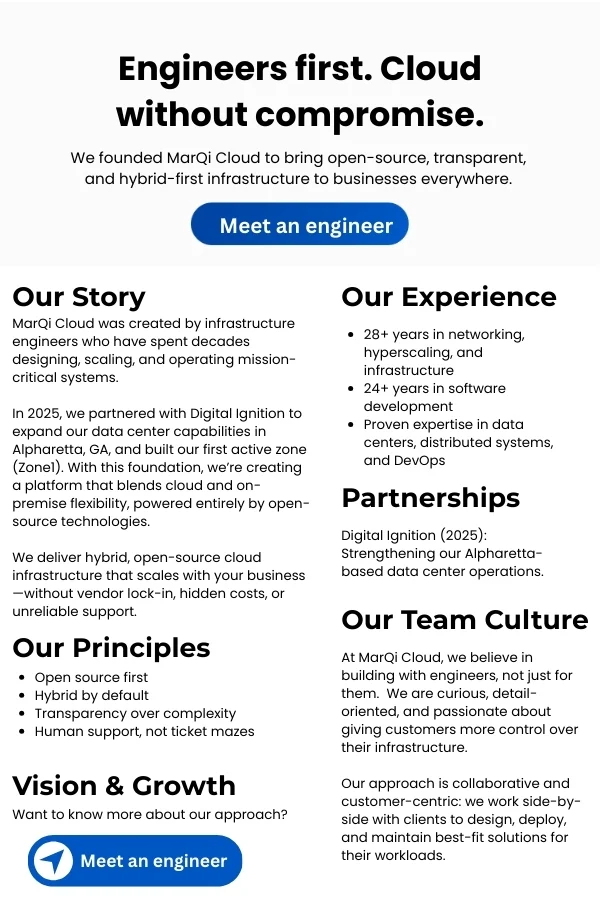
MarQi Cloud is run by infrastructure engineers, in partnership with Digital Ignition, serving the Atlanta metro and customers across the United States. When you open a ticket, an engineer reads it. More on about MarQi Cloud.
Getting started
A first deployment — account, zone, VM, tunnel, storage, protection — is documented step by step under getting started. If you would rather map your current stack with someone first, talk to an engineer.
Latest from the MarQi Cloud blog
New guides on hybrid cloud, GPU infrastructure and colocation, published from our Alpharetta, Georgia operation.
- VM Templates and Golden Images: Building Repeatable VMs
- GPU PCIe Passthrough Explained: Dedicated GPUs for VMs
- vCPU Overcommitment and CPU Steal Time Explained
- What Is PetaSAN? Ceph-Based Scale-Out SAN Explained
- Windows Server on KVM: UEFI, Secure Boot and TPM Explained
- How MarQi Cloud’s Performance, Security, and Zero Lock-In Shape Enterprise Infrastructure
- Why Enterprise Cloud Architecture Should Be Designed for the Next Decade
- The Complete Guide to Cloud Infrastructure Decommissioning & Data Sanitization
- How Cloud Provider Transparency in Incident Communication Builds Trust
- Why Workload-Specific Cloud Instance Selection Outperforms General-Purpose Options
- The Complete Guide to Building a Multi-Year Cloud Infrastructure Roadmap for Enterprise Growth
- How Cloud Infrastructure Drives Digital Transformation in Traditional Industries
- Why the MarQi Cloud Platform Excels for Enterprises Demanding Performance and Freedom
- How MarQi Cloud’s Transparent Pricing and Zero Egress Fees Simplify Cloud Budgeting Forever
- The Complete Guide to Getting Started with MarQi Cloud for Your First Enterprise Workload
- Why MarQi Cloud’s Engineering Team Prioritizes Customer Outcomes
- How MarQi Cloud’s Zone Architecture Ensures Geographic Redundancy for Enterprise Workloads
- Why Cloud-Based Project Management and DevOps Tools Outperform Self-Hosted Alternatives
- How Cloud Infrastructure Supports Bring Your Own Device Policies Securely
- The Complete Guide to Cloud Desktop as a Service for Enterprise Remote Workforces