Windows Server on KVM: UEFI, Secure Boot and TPM Explained
October 29, 2026
vCPU Overcommitment and CPU Steal Time Explained
October 29, 2026
What Is PetaSAN? Ceph-Based Scale-Out SAN Explained
Short answer: PetaSAN is an open source, scale-out software-defined storage system, licensed under the AGPL 3, that builds SAN-style services on top of the Ceph storage engine. It serves block and file protocols such as iSCSI, SMB/CIFS and NFS, plus S3 object storage, from a cluster of ordinary servers, with active/active, highly available services spread across multiple nodes. In practice it gives you the resilience of Ceph with the protocols that traditional SAN clients expect.
How PetaSAN Works
According to the PetaSAN project, it uses the Ceph storage engine together with the Consul service mesh platform, and offers “scale-out, multi-node active/active and highly available storage services”. The storage itself comes from Ceph: the Ceph block device documentation describes Ceph block devices as thin-provisioned, resizable and striped over multiple OSDs, using RADOS capabilities such as snapshotting, replication and strong consistency.
| Layer | What it contributes |
|---|---|
| Ceph storage engine | Stores data across many disks and nodes, with replication and snapshots; block devices are thin-provisioned and resizable |
| Consul service mesh | Used by PetaSAN alongside Ceph to run its storage services across the cluster |
| Protocol services | iSCSI, SMB/CIFS and NFS for block and file clients, and S3 for object storage |
Ceph Directly or Through a SAN Protocol?
Not every client needs a SAN protocol. Ceph documentation notes that cloud platforms such as CloudStack, OpenStack and OpenNebula rely on libvirt and QEMU to integrate with Ceph block devices, so KVM virtual machine disks can use Ceph natively. Systems that expect a conventional storage target instead connect over a protocol such as iSCSI, which is where a SAN layer like PetaSAN fits.
| Access path | Typical client | Typical use |
|---|---|---|
| Ceph block device through libvirt/QEMU | KVM hypervisors managed by a cloud platform | Virtual machine disks |
| iSCSI | Servers and appliances that expect a block storage target | Databases and applications that need a raw block volume |
| SMB/CIFS or NFS | Windows and Linux file clients | Shared file storage |
| S3 | Applications and backup tools that speak the S3 API | Backups, media and unstructured data |
What to Check When Evaluating a Ceph-Based SAN
- Replication and failure domains: how many copies are kept, and whether they sit on separate nodes so a single node failure does not take data offline.
- Protocol per workload: which volumes use native block access, iSCSI or a faster fabric transport, and how that choice is made.
- Behaviour during rebuilds: whether volumes stay online while the cluster recovers from a failed disk or node.
- Snapshot model: how snapshots are taken, where they are stored and whether they are billed separately.
- Pricing model: whether you pay for allocated capacity only, or also for provisioned performance tiers and data transfer.
How MarQi Cloud Uses Ceph and PetaSAN
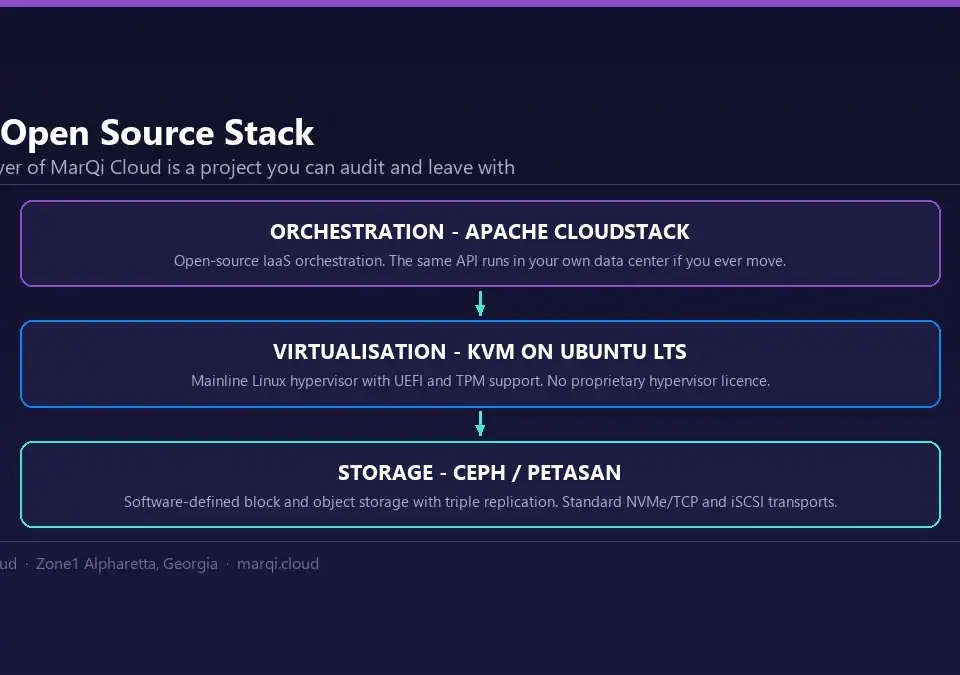
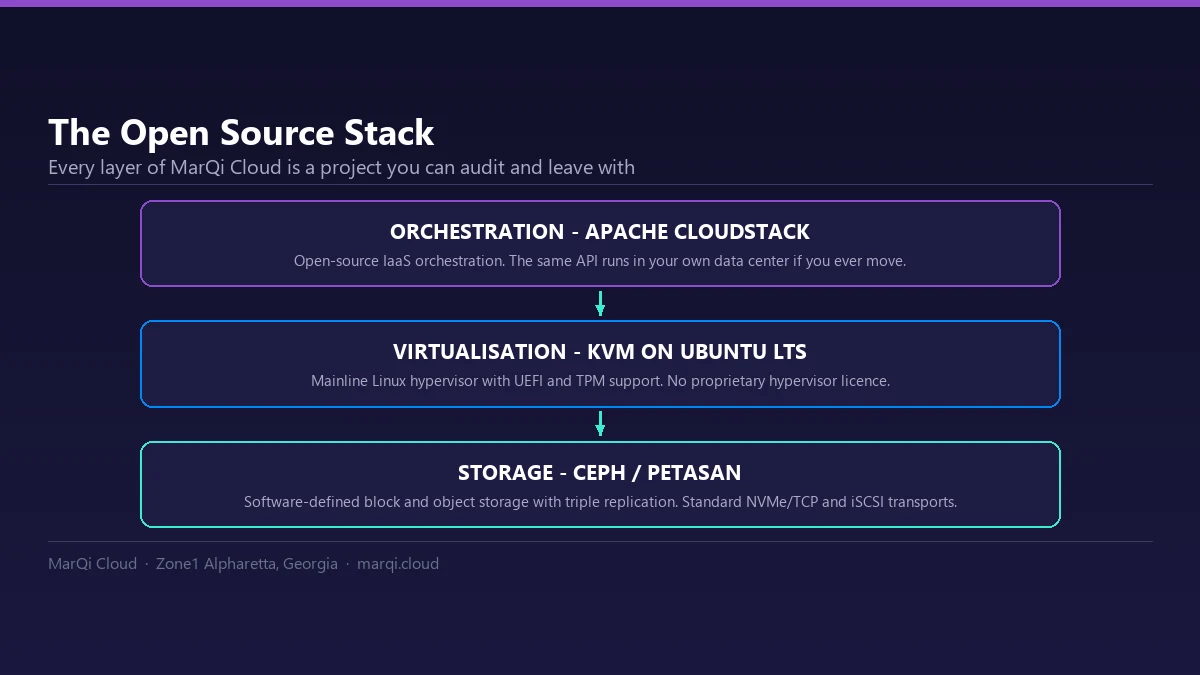
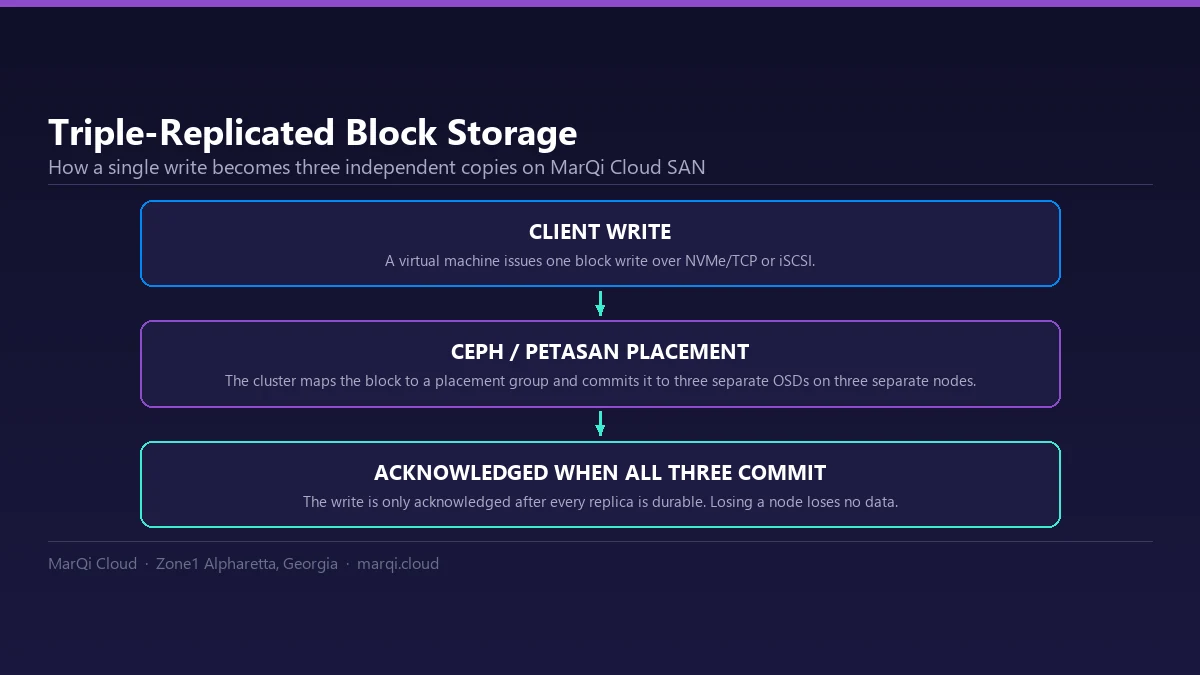
At MarQi Cloud, each zone operates its own dedicated storage cluster built on Ceph / PetaSAN technology, with triple replication. Block storage is presented over both NVMe over Fabrics (NVMe/TCP) and iSCSI, and Ceph-based object storage runs on the same foundation. Block storage is USD 0.13 per GB per month, SSD-backed and billed on allocated capacity, with no provisioned-IOPS tier, and snapshots and backups come with every plan. See storage architecture for the design and pricing for current figures. To choose a transport per volume, read NVMe over Fabrics vs iSCSI for cloud SAN.