
What is included in every plan
Every MarQi Cloud plan includes the things other providers meter: a VPN and load balancer, snapshots and backups, enterprise SSD block storage, and 24/7 monitoring by our NOC. They are part of the plan because a virtual machine you cannot reach privately, cannot restore, and nobody is watching is not actually a service.
No egress fees — and why that matters more than the hourly rate
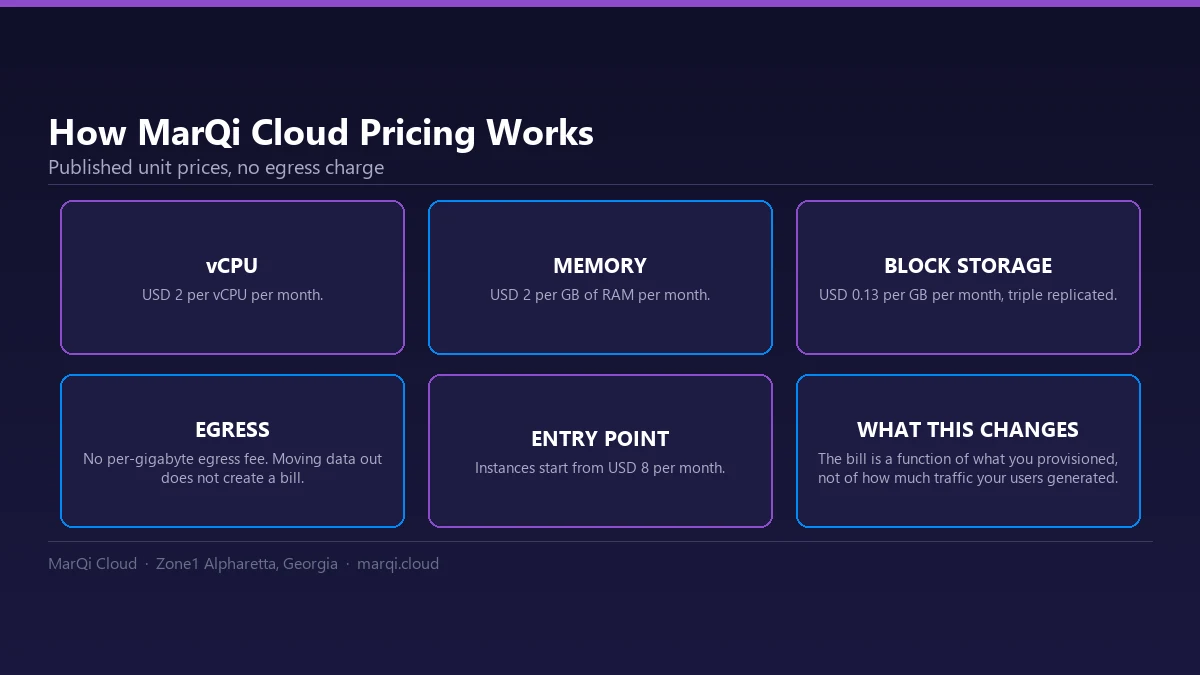
We do not charge for data leaving the platform. On a small workload that is a rounding difference. On anything that moves real volume — backups to another site, analytics exports, media delivery, AI training data, or simply leaving for another provider — egress is routinely the largest single line on a cloud invoice, and it is the line that grows fastest as you succeed. Removing it changes the shape of the bill, not just the size.
It also removes the exit tax. Combined with an open source stack and standard machine images, nothing about our pricing is designed to make leaving expensive.
Block storage pricing: what a cloud SAN costs per GB and per TB
Block storage is billed on capacity at $0.13 per GB per month for SSD-backed enterprise storage — about $130 per TB per month on a 1,000 GB terabyte. That is the whole storage line: IOPS are not sold as a separate provisioned tier, snapshot storage is not priced at a premium, and inter-zone copies are not charged as transfer. The architecture behind it — dedicated per-zone Ceph/PetaSAN clusters with triple replication — is described under storage architecture.
Two things usually decide whether a SAN quote is comparable. The first is whether performance is bundled or metered — where IOPS and throughput are billed separately, the capacity figure alone will understate the invoice. The second is egress: copies leaving the platform are not billed here, so the capacity rate is what the storage actually costs per month. A worked comparison at 10 TB and 100 TB is set out in cloud SAN versus public cloud block storage pricing.
Comparing a quote properly
When you put our figure next to a hyperscaler's, compare the whole invoice rather than the instance line. Add provisioned IOPS, snapshot storage, load balancer hours, VPN gateway hours, monitoring, support tier, and projected egress. In our experience that exercise moves the comparison substantially, and it is the only version of the comparison that predicts what you will actually pay.
Custom builds
Standard plans cover most workloads. When they do not — unusual memory ratios, dedicated GPU capacity, large storage footprints, colocated hardware alongside virtual capacity, or dedicated circuits — we quote the build rather than making you fit a tier. Engineers price it, not a configurator.
Operated for you
If you would rather not staff an on-call rotation, our engineers can run the whole estate under managed services. And whichever way you buy, the platform underneath is the same: compute, network and storage described openly rather than abstracted behind a brand name.
Not sure which plan fits? Getting started walks through a first deployment, or talk to an engineer and we will size it with you.
Published unit prices
| Resource | Unit price | Billed on |
|---|---|---|
| vCPU | USD 2.00 per vCPU / month | Provisioned |
| Memory | USD 2.00 per GB RAM / month | Provisioned |
| Block storage | USD 0.13 per GB / month | Provisioned capacity, triple replicated |
| Snapshots | Included in volume capacity | No separate snapshot tier |
| Provisioned IOPS | Not sold separately | Performance comes from the NVMe tier, not a paid add-on |
| Egress / data transfer out | USD 0.00 | Not metered |
| Entry instance | From USD 8.00 / month | Smallest published configuration |
Worked example: a 1 TB (1,000 GB) block volume is 1,000 × USD 0.13 = USD 130.00 per month, replicated three times, with snapshots and egress included. GPU and colocation configurations are quoted per deployment — contact us with the shape you need.
Cloud pricing calculator — work out a custom build yourself
For a custom resource pool, MarQi Cloud pricing is arithmetic you can do without talking to sales. Three published unit rates, added together:
| Resource | Published rate | Example: 4 vCPU / 8 GB / 100 GB |
|---|---|---|
| vCPU | $2 per vCPU per month | 4 × $2 = $8 |
| RAM | $2 per GB per month | 8 × $2 = $16 |
| Enterprise SSD storage | $0.13 per GB per month | 100 × $0.13 = $13 |
| Egress / bandwidth | $0 — no egress fees | $0 |
| Monthly total | $37 |
The formula is (vCPU × 2) + (GB RAM × 2) + (GB SSD × 0.13) per month for a custom pay-as-you-go pool. The preset Basic / Prestige / Premium packages are priced as packages — see the plan cards above. GPU nodes, private circuits and colocation are quoted per build.
What is not on the bill
The reason a calculator like this works at all is that there is nothing else to add. Every plan already includes VPN, load balancer, snapshots, backups, enterprise SSD storage and 24/7 monitoring, and there are no egress charges — so the number you calculate at the start of the month is the number you see at the end of it.
Service levels and credits
Availability for every plan is committed per service, not as a single blended figure across an account. Compute, block storage, network and connectivity, VPN and load balancing, and colocation power and space are each covered separately. Availability is calculated per calendar month as the percentage of minutes during which the service was available, and an unavailability period starts at the earlier of our monitoring detecting it or you opening a ticket.
When we miss a commitment the remedy is a tiered service credit against the affected service. The specific commitment that applies to your services is stated in your order or agreement with us; if you are evaluating us and need the figures before you sign, ask an engineer and we will put them in writing. The full framework — covered services, how availability is measured, exclusions and the credit mechanism — is published in our Service Level Agreement.
Frequently asked questions
Does MarQi Cloud charge egress fees?
No. Data leaving the platform, moving between zones, or returning to your own hardware is not charged. Egress is often the largest line on a cloud invoice, so removing it changes the shape of the bill rather than just its size.
What is included in every plan?
Every plan includes a VPN and load balancer, snapshots and backups, enterprise SSD block storage, and 24/7 monitoring by our NOC. They are part of the plan rather than metered add-ons.
How is block storage priced?
Block storage is billed on capacity. IOPS are not sold as a separate provisioned tier, snapshot storage is not priced at a premium, and inter-zone copies are not charged as transfer.
Are custom builds available?
Yes. Unusual memory ratios, dedicated GPU capacity, large storage footprints, colocated hardware alongside virtual capacity, and dedicated circuits are quoted as a build by engineers rather than fitted to a tier.
How do I get started with MarQi Cloud?
Create an account and tell us which workload you are bringing over. Every account is engineer-reviewed, so your first machine is sized to the workload before you start paying for it. Then select an image, size the vCPU, RAM and block storage, and deploy - or talk to an engineer and we will map your current stack to a deployment plan.
What does 1 TB of block storage cost per month?
At USD 0.13 per GB per month, a 1 TB (1,000 GB) block volume works out to 1,000 x USD 0.13 = USD 130.00 per month - replicated three times, with snapshots and egress included.
Related engineering articles
- How MarQi Cloud’s Transparent Pricing and Zero Egress Fees Simplify Cloud Budgeting Forever
- The Complete Guide to Cloud Compute Price-Performance Ratio Analysis
- Why Edge Computing and Cloud Computing Are Complementary, Not Competitive
- Why ML Operations Pipelines Need Dedicated Cloud Compute and Storage Resources
- Why MSP Margin Protection Depends on Cloud Provider Pricing Transparency
- How MSPs Can Build Profitable Cloud Services Practices on Reliable Infrastructure
- Unlocking Hidden Costs: A Comprehensive Guide to Cloud Storage Cost Analysis
- How Automated Cloud Scaling Adapts to Traffic Patterns Efficiently
Browse the full archive: Cloud Cost & Pricing (100)