
What "fully managed" covers
Managed cloud services vary wildly in what they actually include, so here is the boundary. We operate the hypervisor and hosts, the storage cluster, the network fabric, the VPN and load balancing tier, patching and upgrades, backup schedules and restore testing, monitoring and alert response, and capacity planning. You keep your application, your data, and every decision about them.
Comparing managed cloud providers
Three questions separate the offerings quickly. First, who is on the other end of a ticket at 3am — an engineer with root, or a coordinator who will escalate? Second, what is genuinely included versus billed per incident, per instance, or per hour? Third, what happens if you leave — is there an export path, or is the value of the engagement partly that unwinding it is painful? Ours are: an engineer, a defined scope rather than per-incident billing, and an open source stack you could operate yourself.
Monitoring and response, not just dashboards
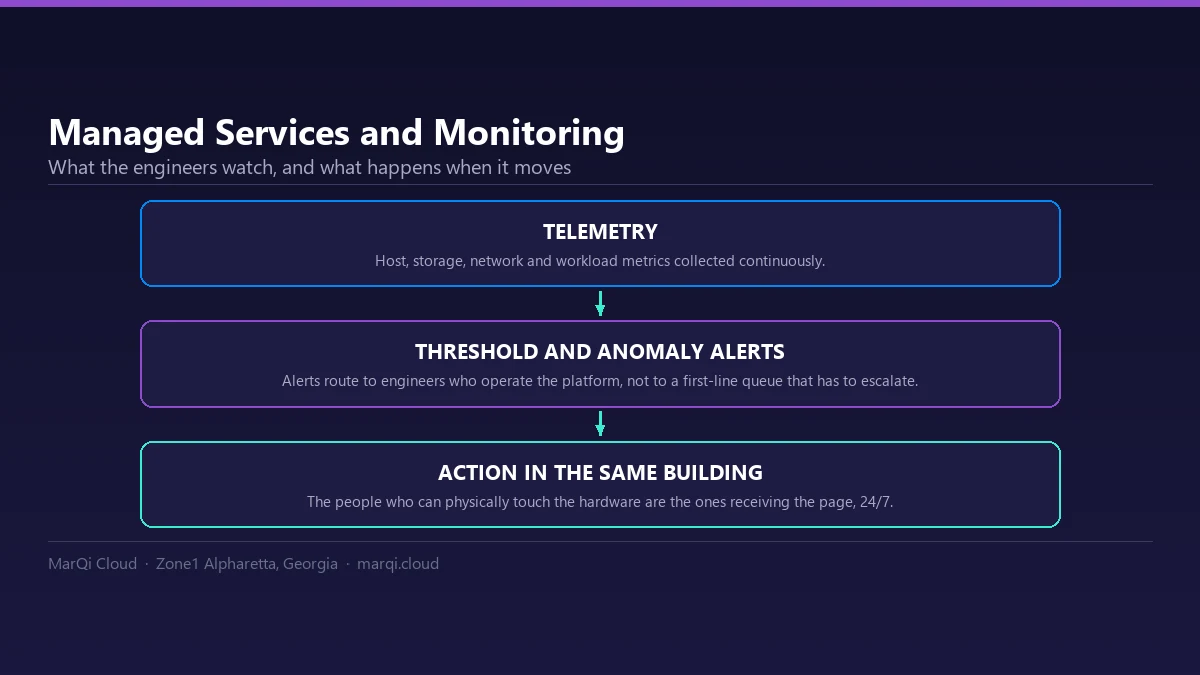
A dashboard nobody watches is a liability. Our NOC covers compute, storage and network 24/7/365, alerting on degraded redundancy rather than waiting for an outage — described under status and monitoring. Backup job health is monitored alongside everything else, because a schedule that silently stopped is one of the most expensive undetected failures in infrastructure: see snapshots and backups.
Managing hybrid and colocated estates
Managed service stops being useful when half the estate is out of scope. Workloads on your own hardware can sit under the same coverage as your cloud instances — one team, one runbook, one escalation path. That applies to equipment racked with us under colocation and to the single-VPC model described under hybrid cloud. GPU estates are covered too — see GPUs for AI/ML.
Migration is part of it
Most managed engagements start with a move. We map the current estate, sequence it so nothing cuts over in one night, and run both sides in parallel until you are satisfied — the single-VPC model is what makes that possible. The step-by-step view is under getting started, and the platform underneath is documented at compute, storage and network.
What it costs depends on scope — see pricing for the platform and talk to an engineer for the engagement.
Service levels and credits
Availability for managed services is committed per service, not as a single blended figure across an account. Compute, block storage, network and connectivity, VPN and load balancing, and colocation power and space are each covered separately. Availability is calculated per calendar month as the percentage of minutes during which the service was available, and an unavailability period starts at the earlier of our monitoring detecting it or you opening a ticket.
When we miss a commitment the remedy is a tiered service credit against the affected service. The specific commitment that applies to your services is stated in your order or agreement with us; if you are evaluating us and need the figures before you sign, ask an engineer and we will put them in writing. The full framework — covered services, how availability is measured, exclusions and the credit mechanism — is published in our Service Level Agreement.
Frequently asked questions
What does managed cloud services mean at MarQi Cloud?
Managed cloud services at MarQi Cloud means our engineers take direct responsibility for operating your infrastructure — from initial architecture design through 24/7/365 monitoring, incident response, patching, and backup management. This is not ticket-based support. Our engineers know your environment, monitor it proactively, and own incidents from open to close.
What is included in MarQi Cloud's managed services?
MarQi Cloud managed services include: architecture design and high availability pattern implementation, 24/7/365 NOC-driven monitoring and alerting, backup strategy design and automated snapshot schedules with recovery drills, OS patching and security updates on approved schedules, sub-15-minute production incident response, and direct engineer access — not tier-1 scripts.
What is the incident response time for managed services?
MarQi Cloud provides sub-15-minute production incident acknowledgment. When an alert fires in your managed environment, an engineer who knows your stack responds — not an automated ticket system. Our team monitors proactively, which means many issues are identified and resolved before they reach production impact.
Do I retain control of my infrastructure with managed services?
Yes. MarQi Cloud managed services are designed to give you full visibility and final authority over your infrastructure while our engineers handle day-to-day operations. You retain dashboard access, root access on bare metal, and approval authority over every configuration change. We operate it — you own it.
Does MarQi Cloud support compliance requirements like HIPAA and PCI under managed services?
Yes — at the infrastructure layer. MarQi Cloud's managed services support compliance-aligned infrastructure for healthcare (HIPAA), financial services (PCI) and government sectors. Our architecture design includes compliance-ready HA patterns, physically isolated environments, encrypted storage, and patch schedules that align with regulatory requirements. To be precise about the boundary: the compliance obligation stays with you as the data owner, and our role is to build and operate infrastructure that supports it. Specific compliance scoping is discussed during your architecture review.
How are backup and recovery handled under managed services?
MarQi Cloud engineers design your backup policy, configure automated volume snapshot schedules, and run regular recovery drills to validate that your RTO and RPO targets are achievable. Backups are not set-and-forget — we test recovery procedures on a schedule and update them as your infrastructure evolves. RTO and RPO are standard contingency-planning terms rather than vendor ones; they are defined in NIST SP 800-34 Rev. 1.
Can managed services be added to an existing MarQi Cloud deployment?
Yes. Managed services can be applied to new MarQi Cloud deployments and to existing environments already running on our platform. The engagement starts with a scoping call where our engineers review your current architecture, identify gaps, and propose a managed services structure that fits your operational needs and budget.
Related engineering articles
- Why White-Glove Cloud Support Empowers MSPs to Deliver Premium Services
- Unlocking Recurring Revenue: Cloud Infrastructure Monitoring for MSPs
- The Ultimate Guide to White-Label Cloud Solutions for Managed Service Providers
- The Complete Guide to Synthetic Monitoring for Cloud Application Health Verification
- The Complete Guide to On-Call Rotation Best Practices for Cloud Operations Teams
- The Ultimate IT Team’s Guide to Post-Incident Reviews and Blameless Postmortems
- The Complete Guide to Site Reliability Engineering Practices on Cloud Platforms
- Why Data Observability Platforms Are Essential for Cloud Data Pipelines
Browse the full archive: Managed Services & Monitoring (38)