
Hybrid Cloud Services
One VPC. Your Hardware + Our Cloud

Place your own hardware in the same zone as your KVM virtual machines and manage both under one isolated, open source Virtual Private Cloud. Scale elastically with virtualization while keeping specialized servers, GPUs, and storage exactly where your workloads need them — with no egress fees and no vendor lock-in.

Key Capabilities of Our Hybrid Cloud Infrastructure

Every capability listed below is included in every MarQi Cloud hybrid deployment — not sold as a premium add-on.

01
Isolated VPCs with WireGuard VPN Access

Secure, encrypted WireGuard VPN connectivity into your isolated hybrid environment — your hardware and VMs share one private network, inaccessible to any other tenant.

02
Load Balancers and SNAT Virtual Routers

Built-in load balancing and source NAT virtual routers for high availability and intelligent traffic management across your hybrid cloud deployment.

03
VM Templates for Rapid Cloning and Deployment

Pre-built and custom VM templates let you clone and deploy new instances in minutes — consistent environments across development, staging, and production.

04
Volume Snapshots, Automated Backups, and HA Design

Scheduled volume snapshots and automated backups with high availability architecture built in from day one — production-grade resilience without a separate contract.

Why Businesses Move to a
Managed Hybrid Cloud Solution

Public cloud was sold as the answer to every infrastructure problem. For many workloads it still is. But for businesses running predictable, high-throughput production environments, the monthly invoice tells a different story.

The Hidden Billing Problem

AWS, Google Cloud, and Azure charge egress fees every time your data moves. API calls, storage retrievals, cross-region transfers — line items that don't appear in any estimate but show up on every invoice. At scale, those fees are not a rounding error. They are a structural cost problem compounding every quarter.

The Vendor Lock-In Trap

Proprietary managed services, platform-specific APIs, and custom runtimes make your workloads progressively harder to move. The more you use, the more expensive leaving becomes. Most enterprises don't discover the true exit cost until they're already trying to leave.

The Hybrid Advantage

Run predictable, always-on workloads on hardware you own or colocate. Keep elastic and burst capacity on managed virtual compute. Stop paying the hyperscaler for what dedicated hardware does better and cheaper — while keeping the cloud flexibility you actually need.

MarQi Cloud connects your physical hardware and our virtual compute layer in the same isolated zone — one VPC, one control plane, one engineering team. You move to a hybrid cloud deployment without rebuilding your stack, without migration drama, and without signing another long-term contract with a vendor whose pricing changes every quarter.

How MarQi Cloud
Hybrid Cloud Deployment Works

Three layers. One unified environment. No proprietary dependencies at any level of the stack.

Your Hardware Joins Our Open Fabric

Rack your own servers in our Alpharetta, Georgia Zone 1 data center or connect them over a dedicated private circuit. Your hardware integrates directly into our OpenStack-powered cloud fabric, operating in the same zone as our hosted virtual nodes — same network, same storage, same control plane.

Open Source Infrastructure Under Everything

OpenStack manages compute and networking. Ceph provides triple-replicated block and object storage. KVM handles hypervisor isolation. WireGuard delivers encrypted VPN access into your VPC. Every layer is open source, auditable, and replaceable — no proprietary lock-in, no migration penalties.

Our Engineers Operate It — You Stay in Control

Our team monitors your hybrid environment 24/7, responds to alerts before they become outages, and manages patching on a schedule your team approves. Sub-15-minute production incident acknowledgment. You retain full dashboard access, root control on bare metal, and final authority on every configuration change.

Who Uses MarQi Cloud
Hybrid Cloud Hosting

Our hybrid cloud solution serves organizations at different stages of infrastructure maturity — from startups repatriating workloads off AWS to enterprises building compliance-ready environments across the US.

Businesses Escaping Hyperscaler Billing

Your compute costs are manageable. It's the egress fees, storage retrieval charges, and cross-region transfers that made the bill unsustainable at scale. Hybrid cloud migration moves predictable workloads to owned hardware — eliminating those line items while keeping elastic capacity for burst demand.

Enterprises With Compliance Requirements

Financial services, healthcare, legal, and government contractors across Alpharetta, Atlanta, and the Southeast US operate under strict data handling rules. Sensitive workloads stay on your own hardware in our SOC-aligned facility — physically isolated, engineer-monitored, and compliant with HIPAA and PCI frameworks.

AI and ML Teams Running GPU Workloads

Training runs and inference pipelines move enormous datasets. On a hyperscaler that movement is billed per gigabyte. MarQi Cloud eliminates egress fees between your GPU hardware and our virtual storage layer — so iterative AI training doesn't generate a compounding data transfer bill alongside the compute cost.

DevOps Teams Needing Environment Consistency

Inconsistency between development, staging, and production causes most deployment failures. MarQi Cloud's VM template system and open source foundation give your team identical environments from code to production — standard OpenStack APIs, infrastructure-as-code ready, no vendor-specific abstractions.

The Open Source Foundation Behind Our
Hybrid Cloud Infrastructure

Every component is open source — from the hypervisor to the observability stack. Not open source at the edges with a proprietary core. Your workloads are portable. Your APIs are standard. Your exit is free.

OpenStack

Compute, networking, identity, and orchestration. Used in production at Nike, Bloomberg, and Walmart. Industry-standard APIs. No proprietary abstractions between you and your infrastructure.

Ceph

Distributed block and object storage with triple replication. Petabyte-proven. No licensing fees. No storage retrieval penalties. Flat, predictable cost per GB stored.

KVM + WireGuard

KVM provides hardware-level tenant isolation for every VM. WireGuard delivers encrypted, modern VPN access into your isolated VPC — faster and more auditable than legacy VPN protocols.

Prometheus + Grafana

Real-time monitoring across your full hybrid environment — VM health, storage IOPS, network throughput, GPU utilization — in dashboards your team can read and act on without a vendor ticket.

Hybrid Cloud Infrastructure
vs. Pure Public Cloud

The decision between hybrid and pure public cloud is a financial and operational calculation based on your specific workload profile.

FactorPure Public Cloud (AWS / GCP / Azure)MarQi Cloud Hybrid Cloud
Egress Fees$0.08–$0.09/GB — compounds at scaleZero. Data moves freely, always.
Vendor Lock-InProprietary APIs and services trap workloads100% open source — portable by design
Predictable BillingVariable — 15–30% hidden in ancillary feesFlat compute + storage, published pricing
Hardware ControlNone — shared multitenant infrastructureFull — your hardware in our facility
ComplianceShared responsibility, limited physical controlPhysical isolation in Alpharetta, GA
Engineering SupportTicket-based, escalation requiredDirect engineer, sub-15-min response

For teams with genuinely unpredictable workloads and no existing hardware, pure public cloud still makes sense early on. But for businesses past early growth — where workloads are predictable, data volumes are high, and the egress bill grows faster than revenue — hybrid cloud infrastructure is where the economics shift decisively in your favor.

Why Choose MarQi Cloud as Your
Hybrid Cloud Provider

There are dozens of vendors that will sell you a hybrid cloud. Most are proprietary platforms, managed wrappers around AWS, or consultancies that hand you a runbook and leave. MarQi Cloud is different in four specific ways.

Open Source Hybrid Cloud Services — No Proprietary Layer

Our hybrid cloud runs on OpenStack, Ceph, KVM, and WireGuard — not a proprietary platform with an open-source wrapper. Workloads are genuinely portable. Architecture is fully auditable. You are never one vendor policy change away from a forced migration or a surprise licensing bill.

Zero Egress Fees — On Every Plan, Always

MarQi Cloud does not charge for outbound data transfer, inter-zone traffic, or movement between your hardware and our virtual fabric. This is not a first-year promotion. It is a permanent pricing commitment that reflects a business model not built on penalizing you for using your own data.

Engineer-Managed — Not Ticket-Managed

When something breaks in your hybrid environment at 2 a.m., you are not opening a ticket and waiting. You reach an engineer who knows your stack, has access to your environment, and owns the incident from open to close. Sub-15-minute production acknowledgment. Every time.

Locally Operated in Alpharetta, Georgia

Zone 1 is in Alpharetta, Georgia — the Southeast US technology corridor. Sub-5ms latency for Atlanta metro businesses. National hybrid cloud services with the same open source foundation, transparent pricing, and direct engineering accountability delivered to businesses across the United States.

Hybrid Cloud Services —
Frequently Asked Questions

Direct answers to the questions businesses ask most often when evaluating hybrid cloud infrastructure, deployment options, and managed services.

What is hybrid cloud infrastructure?
Hybrid cloud infrastructure combines on-premise or colocated physical hardware with hosted virtual compute in a single unified environment. Both layers share the same network, storage fabric, and management control plane. Workloads run on the most appropriate resource: dedicated hardware for performance-critical or compliance-sensitive jobs, and virtual compute for flexible burst demand. MarQi Cloud connects your servers directly to our OpenStack-powered cloud fabric in one isolated VPC, managed by our engineers 24/7.
What is the difference between hybrid cloud and multi-cloud?
Hybrid cloud combines private infrastructure (your own hardware or colocated servers) with managed virtual compute from a single provider in one unified environment. Multi-cloud uses multiple public cloud providers for different workloads but keeps each environment separate. Hybrid cloud is about integrating physical and virtual resources. Multi-cloud is about distributing workloads across vendor platforms. Many enterprises use both strategies together.
How does hybrid cloud migration work at MarQi Cloud?
Hybrid cloud migration at MarQi Cloud follows a structured process: we assess your existing workload profile and hardware, design your target hybrid architecture with the right split between physical and virtual resources, connect your servers to our open source cloud fabric through colocation or private circuit, migrate workloads in prioritized phases to minimize production disruption, and hand over a fully managed, monitored hybrid environment. Most migrations complete without downtime on production services.
Does MarQi Cloud charge egress fees on hybrid cloud services?
No. MarQi Cloud does not charge egress fees on any plan. Data movement between your on-premise hardware, our virtual compute layer, between zones, and outbound to the internet generates no per-gigabyte charge. This applies to all hybrid cloud services including data transfers between colocated hardware and our storage fabric. Zero egress fees is a permanent pricing commitment — not a promotional offering or a first-year incentive.
What open source technologies power MarQi Cloud hybrid cloud?
MarQi Cloud's hybrid cloud infrastructure runs on OpenStack (compute, networking, identity, orchestration), Ceph (distributed block and object storage with triple replication), KVM (hypervisor-level VM isolation), WireGuard (encrypted VPN access into your VPC), and Prometheus with Grafana (open source monitoring and observability). Every component is open source, auditable, and replaceable with no proprietary APIs or vendor-specific dependencies anywhere in the stack.
What is managed hybrid cloud?
Managed hybrid cloud means a third-party engineering team handles the day-to-day operation of your hybrid environment — monitoring, patching, incident response, capacity planning, and configuration management — while you retain full control and visibility. At MarQi Cloud, managed hybrid cloud includes 24/7 engineer monitoring, sub-15-minute production incident response, scheduled OS patching, volume snapshot management, and direct engineer access for any issue that requires immediate attention.
Where is MarQi Cloud's hybrid cloud data center located?
MarQi Cloud Zone 1 is in Alpharetta, Georgia — the Southeast US technology corridor. The facility provides sub-5ms latency for Atlanta metro businesses including Roswell, Duluth, Cumming, Sandy Springs, and Johns Creek. MarQi Cloud serves businesses nationally from this facility, with Zone 2 under construction for expanded capacity and geographic redundancy. All hybrid cloud services are delivered from our Alpharetta, Georgia data center.

Ready to Deploy Your
Hybrid Cloud?

One build. Your hardware + our cloud. Engineer-designed, open source, zero egress fees.

Hybrid cloud infrastructure works best when designed for your specific workload — not templated from a vendor playbook. MarQi Cloud engineers review your architecture, hardware inventory, compliance requirements, and billing pain points before recommending a hybrid design. No pitch deck. The first conversation is an engineering conversation.

MarQi Cloud is the open source hybrid cloud provider operating from Alpharetta, Georgia — serving enterprises, startups, and AI teams across the United States who are done paying the public cloud tax.

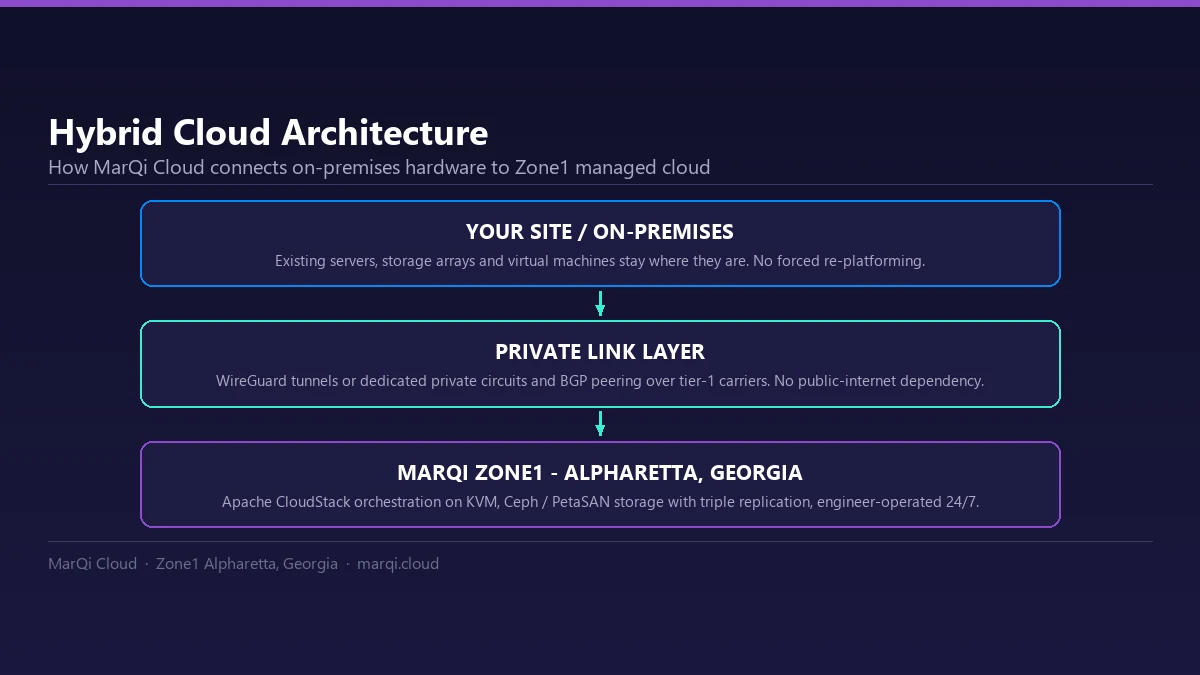
Diagram of MarQi Cloud hybrid cloud architecture: on-premises servers connected through WireGuard tunnels and private BGP circuits to the Zone1 Alpharetta data center running Apache CloudStack on KVM with Ceph storage.
On-premises hardware linked to Zone1 over a private path.

What hybrid actually has to solve

Hybrid cloud is usually sold as a migration story, but most teams reach for it because of a constraint that will not move: hardware still inside its depreciation window, a database that is not going anywhere this year, a compliance boundary, or a latency budget that a distant region cannot meet. The job of a hybrid platform is not to replace those things — it is to put elastic capacity next to them without a rewrite.

How MarQi Cloud connects the two halves

Your existing environment reaches Zone1 in one of three ways. A WireGuard tunnel over your current circuits is included with every plan and takes minutes to stand up. A dedicated private circuit with BGP peering removes the public internet from the path entirely when latency has to be predictable. And if the hardware itself moves into Zone1 colocation, the hybrid link stops being a wide-area link at all — your racks sit beside the managed cloud in the same building.

What runs on the MarQi side

Apache CloudStack orchestrates KVM compute, and Ceph and PetaSAN provide block, object and shared file storage with triple replication. Every layer is open source, so the platform you build against is one you could run yourself — the exit path is a migration, not a rewrite. There is no per-gigabyte egress charge, so moving data back towards your own hardware does not generate a bill.

Where the line sits

We operate the hypervisor, the hosts, the storage cluster and the network fabric, 24/7, from the same building the hardware is in. You keep your operating systems, your data and your application stack. That boundary is deliberate: it is the one that lets you leave.

Frequently asked questions

What is hybrid cloud and when does it make sense?

Hybrid cloud runs part of a workload on infrastructure you control and part on a provider's platform, joined by a private network path. It makes sense when something cannot move - hardware still inside its useful life, a database with a hard latency budget, or a compliance boundary - but you still need elastic capacity beside it. MarQi Cloud connects the two halves with WireGuard tunnels, dedicated private circuits with BGP peering, or by taking your hardware into Zone1 colocation so the link is inside one building.

How does MarQi Cloud connect my existing data center to the cloud?

Three ways. A WireGuard site-to-site tunnel over your existing circuits is included with every plan and deploys in minutes. A dedicated private circuit with BGP peering gives predictable latency and keeps traffic off the public internet. Colocating your hardware in Zone1 removes the wide-area link altogether, because your racks and the managed cloud share the same fabric.

Does hybrid cloud lock me into MarQi Cloud?

The platform is Apache CloudStack orchestrating KVM, with Ceph and PetaSAN for storage - all open source, all runnable in your own data center. There is no per-gigabyte egress fee, so exporting your data does not carry a penalty. The portability test is whether you can export the data, run the stack elsewhere and read the format; the answer is yes on all three.

Who operates what in a MarQi Cloud hybrid deployment?

MarQi Cloud engineers operate the hypervisor, the compute hosts, the storage cluster and the network fabric, 24 hours a day, from the Zone1 facility in Alpharetta, Georgia. You keep your operating systems, your data and your application stack. That boundary is what keeps the platform exitable.

Related engineering articles

Browse the full archive: Hybrid Cloud (110) · Cloud Infrastructure (209)