
Status & Monitoring
24/7 NOC coverage across compute, storage, and network
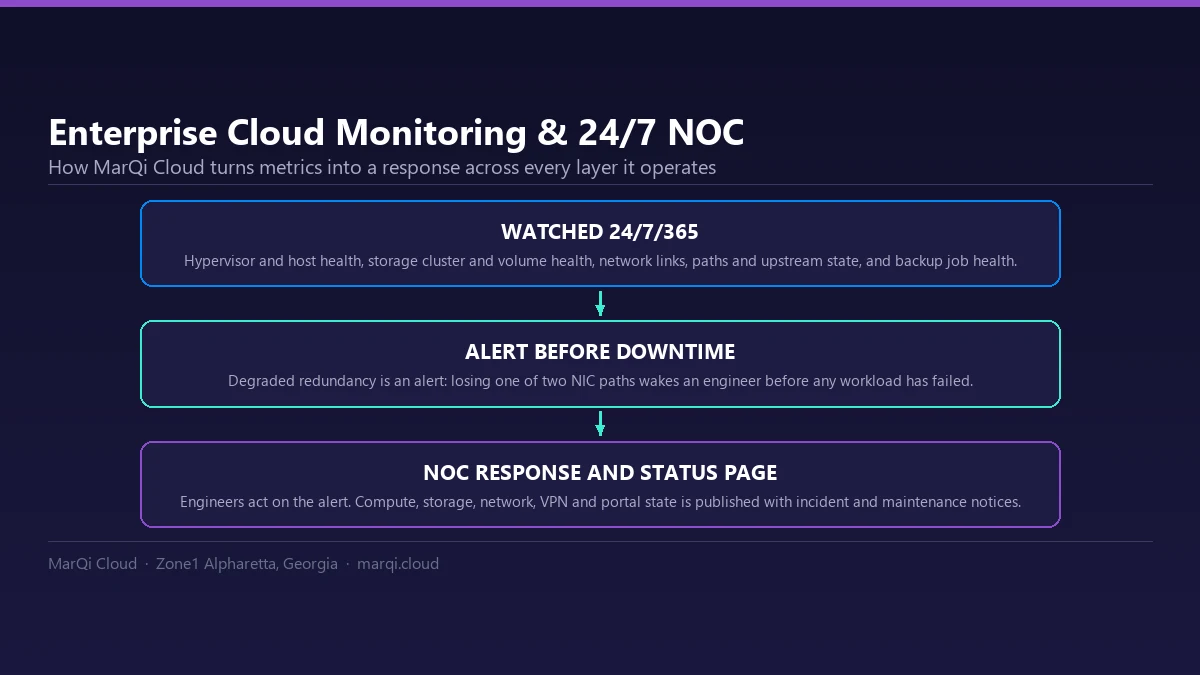
Enterprise cloud monitoring is only useful if someone acts on it. MarQi Cloud combines real-time metrics and alerting with a NOC that watches the platform 24/7/365 — so a failing disk, a saturated link or a stalled backup job produces a response, not just a red square on a dashboard.
What we monitor
Coverage spans every layer we operate: hypervisor and host health on the compute platform, cluster and volume health across storage, and link, path and upstream state across the network fabric. Because hosts have multiple NIC paths into redundant switching, we alert on degraded redundancy — losing one of two paths is a problem worth waking someone for, even though nothing is down yet.
What enterprise monitoring should actually include
Most monitoring setups fail in the same three ways. They watch averages instead of tails, so a p99 latency problem hides behind a healthy mean. They alert on symptoms nobody owns, so pages get muted. And they never test the alerting path itself, so the one night it matters, the notification goes to a decommissioned address. We design around those failure modes: percentile-based thresholds, alerts tied to a named runbook, and periodic verification that the escalation chain still reaches a human.
Taken together, this is infrastructure monitoring handled by a 24/7 NOC: compute, storage and network watched as one estate, with someone on shift to act on the alert rather than a dashboard you have to check yourself.
Capacity and trend visibility
Real-time alerting tells you what is broken now. Trend data tells you what will break next quarter — a volume approaching its growth ceiling, a link whose peak utilisation has been climbing steadily, a host whose memory headroom has quietly disappeared. Both matter, and capacity conversations are much cheaper than emergency ones.
Backup and data-protection monitoring
A backup schedule that silently stopped is one of the most expensive undetected failures in infrastructure. Job health is monitored alongside everything else — see snapshots and backups for how protection is configured in the first place.
Platform status and incident communication
Live platform state for compute, storage, network, VPN and the portal is published on our status page, where you can subscribe to incident and maintenance notifications. When something goes wrong we would rather tell you early with incomplete information than late with a polished summary.
Hybrid and colocated estates
Monitoring stops being useful when half your estate is invisible. Workloads on your own hardware can be covered under the same NOC as your cloud instances — that unified view is the point of our hybrid cloud model and applies to equipment racked with us under colocation and BYO hardware.
Have us run it
If you would rather not staff a rotation, our engineers can own monitoring, response and remediation end to end as part of managed services. Need help now? Open a ticket through the support portal, or talk to an engineer about a monitoring design for your workload.
Frequently asked questions
Is monitoring automated alerting or is someone actually watching?
Both. Real-time metrics and alerting are combined with a NOC that watches the platform 24/7/365, so a failing disk, a saturated link or a stalled backup job produces a response rather than only a red square on a dashboard.
What parts of the stack are monitored?
Every layer MarQi Cloud operates: hypervisor and host health on the compute platform, cluster and volume health across storage, and link, path and upstream state across the network fabric.
Do you alert before something is actually down?
Yes. Because hosts have multiple NIC paths into redundant switching, degraded redundancy is treated as an alertable condition — losing one of two paths is worth waking someone for even though no workload has failed yet.
Is backup health monitored too?
Yes. Backup and data-protection jobs are monitored alongside infrastructure, because a backup that silently stopped running is only discovered at the worst possible moment otherwise.
Related engineering articles
- Why White-Glove Cloud Support Empowers MSPs to Deliver Premium Services
- Unlocking Recurring Revenue: Cloud Infrastructure Monitoring for MSPs
- The Ultimate Guide to White-Label Cloud Solutions for Managed Service Providers
- The Complete Guide to Synthetic Monitoring for Cloud Application Health Verification
- The Complete Guide to On-Call Rotation Best Practices for Cloud Operations Teams
- The Ultimate IT Team’s Guide to Post-Incident Reviews and Blameless Postmortems
- The Complete Guide to Site Reliability Engineering Practices on Cloud Platforms
- Why Data Observability Platforms Are Essential for Cloud Data Pipelines
Browse the full archive: Managed Services & Monitoring (38)