
A zone is a data center, not a label
Each MarQi Cloud zone is a physically separate facility running its own storage cluster and its own compute capacity. That is a deliberate design choice: it means data locality is real rather than nominal, and, once Zone2 is live, a cross-zone copy will give you genuine geographic separation rather than two copies in one building.
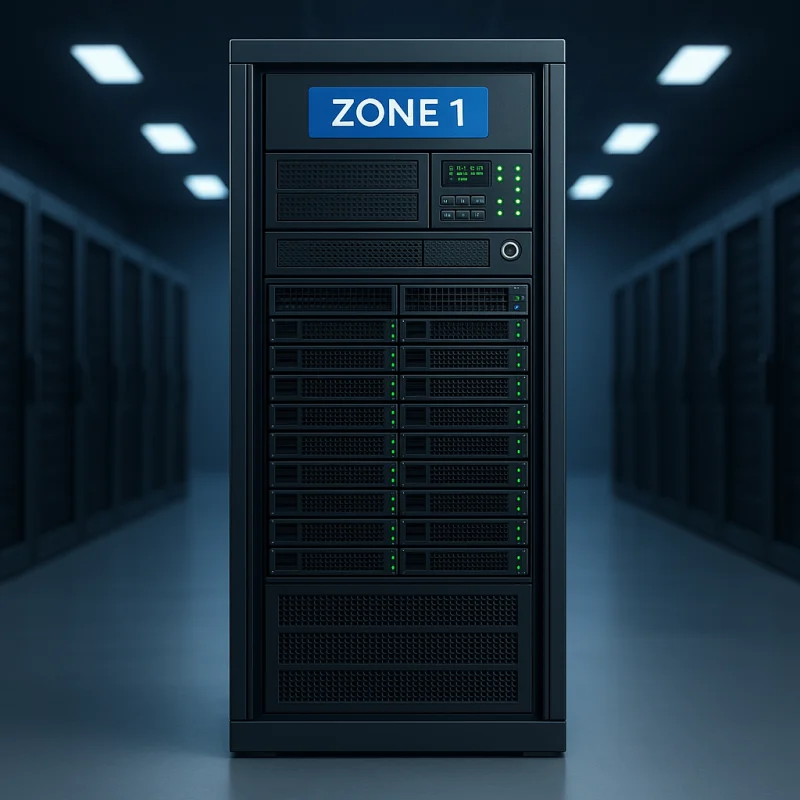
Zone 1 — Alpharetta, Georgia
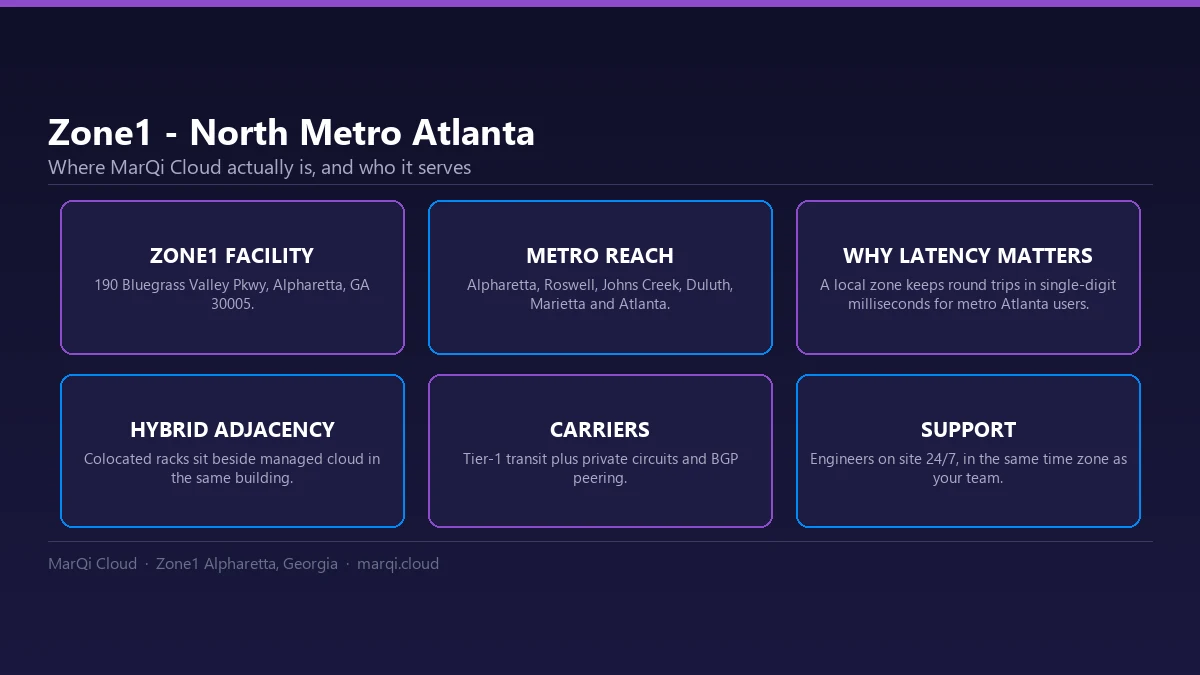
Our primary zone is in Alpharetta, GA, inside the Atlanta metro, with sub-5ms latency across the metro area. For customers in Georgia and the wider Southeast that proximity is the practical argument: training data, database replicas and backup targets do not have to cross the country to reach compute. It is also where hardware racked under colocation and dedicated GPU capacity live.
How zones talk to each other
Inter-zone traffic rides tier-1 backbones rather than the public internet and is encrypted in transit — see network fabric. Because we do not charge egress, moving data between zones will not be a metered event once Zone2 is live, which changes what is reasonable to do: cross-zone snapshot copies and second-site backup targets become architectural decisions rather than budget decisions. See snapshots and backups and pricing.
Choosing a zone
Put compute in the zone closest to whoever consumes it, and put your second copy somewhere else. Where regulation or a specific latency budget constrains the choice, our engineers will design around it — including dedicated connectivity between your sites and a zone, described under private circuits and peering.
The platform in each zone is the same: KVM compute, per-zone block storage with triple replication, and private VPC networking. Getting a first workload into a zone is walked through under getting started, or talk to an engineer.
Zone1 — Alpharetta, Georgia: our Atlanta-metro data center
Zone1 is MarQi Cloud’s own facility at 190 Bluegrass Valley Pkwy, Alpharetta, GA 30005 — inside the Atlanta metro area. It is not a reseller footprint in someone else’s hall: the racks, the storage cluster and the network fabric are operated by the same engineers who answer your support ticket. A second zone, Zone2, is planned.
Get directions to Zone1 — 190 Bluegrass Valley Pkwy, Alpharetta, GA 30005.
| Zone | Location | What runs there | Status |
|---|---|---|---|
| Zone1 | Alpharetta, GA (Atlanta metro) | Apache CloudStack on KVM, Ceph-based block and object storage, colocation racks | Live |
| Zone2 | Announced | Second region for hybrid and DR placement | Upcoming |
Why a Southeast US data center changes your latency budget
For an application serving the Southeast US, physical distance is the part of latency you cannot optimise away in code. Serving Atlanta, Georgia and the wider Southeast from a facility in the same metro removes the long-haul segment entirely; for everything beyond it, private circuits and BGP peering over tier-1 carriers keep the path off the public internet. Distance sets the floor — routing decides how close you get to it.
Georgia data center, engineer-operated
Every zone is run on the same principle: open-source infrastructure (KVM, Apache CloudStack, Ceph), published unit pricing, no egress fees and no vendor lock-in. Hardware refreshes are an engineering decision made in-house, not a vendor ticket.
Zone1 facility protections
Zone1 is housed at 190 Bluegrass Valley Pkwy in Alpharetta, in a data center shared with our partner Digital Ignition, which lists biometric access controls, N+1 redundancy, Liebert-assisted cooling, power generators and ISP connectivity for the site (source: Digital Ignition data center). What is quoted per rack for customer-owned hardware is explained on the colocation page.
Visits to Zone1 are available by arrangement: schedule one through the contact page.
Service levels and credits
Availability for the zones is committed per service, not as a single blended figure across an account. Compute, block storage, network and connectivity, VPN and load balancing, and colocation power and space are each covered separately. Availability is calculated per calendar month as the percentage of minutes during which the service was available, and an unavailability period starts at the earlier of our monitoring detecting it or you opening a ticket.
When we miss a commitment the remedy is a tiered service credit against the affected service. The specific commitment that applies to your services is stated in your order or agreement with us; if you are evaluating us and need the figures before you sign, ask an engineer and we will put them in writing. The full framework — covered services, how availability is measured, exclusions and the credit mechanism — is published in our Service Level Agreement.
Metro Atlanta service area
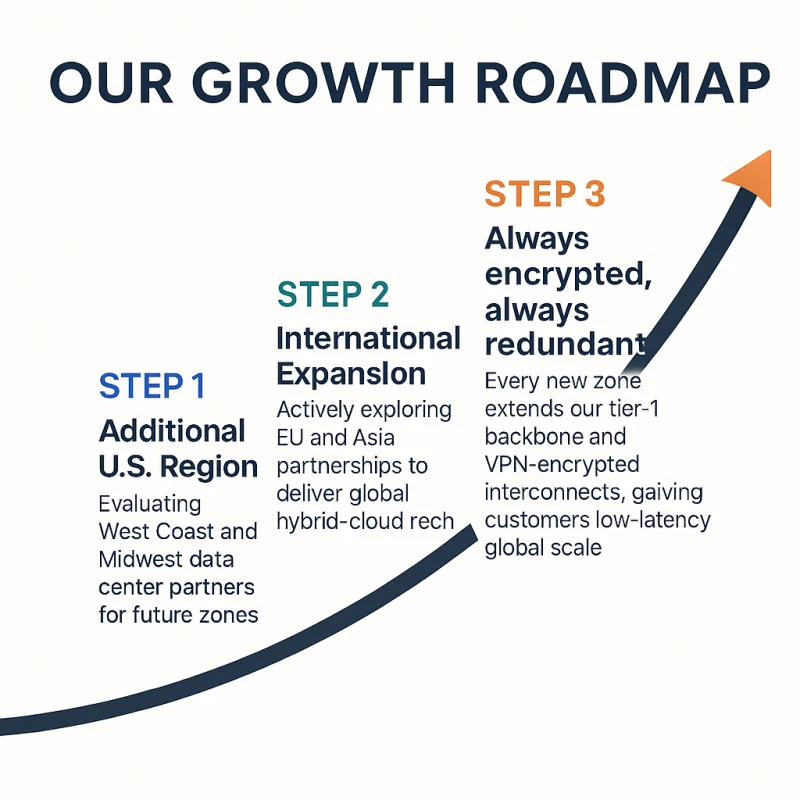
Zone 1 sits in Alpharetta, Georgia — the Southeast US technology corridor — and delivers sub-5ms latency to Atlanta metro businesses including Roswell, Duluth, Cumming, Sandy Springs and Johns Creek. Zone 2 is under construction for geographic redundancy. Customers outside the metro are served nationally from the same facility over private circuits and peering.
Work published from this region — latency measurements, colocation economics and Georgia-specific infrastructure notes — is collected in the Atlanta & Georgia article hub. Directions, hours and the front desk number are on the contact page.
Frequently asked questions
What exactly is a MarQi Cloud zone?
A zone is a physically independent data center — its own storage cluster, its own compute hosts and its own redundant network fabric — not a logical label inside one building. That is what makes fault isolation between zones real rather than nominal.
Where is Zone1 and is it live?
Zone1 is live in Alpharetta, Georgia, at 190 Bluegrass Valley Pkwy on the World Park technology campus, operated in partnership with Digital Ignition. It offers redundant multi-NIC hosts, tier-1 network providers, an enterprise storage cluster, and rack space for customer hardware. Zone2 is under construction.
Which zone should I choose?
Choose the zone closest to the users or systems your workload talks to most, because data locality is what determines latency. If you are placing your own hardware with us, choose the zone you want that hardware to sit in — colocated equipment and virtual machines in the same zone share the same fabric.
How do zones communicate with each other?
Inter-zone traffic uses tier-1 providers only and is always encrypted, so it stays off the public internet. Once Zone2 is live, volume snapshots can be copied between zones for cross-zone recovery; today copies stay within Zone1's triple-replicated storage cluster.
Related engineering articles
- The Complete Guide to Migrating from Colocation to Managed Cloud Infrastructure
- The Ultimate Guide to GPU Hosting in Atlanta
- Unveiling the Atlanta AI Market Growth Statistics: Trends and Insights
- Unlocking the Power of Dedicated AI Servers in Georgia: A Comprehensive Guide
- Unlocking the Future: AI Infrastructure for FinTech in Atlanta
- Revolutionizing Data Center Efficiency: AI Data Center Cooling Technologies
- Why Georgia Is a Hidden Gem for AI
- Atlanta vs Texas: A Comprehensive Comparison for AI Infrastructure
Browse the full archive: Atlanta & Georgia (72) · Colocation & Data Centers (31)