
Snapshots & Backups
Point-in-time recovery included in every plan
Data protection on MarQi Cloud is not a paid tier. Volume snapshots, scheduled backups and fast restores are included with every plan, running on top of a storage cluster that already replicates your data three times before any backup is taken.
Replication is not backup — you get both
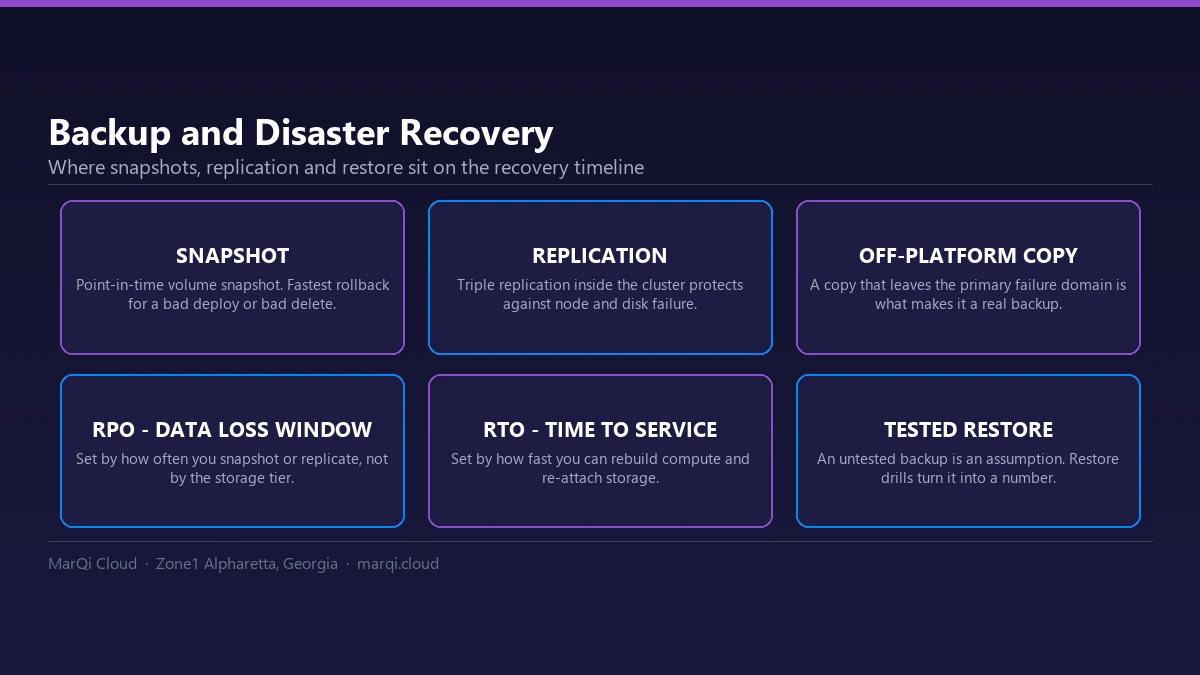
Every block volume lives on a Ceph/PetaSAN cluster with triple replication across separate nodes, so a failed disk or a failed host does not lose data. That protects against hardware failure. It does not protect against the other failure mode: someone drops a table, a deployment corrupts state, or ransomware encrypts a filesystem. For that you need a point you can go back to — which is what snapshots and backups give you. We provide both layers because they solve different problems.
Instant volume snapshots
Take a point-in-time snapshot of any volume, on demand, without stopping the workload. Snapshots are the right tool immediately before a risky change: a schema migration, a major version upgrade, a kernel change. If the change goes badly, you roll back to a known-good volume in minutes rather than rebuilding from a nightly dump.
Scheduled backups
Set a schedule that matches how much data you can afford to lose and how long you need to keep it. The two numbers worth deciding deliberately are your recovery point objective — how far back a restore may take you — and your recovery time objective — how long a restore is allowed to take. Our engineers will size the schedule with you rather than handing you a default and wishing you luck.
Fast restores
A backup you have never restored is a hypothesis, not a safety net. Restores on MarQi Cloud run against the same high-IOPS block storage your production volumes use, so recovery is not throttled by cold archive tiers. We encourage customers to rehearse a restore at least once before it matters.
Cross-zone copies
Once Zone2 is live, snapshots can be copied between zones; today copies stay within Zone1’s triple-replicated storage cluster. Because each zone in our zones is a physically separate data center with its own storage cluster, a cross-zone copy will then give you genuine geographic separation — and moving it will cost nothing, because MarQi Cloud does not charge egress fees. The replication and cluster design is documented under storage architecture.
Protecting hybrid and colocated workloads
If part of your estate runs on your own servers, those workloads can be protected alongside your cloud instances rather than under a separate tool with a separate runbook. That single-pane model is the point of our hybrid cloud, and it applies equally to gear you rack with us under colocation and BYO hardware.
Included, monitored, and supported
Backup jobs are watched by the same NOC that watches everything else — see status and monitoring. A backup that silently stopped running two months ago is a common and expensive failure; alerting on job health is how you avoid it. If you would rather hand the whole lifecycle to us, that is part of managed services.
| Item | What you pay |
|---|---|
| Volume snapshots, on demand | Included with every plan |
| Scheduled backups | Included with every plan |
| Restores | Included with every plan |
| Snapshot storage | Counted within your block storage capacity at USD 0.13 per GB per month, with no premium snapshot rate |
| Replication underneath | Three copies of every volume on separate nodes, before any backup is taken |
| Backup job monitoring | Watched by the 24/7 NOC |
| Copies to a second zone | Available when Zone2 is live; today copies stay within Zone1 |
| Moving backups off the platform | No egress fees |
New to MarQi Cloud? Getting started walks through enabling protection before you go live, and pricing shows exactly what is included. Questions about a specific recovery requirement? Talk to an engineer.
Frequently asked questions
Is data protection an extra paid tier?
No. Volume snapshots, scheduled backups and fast restores are included with every plan, not sold as an upgrade.
If storage is already replicated, why do I still need backups?
Because they solve different problems. Every block volume lives on a Ceph/PetaSAN cluster with triple replication across separate nodes, which protects against a failed disk or host. It does not protect against someone dropping a table, a deployment corrupting state, or ransomware encrypting a filesystem — for that you need a point in time you can return to.
Can snapshots be kept in a different zone?
Yes. Once Zone2 is live, snapshots can be copied across zones so a recovery point exists outside the data center that holds the live volume; today copies stay within Zone1's triple-replicated storage cluster.
Does this cover hardware I colocate rather than rent?
Yes. Colocated and hybrid workloads sit on the same fabric as the virtual estate, so the same snapshot and backup workflow applies to them.
Related engineering articles
- The Ultimate Guide to MSP Cloud Backup and Disaster Recovery Services
- The Complete Guide to Cloud Backup Storage Strategies for Enterprise Data Protection
- Why Cloud Storage Snapshots Provide Point-in-Time Recovery for Critical Workloads
- The Complete Guide to Managed Cloud Backup and Recovery Services
- How Cloud Hosting Supports Construction Project Management Platforms at Scale
- The Complete Guide to Cloud Database Replication for Read-Heavy Workloads
- The Complete Guide to Private Cloud Backup and Snapshot Management
- Why Understanding Recovery Time Actual vs. Recovery Time Objective Matters
Browse the full archive: Backup & Disaster Recovery (43)