
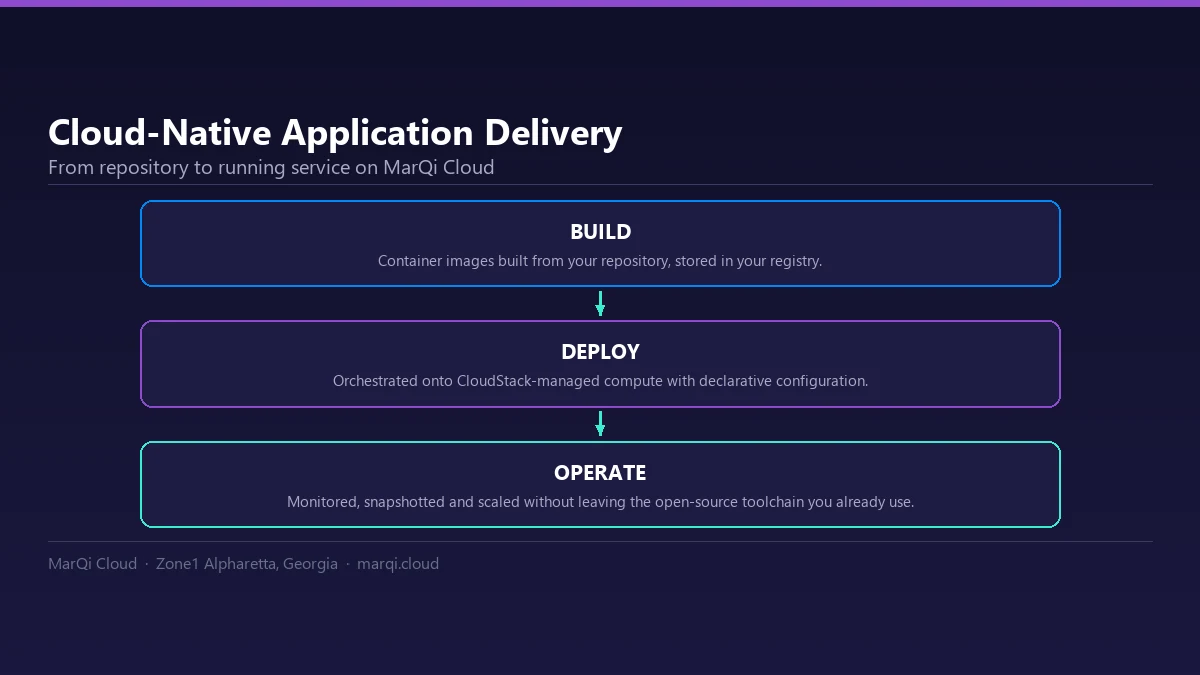
Cloud-native, without the lock-in tax
Most "cloud-native" rewrites end up native to one vendor: managed queues, proprietary functions, a database with no off-ramp. The application becomes portable in theory and immovable in practice. We build on open source primitives — KVM instances, standard block storage, ordinary networking — so the architecture stays portable and the migration path stays open. That constraint costs a little convenience up front and saves a great deal later.
What we build
Application platforms and deployment pipelines, containerised workloads and the orchestration around them, API and service layers, data tiers sized against real access patterns, and the integration work that connects a new application to systems you already run. Engineer-led, on infrastructure we operate — which means the people writing the deployment know how the storage and network behave.
Building on hybrid infrastructure
The interesting cases are rarely greenfield. More often part of the estate must stay where it is — a licensed appliance, a database on hardware you own, a system nobody wants to touch this quarter. Because your hardware and our cloud can share one VPC, an application can span both without a translation layer in the middle: see hybrid cloud and colocation.
The platform it runs on
Applications deploy onto the compute platform with block storage from a triple-replicated cluster (storage architecture), private networking and load balancing (networking and VPN), and repeatable base images (templates and images). Protection and monitoring are included rather than bolted on afterwards — snapshots and backups, status and monitoring.
AI and data-intensive applications
Where the application involves training or inference, the infrastructure decisions dominate the software ones. Dedicated accelerators, a storage path fast enough to keep them fed, and a low-latency route in front of inference — see GPUs for AI/ML.
After it ships
We can hand over completely, or keep running it under managed services. Either way you own the code and the images, and nothing in the stack is ours alone. Start an app project.
Service levels and credits
Availability for application development is committed per service, not as a single blended figure across an account. Compute, block storage, network and connectivity, VPN and load balancing, and colocation power and space are each covered separately. Availability is calculated per calendar month as the percentage of minutes during which the service was available, and an unavailability period starts at the earlier of our monitoring detecting it or you opening a ticket.
When we miss a commitment the remedy is a tiered service credit against the affected service. The specific commitment that applies to your services is stated in your order or agreement with us; if you are evaluating us and need the figures before you sign, ask an engineer and we will put them in writing. The full framework — covered services, how availability is measured, exclusions and the credit mechanism — is published in our Service Level Agreement.
Frequently asked questions
What does MarQi Cloud build under application development services?
MarQi Cloud software engineers build full-stack applications end-to-end — from product discovery and architecture through development, testing, and production deployment hosted on MarQi Cloud infrastructure. Applications are built by default for high availability, distributed databases, and scale, with CI/CD pipelines and observability included from the start.
Where are applications hosted after MarQi Cloud builds them?
Applications built by MarQi Cloud are hosted on MarQi Cloud's own infrastructure — benefiting from the same open source cloud fabric, zero egress fees, 24/7 engineer monitoring, and high availability architecture that all MarQi Cloud services run on. Hosting on our own platform means the team that built the application also operates the infrastructure it runs on.
What does CI/CD pipeline setup include?
MarQi Cloud sets up automated deployment pipelines covering continuous integration (code testing, build automation) and continuous delivery (automated deployment to staging and production). We also configure observability tooling — logging, metrics, and alerting — so your team has real-time insight into application health and deployment status from day one.
Are distributed databases included by default in app builds?
Yes. MarQi Cloud builds applications with distributed databases and fault-tolerant storage as defaults. Scalability and data resilience are designed into the architecture at the start — not added later. This means your application can handle production load growth without requiring architectural rework.
What are SRE-friendly runbooks and why do they matter?
SRE (Site Reliability Engineering) runbooks are operational guides that document how to respond to specific alerts, incidents, and routine maintenance tasks for a given application. MarQi Cloud delivers runbooks alongside monitoring dashboards with every application build — so your operations team can maintain and troubleshoot the application independently after handover, without requiring the original development team for every incident.
Can MarQi Cloud build on top of existing infrastructure or code?
Yes. MarQi Cloud engineers can engage with existing codebases, architectures, and infrastructure deployments. We assess your current state during the scoping phase and design a development engagement that builds on what you have rather than requiring a full rebuild. We work with your stack, your version control, and your deployment requirements.
How does application development pricing work at MarQi Cloud?
Application development is scoped and priced per project based on complexity, team size, and timeline. Hosting on MarQi Cloud infrastructure after delivery uses standard transparent compute and storage pricing with no egress fees. The scoping call is the first step — our engineers review your requirements and provide a project proposal before any commitment is made.
Related engineering articles
- How Automated Cloud Resource Provisioning Reduces Time to Deploy New Environments
- The Ultimate Guide to Ansible, Terraform, and Pulumi for Cloud Automation
- The Complete Guide to Infrastructure as Code Best Practices for Enterprise Cloud
- How Service Mesh Architecture Enhances Reliability in Cloud-Native Applications
- The Ultimate Guide to Automated Testing in Cloud Pipelines
- Ultimate Guide: Deploying Kubernetes on Cloud Infrastructure for Production Workloads
- How Immutable Infrastructure Reduces the Attack Surface of Cloud Deployments
- Why Private Cloud Does Not Mean Sacrificing Cloud-Native Features and Automation
Browse the full archive: Cloud App Development (45)