

Choosing between them
Most customers arrive with one of four problems, and the right starting point follows from which one it is.
"Our cloud bill is unpredictable and we cannot move." The cost is usually egress and per-feature metering rather than compute. Start with hybrid cloud and pricing — the comparison that matters is the whole invoice, not the instance line.
"We own hardware with life left in it." Replacing it with rented capacity is rarely the cheapest answer. Rack it with us and connect it to the same VPC as your cloud instances — see colocation and BYO hardware.
"We need GPUs and the queue is long." Dedicated accelerators, close to your data, with no transfer charge on training sets — see GPUs for AI/ML.
"We do not want to staff this." Our engineers operate the estate end to end under managed services, and build on it under application development.
Where connectivity itself is the constraint — regulated traffic, latency-sensitive replication, committed throughput — the answer is dedicated: see private circuits and peering.
What every solution shares
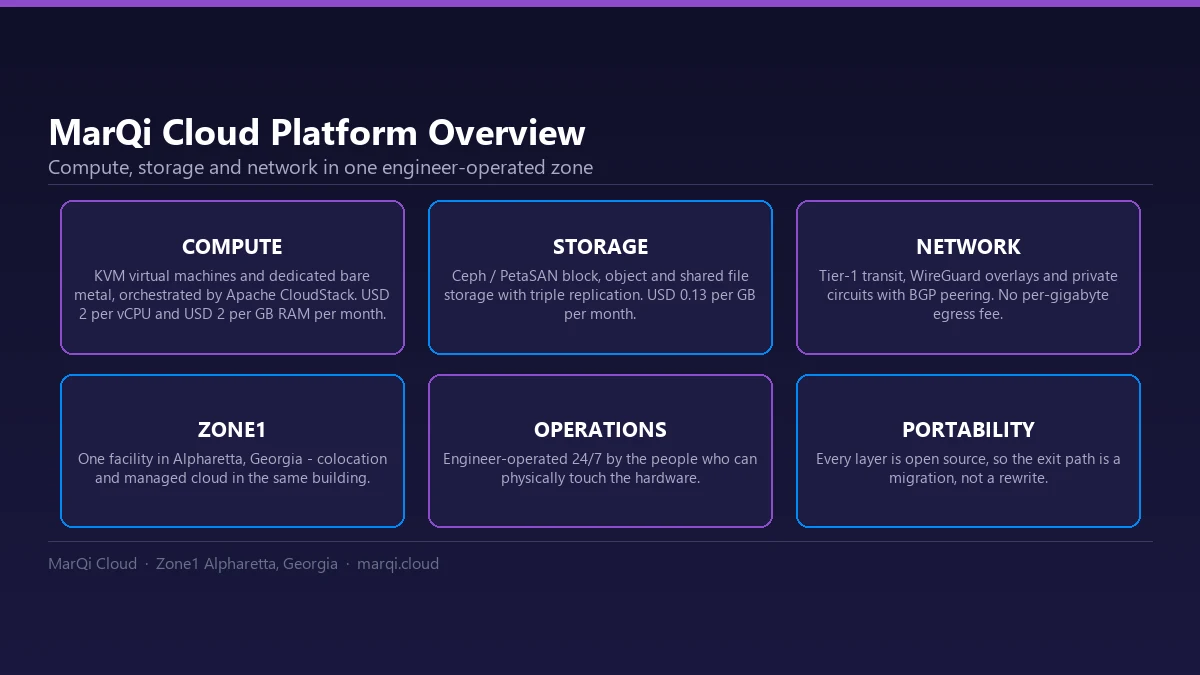
Open source underneath, so the exit path exists on day one. No egress fees. Per-zone storage clusters with triple replication, documented under storage architecture. Private networking by default via VPC and WireGuard. Protection included rather than sold separately — snapshots and backups. And a NOC watching it 24/7, described under status and monitoring.
Not sure which fits? Talk to an engineer — we will map your current stack before recommending anything.
Frequently asked questions
Which MarQi Cloud solution fits my workload?
Hybrid cloud suits teams who already own hardware and want elastic compute beside it. Colocation suits teams who only need rack space, power and connectivity. GPUs for AI/ML is a separate compute pool for training and inference. Private circuits and peering suit workloads that need dedicated point-to-point links into a VPC.
What do all the solutions have in common?
All of them run on the same open source stack, in the same zones, on the same network fabric, with no egress fees and no vendor lock-in clause. Snapshots, backups, VPN, load balancing and monitoring are part of the platform rather than separately metered add-ons.
Can I combine more than one solution?
Yes, and most production setups do. Colocated hardware, KVM virtual machines and a GPU pool can sit in the same zone and the same VPC, with private circuits terminating into it. Because it is one fabric, moving a workload between those shapes does not require re-architecting the network.
Is there a contractual lock-in?
No. The platform is built on open source components — KVM instances, standard image formats, Ceph-based storage — so workloads can be moved off the platform without a rewrite, and there are no egress fees that penalise moving data out.
Related engineering articles
- Why Incident Management Frameworks Reduce Downtime on Cloud Infrastructure
- How to Design a DevOps Culture Around Cloud Infrastructure Operations
- How Change Data Capture Enables Real-Time Data Synchronization in Cloud Systems
- The Complete Guide to ETL and ELT Pipeline Architecture on Cloud Infrastructure
- Why Data Catalog Solutions Enhance Data Discovery in Cloud Environments
- Unlocking Insights: How Graph Databases on Cloud Infrastructure Enable Complex Relationship Queries
- Why Data Mesh Architecture Changes How Enterprises Think About Cloud Data Ownership
- Mastering IoT and Monitoring with Time-Series Databases on Cloud Infrastructure
Browse the full archive: Cloud Strategy & Buying Guides (25) · Cloud Infrastructure (314)