Optimize Cloud Resource Utilization with Container Orchestration
August 6, 2026
How Network Architecture Decisions Impact Monthly Cloud Infrastructure Bills
August 7, 2026
Why Serverless Architecture Reduces Infrastructure Management Overhead
In today’s fast-paced digital landscape, organizations are constantly seeking ways to enhance their operational efficiency and reduce costs. One of the most transformative innovations in cloud computing is serverless architecture, which allows businesses to focus on developing applications without the burden of managing the underlying infrastructure. In this comprehensive article, we will delve into the mechanics of serverless architecture, explore its benefits for specific workloads, and demonstrate how it can significantly reduce infrastructure management overhead. As an enterprise cloud provider, MarQi Cloud offers insights into how serverless solutions can optimize your business processes and drive growth.
What is Serverless Architecture?
Serverless architecture is a cloud computing model that allows developers to build and run applications without having to manage servers. In this paradigm, the cloud provider dynamically manages the allocation of machine resources. Developers can focus on writing code and deploying applications, while the cloud provider handles all aspects of server management, scaling, and maintenance.
Contrary to its name, serverless architecture does not eliminate servers; instead, it abstracts server management away from the developer. This model is primarily built around events and microservices, allowing applications to respond to specific triggers without continuous server operation.
Benefits of Serverless Architecture
Serverless architecture provides numerous advantages that can transform the way organizations develop and deploy applications. Here are some key benefits:
- Cost Efficiency: With serverless architecture, businesses only pay for the compute time they consume. This pay-as-you-go model eliminates the need for over-provisioning resources and reduces costs significantly.
- Scalability: Serverless applications can automatically scale up or down based on demand. This elasticity ensures optimal performance during peak usage periods without manual intervention.
- Faster Time to Market: Developers can rapidly build and deploy applications without worrying about server management. This accelerates the development cycle and enables faster innovation.
- Reduced Operational Overhead: By outsourcing server management to cloud providers, organizations can free up their IT teams to focus on strategic initiatives rather than routine maintenance tasks.
- Enhanced Security: Cloud providers typically invest in advanced security measures to protect their infrastructure. This means that serverless applications benefit from robust security practices without additional overhead.
How Serverless Architecture Reduces Infrastructure Management Overhead
Serverless architecture significantly mitigates the challenges associated with traditional infrastructure management. Here are several ways in which it achieves this:
1. Automated Resource Provisioning
In a serverless model, resource provisioning is automatic. Cloud providers allocate resources based on the application’s needs, ensuring that developers do not have to worry about capacity planning. This means that during periods of high demand, resources are provisioned seamlessly, and during low usage, resources are scaled back, allowing businesses to optimize costs.
2. Simplified Deployment
Serverless architecture simplifies the deployment process. Developers can deploy code as functions, which eliminates the complexity of managing entire server instances. This leads to a more streamlined workflow, allowing for continuous integration and continuous delivery (CI/CD) practices.
3. Event-Driven Processing
Serverless applications are inherently event-driven, meaning they can react to specific triggers without requiring constant server uptime. This event-driven nature reduces the need for constant monitoring and management, further decreasing operational overhead.
4. Integrated Monitoring and Logging
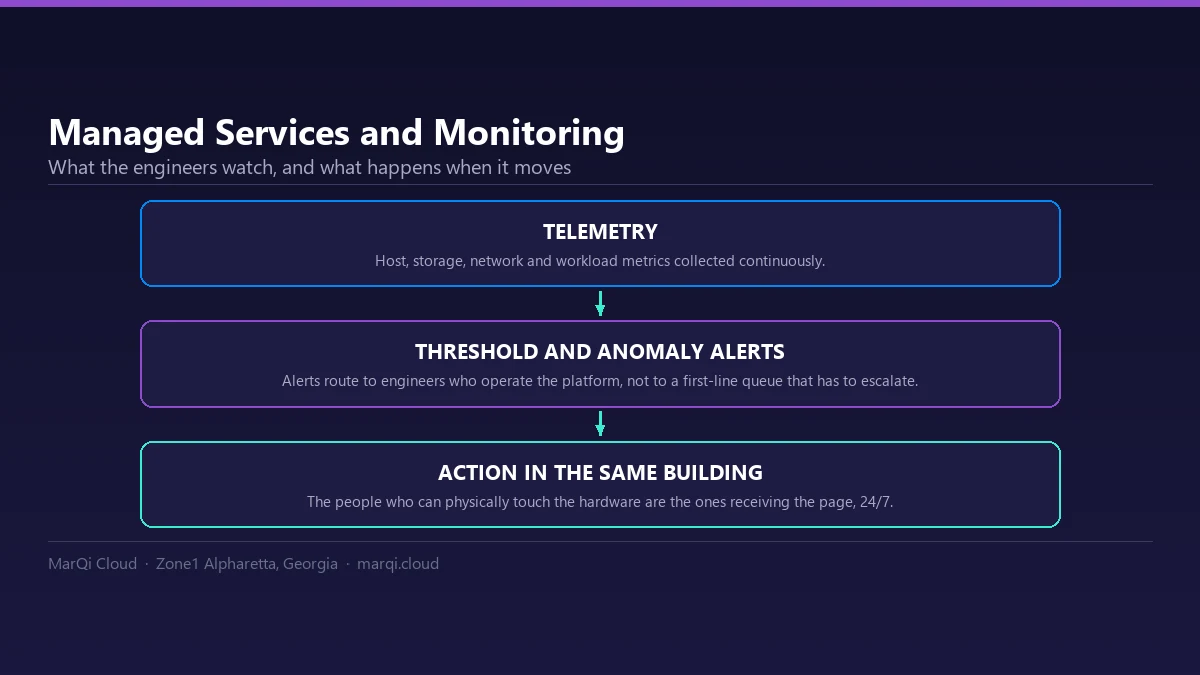
Most serverless platforms come with built-in monitoring and logging capabilities. This allows developers to track application performance, identify bottlenecks, and troubleshoot issues without needing separate monitoring solutions. For example, MarQi Cloud integrates advanced monitoring tools within its infrastructure to provide insights into application health and performance.
5. Focus on Core Business Functions
By adopting serverless architecture, organizations can refocus their IT resources on core business functions rather than infrastructure management. This shift allows teams to concentrate on developing innovative solutions that drive business growth.
Specific Workloads Suited for Serverless Architecture
While serverless architecture offers benefits across various applications, certain workloads are particularly well-suited for this model:
1. Microservices
Microservices architecture aligns well with serverless principles. Each microservice can be deployed as an independent function, allowing for easy scaling, updates, and management.
2. Event-Driven Applications
Applications that rely on event-driven processing, such as real-time data processing and IoT applications, can benefit immensely from serverless architecture. This model allows for immediate responses to events without the need for constant server availability.
3. APIs and Backend Services
Serverless architecture is ideal for building APIs and backend services. Developers can deploy functions that respond to API calls, enabling quick and efficient interactions between services.
4. Batch Processing
Tasks that require batch processing, such as data transformation and ETL (Extract, Transform, Load) operations, can leverage serverless architecture to execute jobs without the need for dedicated servers.
5. Development and Testing Environments
Serverless architecture can also be beneficial for development and testing environments. Developers can quickly spin up and tear down environments without incurring significant costs or resources.
Challenges and Considerations
While serverless architecture offers numerous advantages, it is essential to consider potential challenges:
1. Cold Start Latency
One challenge of serverless architecture is the cold start latency, which occurs when a function is triggered after a period of inactivity. This latency can impact performance, especially for applications that require rapid response times.
2. Vendor Lock-In
Organizations may face vendor lock-in due to the proprietary nature of serverless platforms. It is crucial to evaluate the long-term implications of choosing a specific cloud provider.
3. Limited Control
With serverless architecture, organizations relinquish some control over infrastructure management. This can be a concern for businesses with specific compliance or security requirements.
4. Debugging Complexity
Debugging serverless applications can be more complex due to the distributed nature of functions. Organizations should invest in robust monitoring and logging solutions to aid in troubleshooting.
Best Practices for Implementing Serverless Solutions
To maximize the benefits of serverless architecture, organizations should consider the following best practices:
1. Start Small
Begin by migrating smaller, less critical workloads to serverless architecture. This allows teams to gain experience and understand the nuances of the model before committing to larger applications.
2. Optimize for Performance
Regularly monitor and optimize function performance. Use metrics to identify bottlenecks and areas for improvement. MarQi Cloud provides advanced monitoring tools to help organizations achieve optimal performance.
3. Implement CI/CD Practices
Adopt continuous integration and continuous delivery practices for serverless applications. This ensures that code changes are tested and deployed efficiently, reducing the risk of errors.
4. Use Infrastructure as Code (IaC)
Leverage Infrastructure as Code tools to manage serverless resources. This practice ensures consistency and allows for version control of infrastructure configurations.
5. Maintain Security Best Practices
Implement security best practices, such as least privilege access and regular security audits. Ensure that functions are secured and that sensitive data is handled appropriately.
The Future of Serverless Architecture
The future of serverless architecture looks promising as more organizations recognize its potential to streamline operations and reduce costs. As technology evolves, we can expect advancements in serverless offerings, including:
- Improved Performance: Future serverless platforms will likely address current challenges, such as cold start latency, to enhance performance.
- Greater Integration: We can expect deeper integration with other cloud services and third-party tools, making it easier to build complex applications using serverless architecture.
- Enhanced Security Features: As cyber threats evolve, serverless platforms will continue to enhance security measures to protect applications and data.
- Broader Adoption: As more organizations transition to cloud-native architectures, serverless solutions will become increasingly mainstream, with more businesses leveraging its benefits.
Frequently Asked Questions
What is serverless architecture?
Serverless architecture is a cloud computing model where developers build and run applications without managing servers. The cloud provider handles resource allocation, scaling, and maintenance.
How does serverless architecture reduce infrastructure management overhead?
Serverless architecture automates resource provisioning, simplifies deployment, and allows developers to focus on coding instead of managing servers, significantly reducing operational overhead.
What types of workloads are best suited for serverless architecture?
Workloads such as microservices, event-driven applications, APIs, batch processing, and development environments are particularly well-suited for serverless architecture.
What are the challenges of adopting serverless architecture?
Challenges include cold start latency, vendor lock-in, limited control over infrastructure, and debugging complexity. Organizations should carefully evaluate these factors before migration.
How can organizations optimize performance in serverless applications?
Organizations can optimize performance by regularly monitoring function execution, using metrics to identify bottlenecks, and adopting CI/CD practices for efficient code deployment.
Is serverless architecture cost-effective?
Yes, serverless architecture is cost-effective as businesses pay only for the compute time they consume, eliminating the need for over-provisioning resources.
What security measures should be implemented for serverless applications?
Organizations should implement least privilege access, conduct regular security audits, and ensure that functions are secured appropriately to protect sensitive data.
How can MarQi Cloud assist with serverless architecture?
MarQi Cloud provides enterprise-grade cloud infrastructure and support for organizations looking to implement serverless architecture, ensuring optimal performance and security.