The Step-by-Step Guide to Deploying WordPress on MarQi Cloud VPS
June 4, 2026
How MarQi Cloud Resource Pools Let You Control Every Dollar of Cloud Spend
June 4, 2026
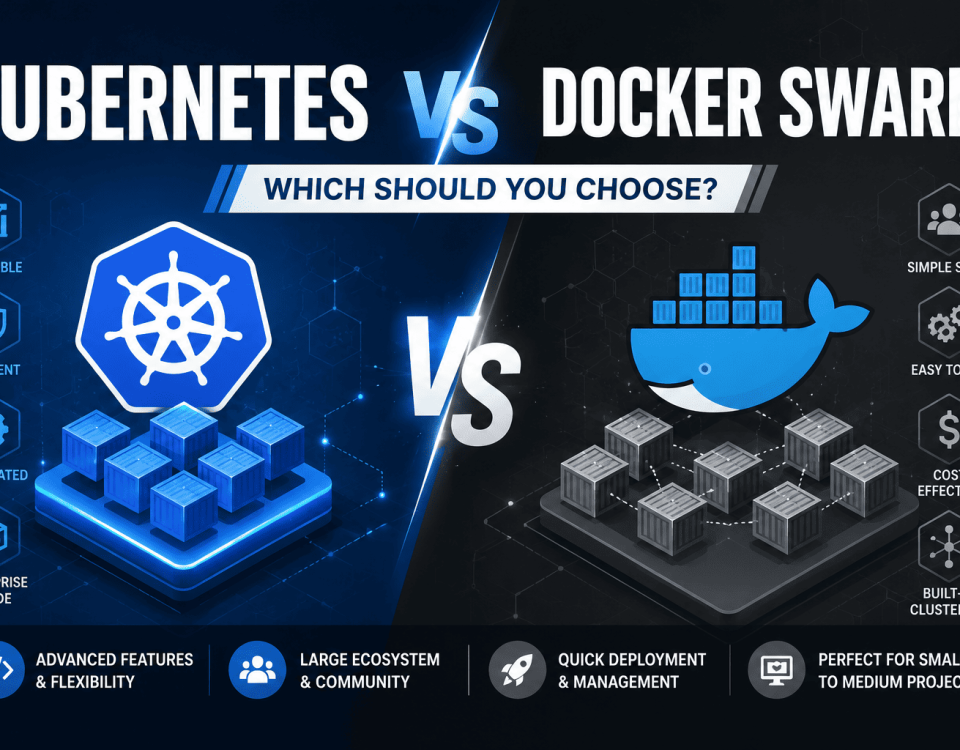
Kubernetes vs Docker Swarm: Which Should You Choose?
Container orchestration has become a core part of modern application deployment. Whether you’re running microservices, SaaS platforms, AI workloads, or enterprise applications, managing containers efficiently is critical for scalability, reliability, and operational efficiency.
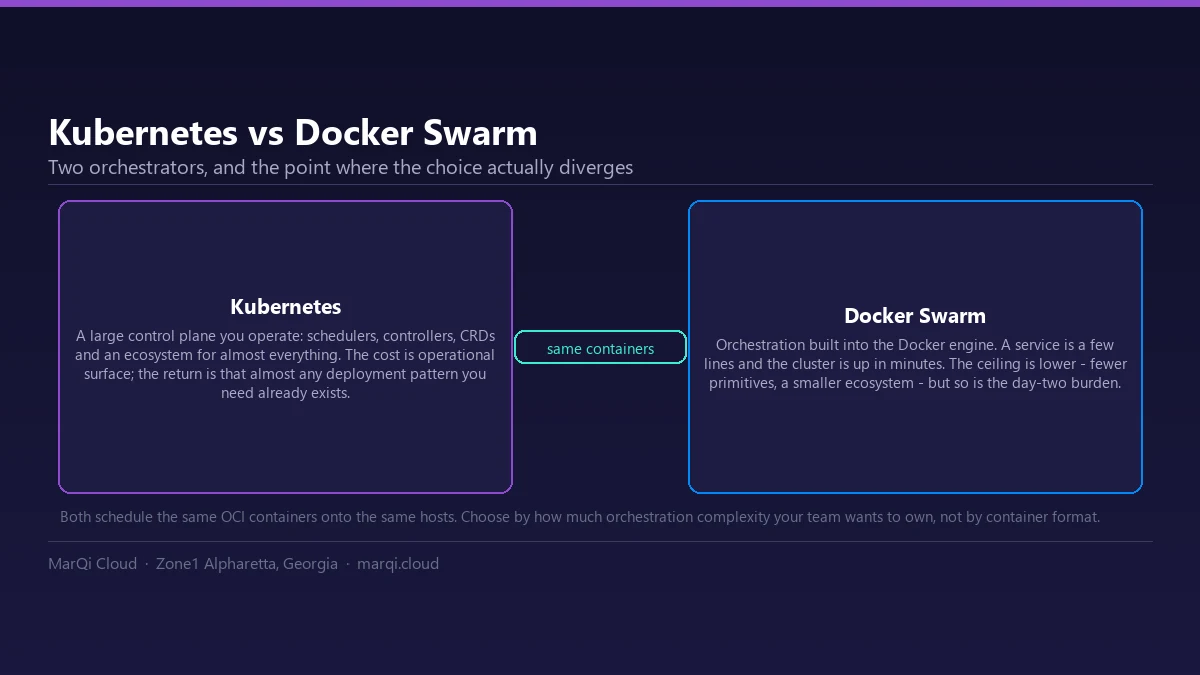
Two of the most recognized orchestration platforms are Kubernetes and Docker Swarm. Both help automate deployment, scaling, networking, and management of containerized applications, but they take very different approaches.
If you’re evaluating orchestration platforms in 2026, this guide explains the key differences between Kubernetes and Docker Swarm, their strengths, limitations, and which option may be the better fit for your infrastructure.
What Is Kubernetes?
Kubernetes (K8s) is an open-source container orchestration platform originally developed by Google. Today, it has become the most widely adopted solution for managing containerized workloads across public cloud, private cloud, and hybrid environments.
Kubernetes automates:
- Container deployment
- Scaling workloads
- Load balancing
- Service discovery
- Rolling updates
- Resource allocation
- Self-healing processes
Organizations building cloud-native applications often combine Kubernetes with application development services to streamline deployment pipelines and containerized software delivery.
What Is Docker Swarm?
Docker Swarm is Docker’s native container orchestration platform. It allows multiple Docker hosts to function as a unified cluster while maintaining the familiar Docker experience.
Docker Swarm provides:
- Simple cluster management
- Native Docker integration
- Service scaling
- Built-in load balancing
- Container scheduling
Because it extends Docker’s existing ecosystem, Swarm is often easier to deploy and manage than Kubernetes, especially for smaller teams.
Kubernetes vs Docker Swarm: Core Differences
Cluster Setup and Deployment
Kubernetes
Kubernetes consists of several components, including:
- Control Plane
- API Server
- Scheduler
- Etcd Database
- Worker Nodes
Deploying Kubernetes requires more planning and operational expertise. While managed Kubernetes services have simplified deployment, there is still a learning curve involved.
Docker Swarm
Docker Swarm is known for its simplicity. A cluster can be initialized with only a few commands, making it much easier to get started.
Teams already familiar with Docker can often deploy Swarm clusters within hours.
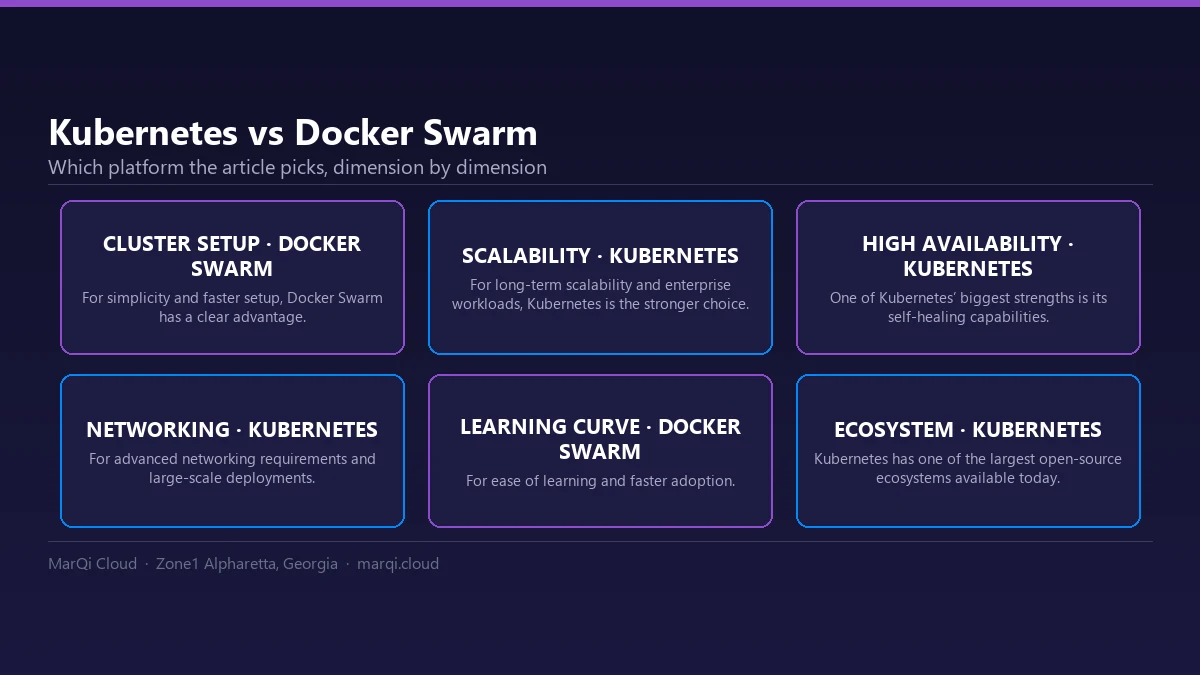
Winner: Docker Swarm
For simplicity and faster setup, Docker Swarm has a clear advantage.
Scalability
Kubernetes
Kubernetes was designed for large-scale environments. It can manage:
- Thousands of nodes
- Tens of thousands of containers
- Multi-region deployments
- Complex microservices architectures
Organizations running large Kubernetes clusters often rely on a high-performance compute platform to handle scaling, container scheduling, and resource-intensive workloads.
Docker Swarm
Docker Swarm scales effectively for small and medium-sized environments. However, as deployments become more complex, Kubernetes generally provides more flexibility and control.
Winner: Kubernetes
For long-term scalability and enterprise workloads, Kubernetes is the stronger choice.
High Availability and Self-Healing
Kubernetes
One of Kubernetes’ biggest strengths is its self-healing capabilities.
Kubernetes can automatically:
- Restart failed containers
- Replace unhealthy pods
- Reschedule workloads
- Maintain desired application states
This reduces downtime and minimizes manual intervention.
Docker Swarm
Docker Swarm supports failover and service recovery but lacks many of Kubernetes’ advanced automation features.
Winner: Kubernetes
Networking Capabilities
Kubernetes
Kubernetes provides extensive networking options, including:
- Ingress Controllers
- Service Discovery
- Network Policies
- Service Mesh Integrations
- Multi-Cluster Networking
A robust network fabric architecture helps reduce latency and improve communication between Kubernetes nodes and services.
Docker Swarm
Docker Swarm includes built-in overlay networking that is straightforward to configure and maintain. For many smaller environments, this functionality is sufficient.
Winner: Kubernetes
For advanced networking requirements and large-scale deployments.
Resource Management
Kubernetes
Kubernetes offers granular resource controls, including:
- CPU limits
- Memory limits
- Resource quotas
- Namespace isolation
- Horizontal autoscaling
This level of control helps optimize infrastructure utilization.
Companies deploying AI workloads frequently combine Kubernetes with dedicated GPU infrastructure for AI and machine learning to accelerate model training and inference.
Docker Swarm
Docker Swarm supports resource constraints but provides fewer options compared to Kubernetes.
Winner: Kubernetes
Learning Curve
Kubernetes
Kubernetes introduces several concepts that administrators must understand:
- Pods
- Deployments
- Services
- StatefulSets
- ConfigMaps
- Persistent Volumes
- Ingress Resources
While powerful, Kubernetes requires more training and operational knowledge.
Docker Swarm
Docker Swarm builds directly on Docker commands and workflows, making it easier for teams already familiar with Docker.
Winner: Docker Swarm
For ease of learning and faster adoption.
Ecosystem and Community Support
Kubernetes
Kubernetes has one of the largest open-source ecosystems available today.
It integrates with:
- Monitoring platforms
- Security solutions
- CI/CD tools
- Storage systems
- Service mesh technologies
- Public cloud platforms
This extensive ecosystem gives organizations flexibility when building modern cloud-native environments.
Docker Swarm
Docker Swarm remains functional but has a significantly smaller ecosystem and community compared to Kubernetes.
Winner: Kubernetes
Storage and Persistent Data
Containers frequently require persistent storage for applications, databases, analytics platforms, and enterprise workloads.
Kubernetes
Kubernetes supports:
- Persistent Volumes
- Storage Classes
- Dynamic Provisioning
- CSI Drivers
Kubernetes integrates well with modern storage architecture solutions that support persistent volumes, dynamic provisioning, and enterprise workloads.
Docker Swarm
Docker Swarm supports storage volumes but lacks many of the enterprise-grade storage capabilities available in Kubernetes.
Winner: Kubernetes
Security Features
Kubernetes
Kubernetes includes:
- Role-Based Access Control (RBAC)
- Network Policies
- Secrets Management
- Namespace Isolation
- Pod Security Controls
These features help organizations manage security and compliance requirements.
Docker Swarm
Docker Swarm provides:
- TLS Encryption
- Mutual Authentication
- Basic Secrets Management
While secure for many use cases, Kubernetes offers more detailed security controls.
Winner: Kubernetes
When Should You Choose Docker Swarm?
Docker Swarm is often a good option if:
- Your team already uses Docker extensively.
- You need rapid deployment.
- Your applications are relatively simple.
- You have limited DevOps resources.
- You want minimal operational complexity.
For startups and smaller businesses, Docker Swarm can provide container orchestration without requiring a large operational team.
When Should You Choose Kubernetes?
Kubernetes is often the better choice if:
- You manage large-scale applications.
- You expect significant growth.
- You require advanced automation.
- You operate microservices architectures.
- You need strong security controls.
- You plan to deploy workloads across multiple environments.
Many businesses reduce operational overhead by using managed cloud services to handle Kubernetes administration, monitoring, and maintenance.
Kubernetes and Hybrid Cloud Deployments
One of the main reasons Kubernetes continues to dominate the orchestration market is its flexibility across different environments.
Kubernetes can run consistently across:
- Public cloud infrastructure
- Private cloud environments
- On-premises data centers
- Colocation facilities
- Hybrid cloud architectures
Hybrid Cloud solutions provide a flexible foundation for Kubernetes deployments that need to run across both private and public infrastructure.
Businesses that require direct connectivity between locations can also benefit from private circuits and peering services when deploying hybrid Kubernetes environments.
This flexibility allows organizations to place workloads where they make the most sense based on performance, compliance, and operational requirements.
FAQ
Is Kubernetes replacing Docker Swarm?
Kubernetes has become the dominant orchestration platform for enterprise deployments, but Docker Swarm remains a practical option for smaller environments and less complex workloads.
Is Docker Swarm easier than Kubernetes?
Yes. Docker Swarm is generally easier to learn, deploy, and manage compared to Kubernetes.
Which platform scales better?
Kubernetes is designed for large-scale environments and offers significantly more scalability options than Docker Swarm.
Is Kubernetes better for enterprise applications?
In most enterprise scenarios, Kubernetes provides stronger scalability, automation, security controls, and ecosystem support.
Can Kubernetes run in a Hybrid Cloud environment?
Yes. Kubernetes is widely used in hybrid cloud environments because it provides a consistent deployment platform across multiple infrastructure locations.
Is Docker Swarm still relevant in 2026?
Yes. While Kubernetes dominates enterprise adoption, Docker Swarm remains useful for organizations seeking simplicity and quick deployment.
Conclusion
Both Kubernetes and Docker Swarm solve container orchestration challenges, but they serve different operational requirements.
Docker Swarm works well for smaller environments that prioritize simplicity and rapid deployment. Kubernetes is generally the preferred option for organizations that require scalability, automation, advanced networking, and support for complex cloud-native applications.
Whether you’re deploying containers on dedicated infrastructure, AI environments, or hybrid cloud platforms, choosing the right orchestration platform should align with your long-term operational goals.
MarQi Cloud provides cloud infrastructure, hybrid cloud solutions, GPU resources, enterprise storage, and managed services that support modern Kubernetes deployments and containerized workloads.