Why Cloud Security Posture Management Validates Your Configuration Continuously
August 11, 2026
How Container Security Scanning Prevents Vulnerable Images from Reaching Production
August 12, 2026
The Complete Guide to Secure API Gateway Configuration for Cloud Services
In today’s digital landscape, businesses are increasingly reliant on cloud services and APIs to enhance their operational efficiency and deliver seamless customer experiences. However, as the adoption of cloud-based infrastructures grows, so does the importance of securing these services. A well-configured API gateway is essential for safeguarding sensitive data, managing traffic, and ensuring compliance with industry regulations. In this comprehensive guide, we will explore the intricacies of secure API gateway configuration, best practices, and how MarQi Cloud’s enterprise-grade solutions can help you achieve a robust security posture.
What is an API Gateway?
An API gateway acts as a mediator between clients and services, providing a single entry point for API requests. It handles various tasks such as request routing, composition, and protocol translation, simplifying the interactions between different services and clients. API gateways are crucial in microservices architectures, where they help manage traffic effectively and ensure that all services are accessible in a secure manner.
Importance of API Gateway Security
With the rise of cyber threats and data breaches, securing your API gateway has never been more critical. API gateways often handle sensitive information, making them prime targets for attackers. A compromised API can lead to unauthorized access, data leaks, and significant financial loss. According to Verizon’s 2020 Data Breach Investigations Report, web applications were involved in 43% of breaches, highlighting the need for robust security measures.
Implementing a secure API gateway can help organizations:
- Protect sensitive data: By enforcing encryption and access controls, organizations can safeguard sensitive information from unauthorized access.
- Manage traffic effectively: A secure API gateway can help throttle traffic, preventing denial-of-service attacks that can cripple services.
- Ensure compliance: Many industries are subject to regulations that require strict data protection measures. A secure API gateway can help meet these compliance requirements.
Key Components of a Secure API Gateway
To ensure a secure API gateway, several key components must be considered:
1. Authentication and Authorization
Authentication verifies the identity of users or systems accessing the API, while authorization determines their level of access. Implementing OAuth 2.0 or JWT (JSON Web Tokens) can enhance security. These protocols allow for fine-grained access control, ensuring that only authorized users can access specific resources.
2. Encryption
Data should be encrypted both in transit and at rest. SSL/TLS encryption is essential for securing data transmitted over the network. Additionally, sensitive data stored on servers should also be encrypted to protect against unauthorized access.
3. Rate Limiting and Throttling
Implementing rate limiting and throttling mechanisms can help prevent abuse and denial-of-service attacks by controlling the number of requests a user can make in a given timeframe. This ensures the API remains responsive and available to legitimate users.
4. Logging and Monitoring
Comprehensive logging and monitoring are vital for detecting and responding to security incidents. API gateways should log all requests and responses, along with relevant metadata, to facilitate incident investigation and compliance auditing.
5. Security Policies
Defining and enforcing security policies is essential for maintaining a secure API gateway. This includes implementing CORS (Cross-Origin Resource Sharing) policies, input validation, and output encoding to prevent common attacks such as cross-site scripting (XSS) and SQL injection.
Best Practices for Secure API Gateway Configuration
Implementing the following best practices can enhance the security of your API gateway:
1. Use Strong Authentication Mechanisms
Implement multi-factor authentication (MFA) to strengthen user verification processes. This adds an extra layer of security, making it more difficult for unauthorized users to gain access.
2. Regularly Update and Patch
Keep your API gateway and its components updated with the latest security patches. Vulnerabilities in software can be exploited by attackers, so regular updates are crucial for maintaining security.
3. Conduct Security Audits and Penetration Testing
Regular security audits and penetration testing can help identify vulnerabilities in your API gateway configuration. These proactive measures allow you to address weaknesses before they can be exploited by attackers.
4. Implement API Gateway Security Features
Utilize built-in security features provided by your API gateway solution, such as Web Application Firewalls (WAFs) and DDoS protection services. These features can help mitigate various types of attacks.
5. Educate Your Team
Ensure that your development and operations teams are trained on best security practices. A well-informed team is better equipped to implement and maintain secure configurations.
Running a Secure API Gateway on MarQi Cloud
MarQi Cloud provides the infrastructure, and the API gateway is software you choose and run on it, such as an open source gateway on MarQi Cloud virtual machines placed on isolated private networks. On that foundation:
- Authentication and Authorization: Configure OAuth 2.0 or JWT validation in the gateway you deploy.
- End-to-End Encryption: Terminate TLS at the gateway and use TLS between the gateway and your backends, so data stays encrypted in transit; administrative access can run over encrypted WireGuard VPN.
- Traffic Management: Turn on the gateway’s rate limiting and throttling to protect against abuse.
- Monitoring: Send gateway logs and metrics to your monitoring stack, for example Prometheus and Grafana, to track API usage and detect anomalies.
- Expert Support: If you want help running the infrastructure beneath your gateway, MarQi Cloud’s managed services add 24/7 engineer-run operations and monitoring.
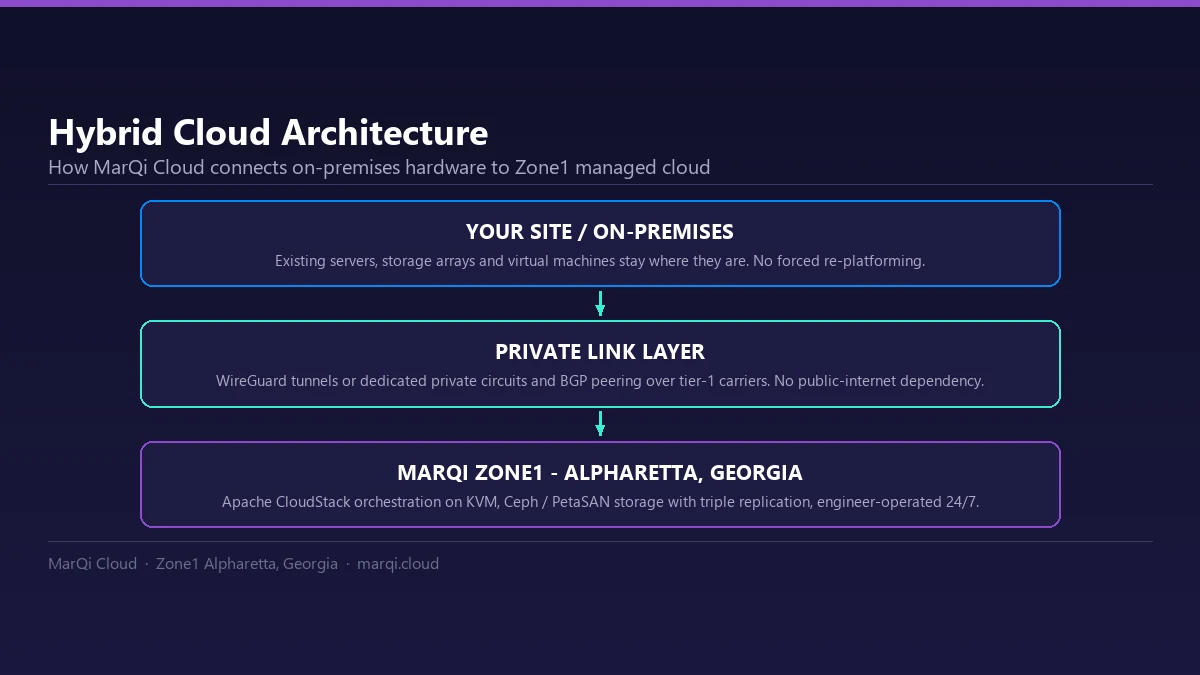
For organizations looking to migrate their APIs to a secure environment, MarQi Cloud offers hybrid cloud solutions that combine the flexibility of cloud services with the security of private infrastructure.
FAQ
1. What is an API gateway?
An API gateway is a server that acts as an intermediary between clients and backend services, managing requests and responses while providing various functionalities such as authentication, routing, and monitoring.
2. Why is API security important?
API security is crucial because APIs often handle sensitive data. A compromised API can lead to data breaches, unauthorized access, and significant financial losses.
3. What are common security threats to APIs?
Common threats include injection attacks, cross-site scripting (XSS), denial-of-service (DoS) attacks, and insecure direct object references.
4. How can I secure my API gateway?
To secure your API gateway, implement strong authentication and authorization measures, encrypt data, monitor traffic, and regularly update your software.
5. What is OAuth 2.0?
OAuth 2.0 is an authorization framework that allows third-party applications to access user data without sharing passwords, using access tokens instead.
6. What is the difference between authentication and authorization?
Authentication verifies the identity of a user or system, while authorization determines what resources that user or system is allowed to access.
7. How can I monitor my API security?
Implement logging and monitoring tools to track API usage and detect anomalies. Regular audits and penetration testing can also help identify vulnerabilities.
8. What are some best practices for API security?
Best practices include using strong authentication mechanisms, conducting regular security audits, keeping software updated, and educating your team on security measures.
9. What is a Web Application Firewall (WAF)?
A WAF is a security solution that monitors and filters HTTP traffic to and from a web application, providing protection against common threats.
10. How can MarQi Cloud help with API security?
MarQi Cloud provides the infrastructure for the API gateway you run: virtual machines on isolated private networks, encrypted WireGuard VPN access and, through its managed services, 24/7 engineer-run operations and monitoring. The gateway’s own security features are set up in the gateway software you choose.
11. Are there compliance requirements for API security?
Yes, many industries have compliance requirements that mandate specific data protection measures, including those related to API security.
12. What tools can I use for API security testing?
There are several tools available for API security testing, including Postman, OWASP ZAP, and Burp Suite, which can help identify vulnerabilities and ensure secure configurations.