Why Businesses Are Moving to Cloud-Native Apps
December 7, 2025
Scaling LLM Training with Dedicated GPU Cluster Solutions
December 11, 2025

Hybrid-Ready Infrastructure for Modern Cloud Workloads
Introduction – Why Hybrid-Ready Infrastructure Matters Today
More and more businesses are moving away from old, fixed IT setups and choosing systems that offer greater flexibility. Instead of relying only on their on-premises environment or fully shifting to the cloud, companies are finding real value in combining both. This hybrid approach lets them keep sensitive operations close while still enjoying the speed and convenience of cloud technology.
Digital transformation is also accelerating this change. As organisations adopt new tools, modern apps, and data-driven technologies, they need an infrastructure that can adapt quickly. Today’s workloads demand agility, the ability to scale instantly, and strong resilience to keep services running smoothly. A hybrid-ready infrastructure provides all of these benefits, making it an essential foundation for any business looking to grow and stay competitive.
Understanding Hybrid-Ready Infrastructure
A hybrid-ready infrastructure combines on-premises systems, private clouds, and public cloud platforms into one flexible environment. This approach gives businesses the freedom to place each workload where it performs best while still enjoying strong security, reliability, and scalability.
Key points about what a hybrid-ready infrastructure offers:
- Seamless integration: All environments, on-premises, private cloud, and public cloud, work together smoothly without disruption.
- Workload mobility: Companies can move applications and data between environments based on performance, cost, or compliance needs.
- Centralized management: A unified control layer helps monitor, manage, and optimize workloads across all systems.
- Stronger flexibility: Stable workloads can stay on local hardware, while high-demand or unpredictable tasks are shifted to the cloud.
Benefits of adopting a hybrid-ready infrastructure include:
- Scalability: Quickly scale resources up or down during traffic spikes or heavy workloads.
- Cost optimization: Run predictable tasks on cost-effective on-prem hardware, and use cloud resources only when needed.
- Faster innovation: Easily adopt new tools, technologies, and cloud-native applications without rebuilding the entire system.
- Better disaster recovery: Hybrid environments support stronger resilience and continuity planning.
A well-designed hybrid-ready infrastructure gives businesses the agility and performance needed for modern workloads, especially during digital transformation.
How MarQi Cloud supports this approach:
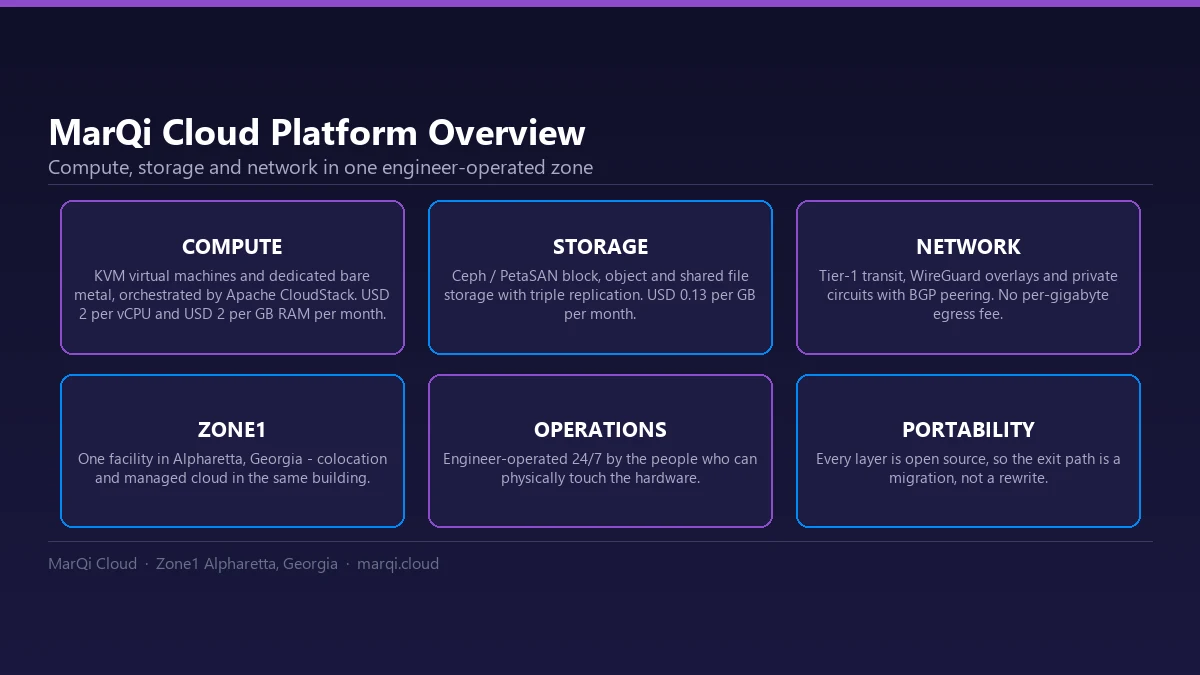
- Independent data center designed for hybrid workloads
- High-performance storage cluster for reliable data access
- Redundant network fabric for maximum uptime and smooth workload movement
- Secure, flexible environment built to enhance your hybrid-ready infrastructure
The Role of Digital Transformation in Cloud Computing
Digital transformation and cloud computing are changing the way businesses work by helping them utilize modern technology to enhance operations and deliver better value to customers. Digital transformation isn’t just about moving data online, it’s about reshaping how a company thinks, plans, and serves its audience.
Cloud computing supports this change by giving businesses the tools and flexibility they need to modernize, innovate, and grow. With digital transformation cloud computing, companies can upgrade their systems, automate tasks, and adopt new technologies like AI and IoT much faster than before.
What Digital Transformation Means
- Using digital tools to improve processes and workflows
- Automating tasks to save time and reduce errors
- Enhancing customer experiences through smarter solutions
- Making long-term changes to strategy, culture, and business operations
How Cloud Computing Enables Digital Transformation
- Scalable infrastructure: Increase or decrease computing power as needed
- Faster innovation: Build and test new apps using microservices, containers, or serverless tools
- Improved efficiency: Modernize IT systems and give teams secure access from anywhere
- More agility: Quickly adopt new cloud services and react to market changes
- Support for new business models: Enable remote work and create new digital services easily
Overcoming Legacy System Limitations
- Reduce dependency on outdated hardware
- Move workloads with minimal disruption
- Modernize in stages without risking business operations
How MarQi Cloud Supports Your Transformation
- Independent data center built for modern workloads
- High-performance storage cluster for smooth data access
- Redundant network fabric for maximum reliability
- A secure, flexible platform ideal for digital transformation cloud computing
The Power of Open Source in Cloud Computing
Open source in cloud computing allows businesses to use software whose code is freely accessible, modifiable, and shareable. This approach provides companies with the flexibility to build cloud solutions tailored to their specific needs, while avoiding vendor lock-in. It also encourages innovation and cost savings by leveraging community-driven improvements.
Key benefits of open source in cloud computing:
- Flexibility and freedom: Use vendor-neutral tools that work across platforms
- No vendor lock-in: Maintain control over your infrastructure without dependency on a single provider
- Cost efficiency: Reduce licensing costs and benefit from long-term savings
- Innovation: Rapid updates and feature development driven by global developer communities
- Support for modern cloud technologies: Powers virtualization, container orchestration, databases, and infrastructure management tools
Popular open-source tools in cloud computing:
- Kubernetes – for container orchestration
- OpenStack – for building private and public clouds
- Ceph – for scalable storage solutions
- Other community-driven platforms supporting AI, analytics, and large-scale applications
Why it matters:
Using open source in cloud computing helps organizations stay agile, adopt new technologies faster, and build scalable, cost-effective cloud environments.
Why IT Infrastructure Modernization Is Essential
Upgrading for Modern Workloads
- Future-proofing your environment
- Improving performance for real-time workloads
- Enhancing uptime and availability
Boosting Security and Operational Efficiency
- Greater visibility across hybrid environments
- Zero-trust architecture
- Automated scaling, updates, and failover
How MarQi Cloud Supports Hybrid-Ready Infrastructure
MarQi Cloud – Built for Modern Hybrid Environments
MarQi Cloud provides a strong foundation for businesses adopting a hybrid-ready infrastructure, offering flexibility, reliability, and scalability for modern workloads.
Key features:
- Independent data center: With its own storage cluster for fast and secure data access
- Redundant network fabric: Ensures continuous uptime and availability
- Flexible, vendor-neutral architecture: Works smoothly with different systems
- Seamless hybrid cloud support: Easily manages workloads across on-premises, private, and public clouds
- Supports IT infrastructure modernization: Helps businesses upgrade and modernize their IT systems efficiently
Conclusion
Hybrid-ready infrastructure is a crucial element for modern digital transformation, providing businesses with the flexibility, security, and performance they need to stay competitive. With solutions like MarQi Cloud, companies can confidently adopt hybrid architectures, seamlessly managing workloads across on-premises, private, and public cloud environments. As organizations continue to embrace innovation, the future of cloud computing is becoming increasingly open, scalable, and hybrid, enabling businesses to grow and adapt with confidence.