
The Surprise-Free Billing Promise: How MarQi Cloud Keeps Costs Predictable
June 21, 2026
What Is a Cloud Zone and Why MarQi Cloud’s Zone Architecture Changes Everything
June 22, 2026
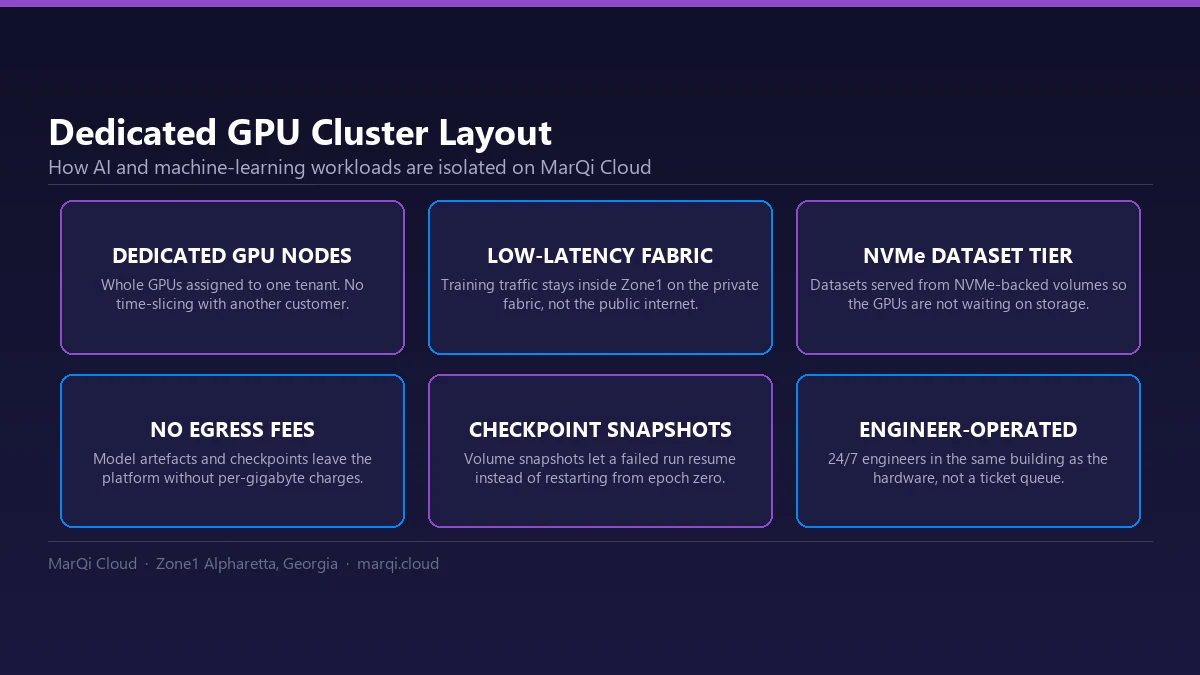
How to Run Machine Learning Pipelines on MarQi Cloud GPU Clusters
In today’s fast-paced digital landscape, machine learning (ML) has become an essential tool for businesses aiming to harness the power of data. With the emergence of cloud computing, executing complex ML pipelines has never been more accessible. MarQi Cloud offers enterprise-grade GPU clusters that are ideal for running machine learning models efficiently and effectively. In this article, we will explore how to run machine learning pipelines on MarQi Cloud GPU clusters, covering everything from setup to deployment.
What are GPU Clusters?
GPU clusters are groups of interconnected Graphics Processing Units (GPUs) designed to handle parallel processing tasks, such as those common in machine learning. Unlike traditional CPUs, GPUs can process multiple tasks simultaneously, making them particularly well-suited for the high computational demands of ML algorithms.
Benefits of Using GPU Clusters for Machine Learning
- Speed: GPU clusters significantly reduce the time required to train machine learning models.
- Scalability: They can easily scale to accommodate larger datasets and more complex models.
- Cost-effectiveness: With flexible pricing models, businesses can optimize their resources according to their needs.
Why Choose MarQi Cloud for Machine Learning?
MarQi Cloud offers a robust platform for businesses looking to leverage machine learning capabilities. Here are some of the key value propositions that make MarQi Cloud an ideal choice:
Enterprise-Grade Cloud Infrastructure
MarQi Cloud provides a reliable and secure cloud infrastructure tailored for enterprise needs. This includes high-performance GPUs that are specifically designed to handle intensive computational tasks.
Hybrid Cloud Deployment Models
With MarQi Cloud, organizations can choose from various hybrid cloud deployment models that best suit their operational requirements. This flexibility allows businesses to maintain control over their data while benefiting from cloud scalability.
Private and Secure Hosting Environments
Your data security is paramount. MarQi Cloud ensures that all machine learning processes occur in a secure environment that adheres to industry best practices.
Flexible Pricing Models
MarQi Cloud offers multiple pricing options, allowing businesses to choose a model that aligns with their budget and usage patterns.
Setting Up Your Environment on MarQi Cloud
To get started with running machine learning pipelines on MarQi Cloud GPU clusters, follow these steps:
1. Create a MarQi Cloud Account
Begin by signing up for a MarQi Cloud account. This process is straightforward and provides you access to the cloud infrastructure needed for your ML projects.
2. Select the Appropriate GPU Cluster
Once your account is set up, select a GPU cluster that meets your computational and storage requirements. MarQi Cloud provides a range of options, from entry-level GPUs to advanced configurations for complex tasks.
3. Configure Your Cluster
After selecting a cluster, configure it according to your project needs. This includes choosing the operating system, software packages, and necessary libraries for your ML tasks.
Building Your Machine Learning Pipeline
Now that your environment is set up, you can begin building your machine learning pipeline. A typical ML pipeline consists of several key stages:
1. Data Collection
Gather data from various sources, which may include databases, APIs, or public datasets. Ensure the data is relevant and clean, as this will greatly influence your model’s performance.
2. Data Preprocessing
Data preprocessing is crucial for preparing your dataset for modeling. This stage may involve data cleaning, normalization, and feature selection.
3. Model Selection
Select an appropriate machine learning algorithm based on your project’s objectives. Common algorithms include linear regression, decision trees, and neural networks.
4. Training the Model
Utilize the power of MarQi Cloud’s GPU clusters to train your model. This process may require adjusting hyperparameters to optimize performance.
5. Model Evaluation
After training, evaluate your model using metrics such as accuracy, precision, and recall. This step is vital for understanding how well your model performs.
6. Model Deployment
Once satisfied with your model’s performance, deploy it to a production environment. MarQi Cloud provides options for seamless deployment, ensuring your model can be accessed and utilized effectively.
Best Practices for Running ML Pipelines on MarQi Cloud
To maximize the effectiveness of your machine learning pipelines on MarQi Cloud, consider the following best practices:
- Monitor Resource Usage: Keep track of your cluster’s resource usage to optimize performance and cost.
- Regularly Update Your Models: Continuously update and retrain your models with new data to maintain accuracy.
- Implement Version Control: Use version control for your code and models to ensure reproducibility.
Common Challenges and Solutions
Running machine learning pipelines in the cloud can present challenges. Here are some common issues and how to address them:
1. Data Security Concerns
Ensure that you are following best practices for data security, including encryption and access controls, to protect sensitive information.
2. Cost Management
Utilize MarQi Cloud’s flexible pricing models to manage costs effectively. Regularly review your resource usage and adjust as necessary.
Conclusion
Running machine learning pipelines on MarQi Cloud GPU clusters can significantly enhance your organization’s ability to leverage data for decision-making. With enterprise-grade infrastructure, flexible deployment options, and a focus on performance, MarQi Cloud is an excellent choice for businesses looking to streamline their ML processes. By following the steps and practices outlined in this guide, you can harness the full potential of your machine learning initiatives.
Frequently Asked Questions (FAQ)
1. What are GPU clusters, and why are they important for machine learning?
GPU clusters consist of multiple GPUs working together to handle parallel processing tasks, making them ideal for the computationally intensive requirements of machine learning.
2. How does MarQi Cloud ensure data security for machine learning projects?
MarQi Cloud provides secure hosting environments with encryption, access controls, and compliance with industry best practices to protect your data.
3. Can I scale my resources on MarQi Cloud easily?
Yes, MarQi Cloud offers scalable compute and storage resources that allow you to adjust your infrastructure according to your project’s demands.
4. What types of machine learning algorithms can I use on MarQi Cloud?
You can use a variety of machine learning algorithms, including supervised, unsupervised, and reinforcement learning models.
5. Is there support available if I face issues while using MarQi Cloud?
Absolutely! MarQi Cloud provides US-based infrastructure and support to assist you with any challenges you may encounter.
6. How often should I update my machine learning models?
It’s recommended to regularly update and retrain your models with new data to ensure they remain accurate and relevant.
7. What are the pricing models available on MarQi Cloud?
MarQi Cloud offers flexible pricing models, allowing you to choose options that suit your budget and resource usage patterns.
8. Can I deploy my machine learning models directly from MarQi Cloud?
Yes, MarQi Cloud provides options for seamless model deployment to ensure your models are accessible and functional in a production environment.