Ultimate Guide to Optimize Cloud VPS Performance for High-Traffic Applications
August 18, 2026
Why Content Delivery Network Integration Enhances Global Cloud Application Performance
August 18, 2026
The Complete Guide to Cloud Load Balancing Architectures for Enterprise Applications
In the rapidly evolving landscape of enterprise applications, ensuring seamless performance, reliability, and scalability is paramount. One of the most effective strategies to achieve these goals is through cloud load balancing architectures. This comprehensive guide will delve into the various types of cloud load balancing, their architectures, and how they can be leveraged to optimize enterprise applications. Whether you’re considering a shift to hybrid cloud solutions or looking to enhance your existing infrastructure, this guide will equip you with the knowledge needed to make informed decisions.
What is Cloud Load Balancing?
Cloud load balancing is the process of distributing incoming network traffic across multiple servers in a cloud environment. This ensures that no single server becomes overwhelmed with requests, leading to improved application performance and availability. By utilizing cloud load balancers, organizations can efficiently manage traffic and provide users with a seamless experience.
Importance of Load Balancing in Enterprise Applications
For enterprise applications, load balancing is not just a technical necessity; it is a cornerstone of operational success. Here are the key reasons why load balancing is critical:
- Enhanced Performance: Load balancing optimizes resource use, maximizing throughput and minimizing response time.
- Scalability: As businesses grow, so do their traffic demands. Load balancing allows for horizontal scaling, enabling organizations to add more servers seamlessly.
- Reliability and Redundancy: Load balancers can automatically redirect traffic to healthy servers, ensuring high availability and resilience against server failures.
- Security: Load balancing can enhance security by distributing traffic and mitigating DDoS attacks.
Types of Load Balancing Architectures
Understanding the different types of load balancing architectures is essential for choosing the right solution for your enterprise application needs. Below are the main types:
1. Hardware Load Balancers
Hardware load balancers are physical devices that distribute traffic at the network level. They are known for their high performance and reliability, but they can be expensive and require significant maintenance.
2. Software Load Balancers
Software load balancers are applications that run on standard servers. They offer flexibility and scalability at a lower cost compared to hardware solutions. Examples include NGINX and HAProxy.
3. Cloud-Based Load Balancers
Cloud load balancers, such as those offered by Amazon Web Services (AWS), Google Cloud Platform (GCP), and Microsoft Azure, provide scalable and managed load balancing solutions. They automatically adjust to traffic demands and are billed on a pay-as-you-go basis.
4. Global Server Load Balancers (GSLB)
GSLBs manage traffic across multiple geographic locations, directing users to the nearest or best-performing data center. This is particularly useful for global enterprises with users distributed across various regions.
5. Application Load Balancers (ALB)
ALBs operate at the application layer (Layer 7) of the OSI model, allowing for advanced routing decisions based on the content of the requests. This enables more granular control over traffic distribution.
| Type of Load Balancer | Key Features | Use Cases |
|---|---|---|
| Hardware Load Balancer | High performance, reliability | Large enterprises with high traffic |
| Software Load Balancer | Flexibility, cost-effective | Medium to large enterprises |
| Cloud-Based Load Balancer | Scalable, managed service | Startups, businesses with fluctuating traffic |
| Global Server Load Balancer | Geographic traffic distribution | Global enterprises |
| Application Load Balancer | Advanced routing | Microservices architectures |
How Load Balancing Works
Load balancing operates through various algorithms to distribute traffic effectively. Here are some of the most common algorithms:
1. Round Robin
This method distributes requests sequentially to each server in a pool. It is simple and effective for servers with similar capabilities.
2. Least Connections
This algorithm directs traffic to the server with the fewest active connections, ensuring that no single server is overwhelmed.
3. IP Hash
IP hashing uses the client’s IP address to assign requests to servers. This method ensures that a client consistently connects to the same server, which is beneficial for session persistence.
4. Weighted Load Balancing
In this method, servers are assigned weights based on their capacity. Heavier loads are directed to servers that can handle more traffic, optimizing resource utilization.
Best Practices for Cloud Load Balancing
Implementing cloud load balancing effectively requires adherence to several best practices:
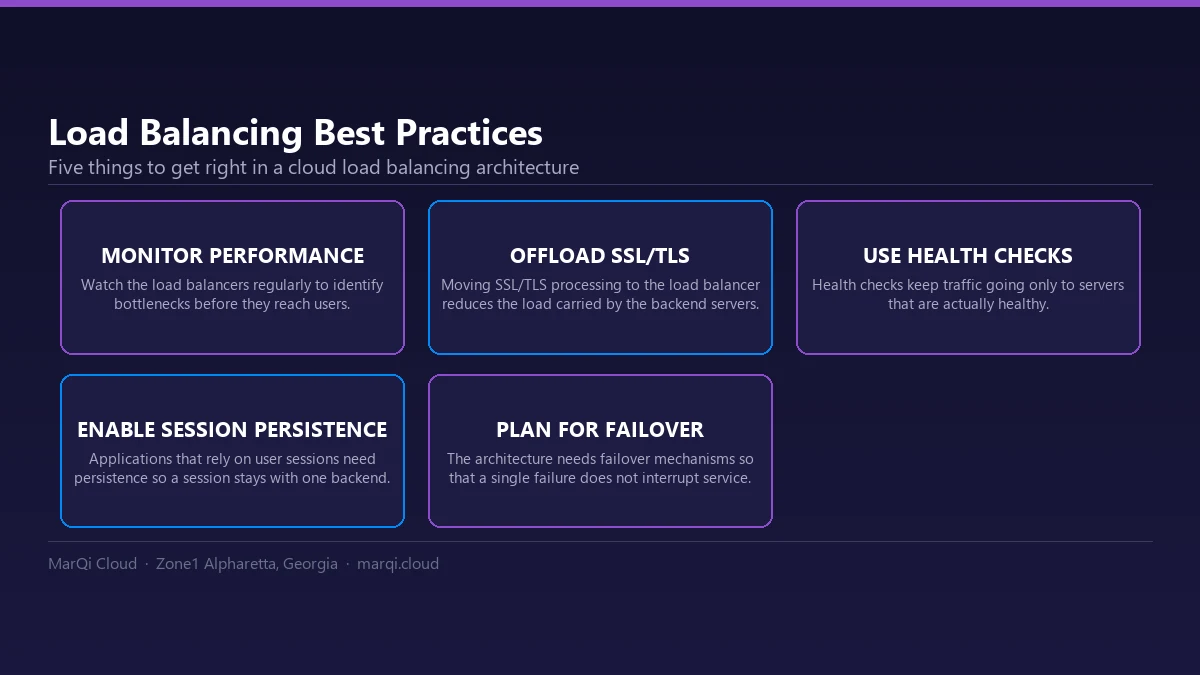
- Monitor Performance: Regularly monitor the performance of your load balancers to identify bottlenecks and optimize configurations.
- Implement SSL Offloading: Consider offloading SSL/TLS processing to your load balancers to reduce the load on your application servers.
- Use Health Checks: Configure health checks to ensure that traffic is only directed to healthy servers, enhancing reliability.
- Enable Session Persistence: For applications requiring user sessions, implement session persistence to maintain user experience.
- Plan for Failover: Ensure that your load balancing architecture includes failover mechanisms to maintain uptime during server outages.
Example Scenarios
The scenarios below are illustrative examples of how organizations typically apply these practices; they do not describe specific MarQi Cloud customers or measured results.
Example 1: E-Commerce Platform
An e-commerce company experienced significant traffic spikes during holiday sales. By implementing a cloud-based load balancer, they achieved seamless scaling, directing users to the nearest data center and maintaining an optimal shopping experience.
Example 2: SaaS Application
A SaaS provider utilized application load balancing to manage microservices traffic. By employing advanced routing techniques, they improved their application’s performance and reduced latency.
Example 3: Global Financial Institution
A multinational bank adopted global server load balancing to direct users to the closest data center based on their geographic location. This reduced response times and enhanced customer satisfaction.
FAQ
1. What is the primary function of a load balancer?
The primary function of a load balancer is to distribute incoming network traffic across multiple servers to ensure optimal resource use, enhance performance, and maintain high availability.
2. How does cloud load balancing differ from traditional load balancing?
Cloud load balancing is typically managed by cloud providers, offering scalability and flexibility, while traditional load balancing often relies on physical hardware and requires more maintenance.
3. What are the benefits of using a global server load balancer?
Global server load balancers provide geographic traffic distribution, reducing latency and improving user experience by directing users to the nearest data center.
4. Can load balancers enhance security?
Yes, load balancers can enhance security by distributing traffic and mitigating DDoS attacks, as well as providing SSL termination.
5. What is session persistence in load balancing?
Session persistence, or sticky sessions, ensures that a user’s requests are directed to the same server during a session, which is important for applications that maintain user state.
6. How do I choose the right load balancing architecture for my enterprise?
Consider factors such as traffic patterns, application architecture, budget, and scalability requirements when choosing a load balancing architecture.
7. What are some common load balancing algorithms?
Common load balancing algorithms include round robin, least connections, IP hash, and weighted load balancing.
8. How can I monitor the performance of my load balancer?
You can monitor load balancer performance using built-in analytics tools provided by cloud vendors or through third-party monitoring solutions.
Conclusion
Cloud load balancing architectures are essential for enterprise applications seeking to enhance performance, reliability, and scalability. By understanding the various types of load balancers and adhering to best practices, organizations can optimize their cloud infrastructure and ensure a seamless user experience. For businesses looking to adopt cloud solutions, MarQi Cloud offers enterprise-grade infrastructure and hybrid cloud deployment models that can support your load balancing needs. Contact us today to learn more about how we can help you achieve a performance-driven infrastructure.