Maximizing Cloud Database Performance with Connection Pooling & Query Optimization
August 20, 2026
The Complete Guide to Cloud Network Throughput Testing and Optimization
August 20, 2026

What are memory-optimized instances?
Memory-optimized instances are tailored for memory-intensive applications that need a larger amount of RAM relative to CPU, so large datasets can be held in memory and reached quickly. Typical uses are in-memory databases such as Redis and Memcached, real-time big data analytics, high-performance computing, and enterprise applications such as SAP HANA. Compute-optimized instances invert that ratio: more CPU relative to memory, for compute-intensive work.
Compute-Optimized vs Memory-Optimized Instances: Understanding Workload Needs
In the ever-evolving landscape of cloud computing, organizations face a pivotal decision when selecting the right infrastructure to support their applications. The choice between compute-optimized and memory-optimized instances can significantly impact performance, cost-efficiency, and scalability. This article will delve deep into the distinct characteristics of these instances, exploring how they cater to different workload needs and providing actionable insights for organizations looking to leverage cloud resources effectively.
As an enterprise cloud provider, MarQi Cloud is committed to helping businesses navigate these complexities. In this comprehensive guide, we will cover:
1. Understanding Cloud Instances
Cloud instances are virtual machines (VMs) that run in a cloud environment, providing scalable computing resources to businesses. These instances are categorized based on their performance characteristics, which include CPU, memory, storage, and network capabilities. Choosing the right instance type is crucial for optimizing application performance and managing costs.
2. What are Compute-Optimized Instances?
Compute-optimized instances are designed to deliver high performance for compute-intensive workloads. They are characterized by a higher ratio of CPU to memory, making them ideal for applications that require significant processing power. Examples of such workloads include:
- High-performance web servers
- Batch processing
- Machine learning inference
- Video encoding
- Gaming servers
Organizations leveraging compute-optimized instances can benefit from faster processing speeds, improved throughput, and lower latency. This makes them a preferred choice for businesses seeking to handle large volumes of transactions or data processing tasks efficiently.
3. What are Memory-Optimized Instances?
In contrast, memory-optimized instances are tailored for memory-intensive applications that require a larger amount of RAM relative to CPU. These instances are designed to support workloads that require quick access to large datasets stored in memory. Common use cases include:
- In-memory databases (e.g., Redis, Memcached)
- Real-time big data analytics
- High-performance computing (HPC)
- Enterprise applications such as SAP HANA
By utilizing memory-optimized instances, organizations can achieve lower response times and improved performance for applications that demand rapid data retrieval and processing capabilities.
4. Key Differences Between Compute and Memory Optimized Instances
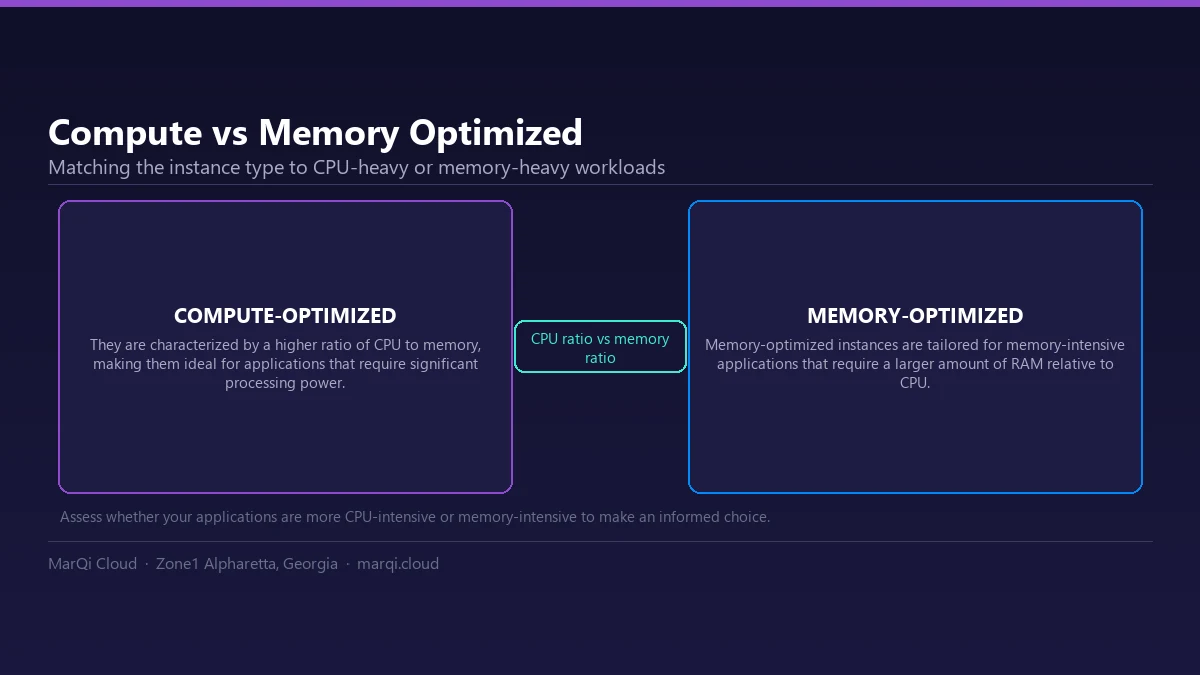
The differences between compute-optimized and memory-optimized instances can be summarized as follows:
| Feature | Compute-Optimized Instances | Memory-Optimized Instances |
|---|---|---|
| CPU to Memory Ratio | High CPU ratio | High memory ratio |
| Ideal Use Cases | Compute-intensive workloads | Memory-intensive workloads |
| Performance | Faster processing speeds | Lower latency in data access |
| Examples | Web servers, batch processing | In-memory databases, analytics |
Understanding these differences is key for organizations to effectively match their workloads to the appropriate instance type. Choosing incorrectly can lead to performance bottlenecks and increased operational costs.
Where storage-optimized instances fit
Compute-optimized and memory-optimized are not the only two families. A third one, usually labelled storage-optimized or I/O-optimized, leaves the CPU-to-memory ratio unremarkable and instead attaches fast local NVMe capacity to the instance. The bottleneck it targets is neither clock speed nor working-set size, but read/write throughput and latency to disk.
The practical rule is to ask which resource the workload exhausts first. A job that pins every core wants compute-optimized. A job that falls over once the dataset no longer fits in RAM wants memory-optimized. A job that spends its time waiting on disk, such as a log-structured database, an analytics query that scans far more data than it can cache, a search index rebuild or a data node replicating large volumes, wants storage-optimized. Comparing memory-optimized against storage-optimized therefore comes down to a single question: are you trying to hold the working set in memory, or to stream more data than memory could ever hold?
5. Use Cases for Compute-Optimized Instances
Compute-optimized instances are best suited for:
- Web Hosting: Applications that require quick responses to user requests benefit from the high processing power of compute-optimized instances.
- Machine Learning: Training machine learning models can be resource-intensive. These instances provide the necessary computational power to process large datasets efficiently.
- Batch Processing: Tasks that involve processing large volumes of data can run more efficiently on compute-optimized instances, reducing overall processing time.
- Gaming Servers: Online gaming applications require low latency and high processing capabilities, making compute-optimized instances an ideal choice.
6. Use Cases for Memory-Optimized Instances
Memory-optimized instances excel in the following scenarios:
- In-Memory Databases: Applications like Redis and Memcached require fast data access and benefit from the high memory capacity of these instances.
- Real-Time Analytics: Businesses needing real-time insights from large datasets can leverage memory-optimized instances for faster data processing.
- Enterprise Applications: Applications like SAP HANA that require significant memory resources are best suited for memory-optimized environments.
- Big Data Processing: Memory-optimized instances can handle large-scale data processing tasks with efficiency, enabling businesses to derive insights quickly.
7. Choosing the Right Instance Type for Your Workload
When selecting between compute-optimized and memory-optimized instances, organizations should consider the following factors:
- Workload Characteristics: Assess whether your applications are more CPU-intensive or memory-intensive to make an informed choice.
- Cost Considerations: Compute-optimized instances may offer lower costs for CPU workloads, while memory-optimized instances can provide better performance for memory-heavy applications.
- Scalability: Consider your future workload requirements. If you expect growth in data processing or memory needs, choose a scalable instance type.
Organizations can also benefit from consulting with cloud infrastructure experts to identify the best configurations for their specific needs. At MarQi Cloud, we offer managed services that can help streamline your cloud infrastructure decisions.
8. Conclusion
In conclusion, understanding the differences between compute-optimized and memory-optimized instances is crucial for organizations looking to maximize their cloud investments. By aligning the right instance type with the specific needs of your workloads, you can enhance performance, reduce costs, and ensure scalability. As an enterprise cloud provider, MarQi Cloud is dedicated to delivering tailored solutions that meet the unique requirements of each client. Whether you need hybrid cloud solutions or private cloud hosting, our team of experts is here to assist you in navigating the cloud landscape effectively.
9. Frequently Asked Questions
What are the main differences between compute-optimized and memory-optimized instances?
Compute-optimized instances have a higher CPU to memory ratio, making them ideal for CPU-intensive workloads, while memory-optimized instances have a higher memory to CPU ratio, suitable for memory-intensive applications.
When should I use compute-optimized instances?
You should consider using compute-optimized instances for high-performance web servers, batch processing, machine learning inference, and gaming servers.
What types of workloads benefit from memory-optimized instances?
Memory-optimized instances are best for in-memory databases, real-time big data analytics, high-performance computing tasks, and enterprise applications like SAP HANA.
How can I determine which instance type is right for my application?
Assess your application’s requirements in terms of CPU and memory usage. If your application is CPU-intensive, choose compute-optimized instances; if it is memory-intensive, opt for memory-optimized instances.
Are there cost differences between compute and memory-optimized instances?
Yes, compute-optimized instances may generally offer lower costs for CPU-heavy workloads, while memory-optimized instances can be more expensive but provide better performance for memory-heavy applications.
Can I switch between instance types later on?
Yes, most cloud providers allow you to change instance types, but this may involve downtime, so plan accordingly.
What other factors should I consider when choosing an instance type?
In addition to workload characteristics, consider cost, performance requirements, and future scalability needs when selecting an instance type.
How can MarQi Cloud help with my cloud infrastructure needs?
MarQi Cloud offers a range of services, including cloud migration services and infrastructure consulting, to help you make informed decisions about your cloud strategy.