How to Build a Hybrid IT Strategy That Grows With Your Business on MarQi Cloud
May 17, 2026
How to Set Up a Private Dedicated Circuit to MarQi Cloud in Under a Week
May 17, 2026
MarQi Cloud Peering Explained: How Your Traffic Never Touches Public Internet
In today’s digital landscape, seamless connectivity and data security are paramount for businesses that rely on cloud services. One innovative solution that addresses these concerns is cloud peering, a service that allows direct data transfers between cloud service providers and users without using the public internet. At MarQi Cloud, we offer advanced cloud peering solutions that ensure your traffic remains secure and efficient. In this article, we will delve into the intricacies of cloud peering, its benefits, and how MarQi Cloud can enhance your business operations.
What is Cloud Peering?
Cloud peering is a networking arrangement that facilitates the exchange of data between two or more cloud networks without traversing the public internet. This private interconnection can be established through various methods, including direct connections, private networks, or virtual connections. Cloud peering is essential for organizations that require high-performance, low-latency data transfer, and enhanced security for their sensitive information.
Types of Cloud Peering
There are several types of cloud peering, each with unique characteristics and benefits:
- Direct Peering: This involves a physical connection between two networks, allowing for faster data transfer rates and lower latency.
- Carrier Peering: This method utilizes a telecommunications carrier to facilitate connections between different cloud networks, offering redundancy and increased reliability.
- Internet Exchange Peering: This type of peering occurs at an Internet exchange point (IXP), where multiple networks connect and exchange traffic, often resulting in lower costs and improved performance.
Benefits of Cloud Peering
Cloud peering offers numerous advantages that can significantly impact your business operations:
1. Enhanced Security
By keeping your traffic off the public internet, cloud peering minimizes exposure to potential cyber threats. Data transmitted through private connections is less susceptible to attacks, ensuring that your sensitive information remains secure.
2. Improved Performance
With direct connections and reduced latency, cloud peering ensures faster data transfers, which can enhance application performance and user experience. This is especially critical for businesses that rely on real-time data processing.
3. Cost-Effective Solutions
By bypassing the public internet for data transfers, businesses can reduce bandwidth costs and optimize their overall cloud expenditure. MarQi Cloud’s flexible pricing models allow you to choose the best option for your needs.
4. Scalability
As your business grows, so do your data transfer requirements. Cloud peering solutions are designed to scale alongside your operations, providing you with the necessary resources to handle increased traffic without compromising performance.
5. Reliable Connectivity
Cloud peering offers a higher degree of reliability compared to public internet connections. With redundant paths and a dedicated infrastructure, businesses can experience minimal downtime and consistent performance.
How MarQi Cloud Implements Cloud Peering
At MarQi Cloud, we understand the importance of a robust and secure cloud infrastructure. Our cloud peering solutions are designed to meet the unique needs of your business:
Enterprise-Grade Infrastructure
Our cloud infrastructure is built to support enterprise-level applications, ensuring that your data transfers are not only secure but also efficient and reliable.
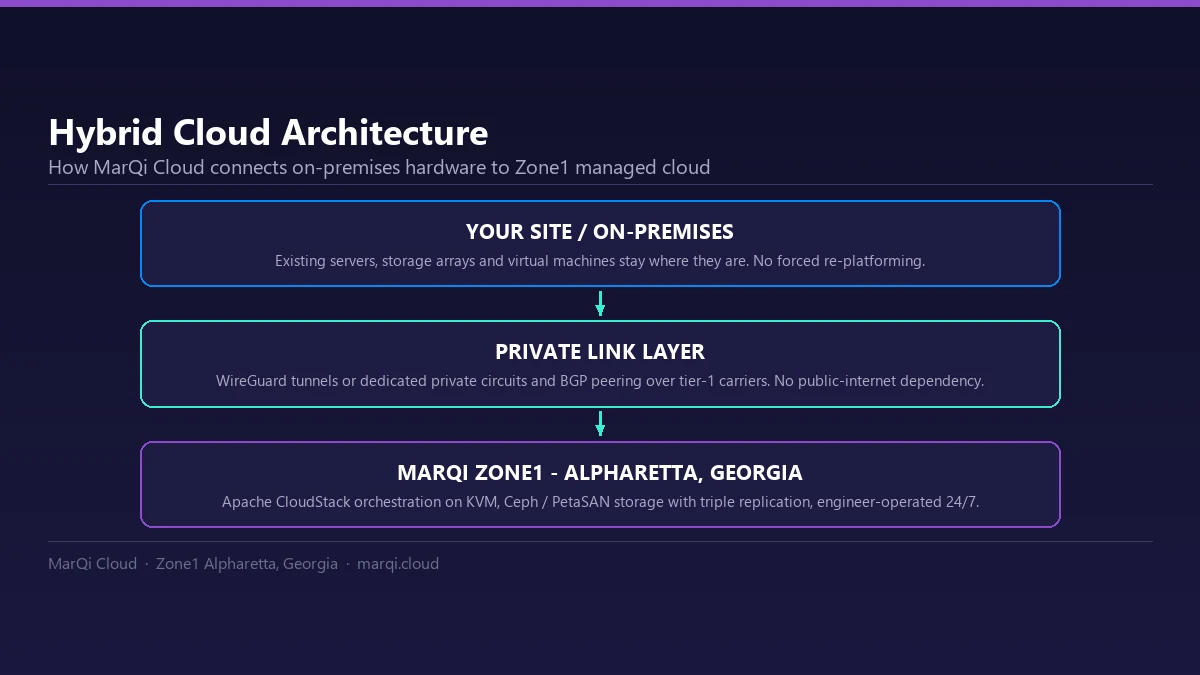
Hybrid Cloud Deployment Models
We offer flexible hybrid cloud deployment options, allowing businesses to tailor their cloud environments based on specific requirements. This versatility is crucial for companies navigating the complexities of modern data management.
Private and Secure Hosting Environments
Our commitment to security ensures that your data is hosted in private environments, minimizing risks associated with public cloud services.
Performance-Driven Infrastructure Design
MarQi Cloud’s infrastructure is designed with performance in mind, enabling optimal data transfer speeds and reduced latency.
US-Based Infrastructure and Support
With our US-based infrastructure, you can ensure compliance with local regulations while benefiting from our dedicated support team, available to assist you whenever needed.
Real-World Applications of Cloud Peering
Cloud peering is beneficial across various industries, including:
1. Financial Services
In the financial sector, where data security and compliance are critical, cloud peering provides a secure method for transferring sensitive information, helping organizations meet stringent regulatory requirements.
2. Healthcare
Healthcare organizations can leverage cloud peering to securely transfer patient data between providers and cloud services, ensuring compliance with HIPAA regulations while maintaining data integrity.
3. E-commerce
For e-commerce businesses, cloud peering can enhance the performance of online transactions, ensuring a smooth customer experience while protecting sensitive customer information.
MarQi Cloud Peering: FAQs
1. What is the difference between cloud peering and traditional cloud hosting?
Cloud peering involves direct connections between networks for data transfer, while traditional cloud hosting relies on the public internet, which can introduce latency and security risks.
2. How does cloud peering enhance security?
Cloud peering keeps your data off the public internet, reducing the risk of cyber threats and ensuring that sensitive information is transmitted securely through private connections.
3. Can cloud peering improve application performance?
Yes, cloud peering reduces latency and increases data transfer speeds, resulting in improved application performance and user experience.
4. Is cloud peering suitable for all businesses?
While cloud peering is beneficial for many organizations, it is particularly advantageous for businesses that handle sensitive information or require high-performance data transfers.
5. How can MarQi Cloud help my business with cloud peering?
MarQi Cloud offers enterprise-grade cloud infrastructure, hybrid deployment models, and tailored peering solutions to meet your specific business needs.
6. What are the costs associated with cloud peering?
Costs can vary based on the type of peering, the volume of data transferred, and the specific services used. MarQi Cloud provides flexible pricing models to accommodate different budgets.
7. Can cloud peering be integrated with existing cloud services?
Yes, cloud peering can be integrated with various cloud services, enabling seamless data transfers and enhanced security for your existing infrastructure.
8. How does MarQi Cloud ensure reliable connectivity?
Our infrastructure is designed with redundancy and high availability in mind, ensuring that your data transfers are reliable and consistent.
Conclusion
In an era where data security and performance are critical, cloud peering offers significant advantages for businesses seeking to enhance their cloud infrastructure. MarQi Cloud’s enterprise-grade solutions provide the necessary tools to ensure that your traffic never touches the public internet, allowing for secure, efficient, and reliable data transfers. If you’re ready to elevate your cloud experience, contact us at +1 770-369-9321 to learn more about our cloud peering solutions.