Why Kubernetes on Hybrid Cloud Creates a Portable Application Platform
July 26, 2026
How to Build a Hybrid Cloud Security Posture That Spans All Environments
July 27, 2026
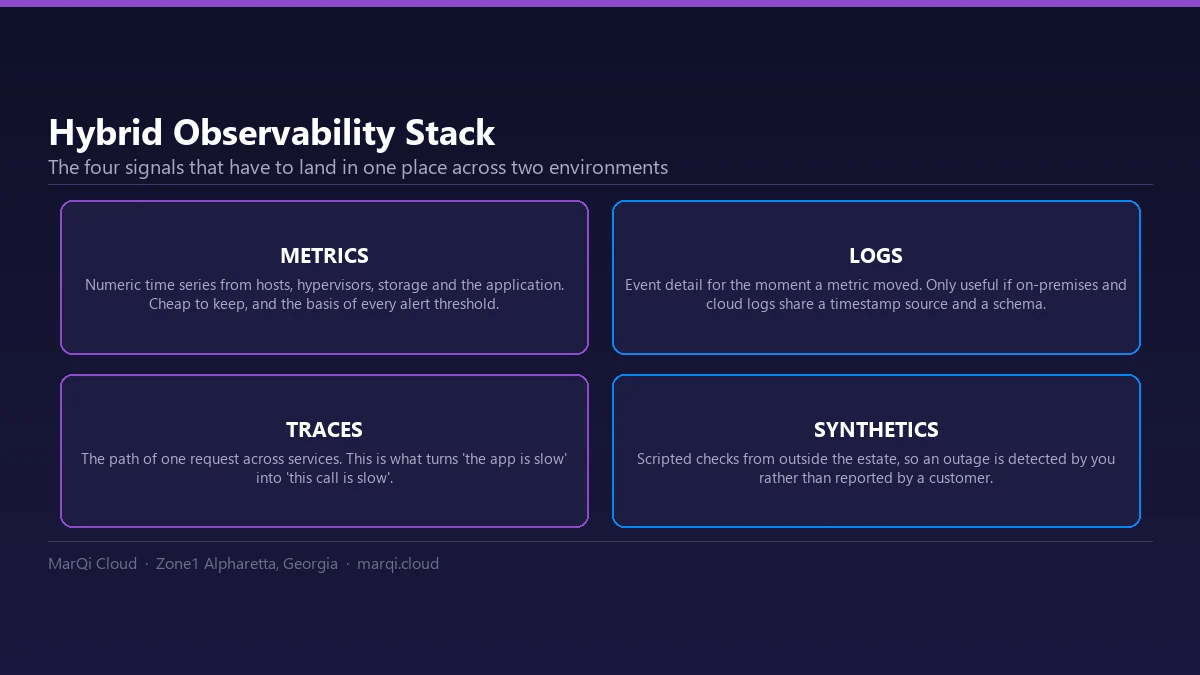
How do you monitor a hybrid cloud estate?
Correlate four signals in one place across both sides: metrics for thresholds, logs for detail, traces for request paths, and synthetic checks from outside the estate. The hard part is not collection — it is a shared timestamp source and a common naming scheme so on-premises and cloud events line up.
The Complete Guide to Monitoring and Observability Across Hybrid Cloud Environments
In today’s fast-paced digital landscape, organizations are increasingly adopting hybrid cloud environments to leverage the benefits of both public and private cloud infrastructures. However, with greater flexibility comes the challenge of ensuring consistent monitoring and observability across these complex environments. This comprehensive guide aims to equip IT leaders and decision-makers with the knowledge and strategies necessary for effective monitoring and observability in hybrid cloud setups. You will learn about the key concepts, best practices, and tools that can help you maintain optimal performance, security, and compliance in your hybrid cloud infrastructure.
What is Monitoring and Observability?
Monitoring refers to the process of continuously assessing the performance, health, and availability of IT systems and applications. It involves collecting metrics, logs, and events from various components of your infrastructure, enabling you to detect issues before they escalate into significant problems.
Observability, on the other hand, extends beyond mere monitoring. It encompasses the ability to understand the internal state of a system based on the data it generates, allowing for deeper insights into system behavior, performance, and user experience. In essence, observability provides a more comprehensive view, enabling organizations to troubleshoot and optimize their hybrid cloud environments effectively.
The Importance of Monitoring in Hybrid Cloud Environments
As businesses increasingly rely on hybrid cloud solutions, the importance of effective monitoring cannot be overstated. Here are several reasons why monitoring is crucial:
- Performance Optimization: Continuous monitoring helps identify bottlenecks and performance issues, ensuring that applications run smoothly and efficiently across hybrid environments.
- Security and Compliance: Monitoring provides vital insights into security threats and compliance gaps, enabling organizations to respond swiftly to potential vulnerabilities.
- Cost Management: By monitoring resource usage, organizations can optimize costs associated with cloud services, avoiding unnecessary expenses.
- Enhanced User Experience: Monitoring the performance of applications helps maintain a positive user experience, which is essential for customer satisfaction and retention.
Key Challenges in Hybrid Cloud Monitoring
While monitoring in hybrid cloud environments offers numerous benefits, it also presents several challenges:
- Data Silos: Different cloud providers and on-premises solutions may generate disparate data formats, making it difficult to obtain a unified view of the infrastructure.
- Complexity: The intricacy of hybrid cloud architectures can complicate monitoring efforts, requiring specialized tools and expertise.
- Latency Issues: Monitoring tools may introduce latency, affecting application performance and user experience.
- Integration Difficulties: Integrating monitoring solutions with existing tools and processes can be challenging, especially in legacy systems.
Best Practices for Effective Hybrid Cloud Monitoring
To overcome the challenges associated with hybrid cloud monitoring, consider the following best practices:
1. Centralize Monitoring Data
Utilize a centralized monitoring solution that aggregates data from both on-premises and cloud environments. This approach reduces data silos and provides a holistic view of your infrastructure.
2. Implement Automated Alerts
Set up automated alerts for key performance indicators (KPIs) and critical events. This enables your team to respond promptly to issues before they impact users. If nobody is on shift at 03:00, the alert is only a record of what broke — that gap is what 24/7 NOC monitoring closes.
3. Leverage APM Tools
Application Performance Management (APM) tools can provide deep insights into application performance, helping identify bottlenecks and optimize user experiences.
4. Regularly Review and Optimize
Conduct regular reviews of your monitoring strategy to ensure it aligns with evolving business needs and technology changes. Optimization should be an ongoing process.
5. Train Your Team
Invest in training for your IT staff to ensure they are equipped with the skills and knowledge to utilize monitoring tools effectively.
Tools and Technologies for Hybrid Cloud Observability
Choosing the right tools is critical for effective observability in hybrid cloud environments. Here are some popular options:
| Tool | Type | Key Features |
|---|---|---|
| Prometheus | Open Source Monitoring | Time-series data, alerting, visualization |
| Grafana | Data Visualization | Custom dashboards, integrates with various data sources |
| Datadog | Cloud Monitoring | Infrastructure monitoring, APM, log management |
| New Relic | Application Monitoring | Performance monitoring, error tracking, real-time insights |
| Splunk | Log Management | Data analytics, machine learning capabilities, security insights |
Each tool serves a specific purpose, and organizations should evaluate their unique requirements when selecting the best fit for their hybrid cloud environments.
Building an Observability Strategy
Creating a robust observability strategy involves several key components:
1. Define Objectives
Start by defining clear objectives for your observability efforts. Identify what you hope to achieve, such as improved performance, enhanced security, or better user experiences.
2. Select the Right Metrics
Choose the right metrics to track based on your objectives. Common metrics include application response times, error rates, and resource utilization.
3. Implement Observability Tools
Select and implement the tools that best fit your needs, ensuring they integrate seamlessly with your existing infrastructure.
4. Foster a Culture of Observability
Encourage a culture of observability within your organization. Ensure that all stakeholders understand the importance of monitoring and observability and their role in maintaining system health.
5. Continuously Improve
Observability is not a one-time effort; it requires continuous improvement and adaptation as your environment evolves.
Case Studies and Examples
To illustrate the effectiveness of monitoring and observability in hybrid cloud environments, consider the following case studies:
Case Study 1: E-Commerce Platform
An e-commerce platform migrated to a hybrid cloud environment to manage peak traffic during sales events. By implementing a centralized monitoring solution, they were able to identify performance bottlenecks in real-time, leading to a 30% increase in conversion rates during peak periods.
Case Study 2: Healthcare Provider
A healthcare provider adopted a hybrid cloud strategy to comply with regulatory requirements while improving service delivery. By leveraging observability tools, they enhanced their security posture, reducing compliance risks and improving patient trust.
Frequently Asked Questions
What is the difference between monitoring and observability?
Monitoring focuses on tracking the performance and availability of systems, while observability aims to provide insights into the internal state of those systems based on the data they generate.
Why is monitoring important for hybrid cloud environments?
Monitoring is crucial for ensuring performance optimization, security, compliance, cost management, and enhanced user experiences in hybrid cloud environments.
What are some common challenges in hybrid cloud monitoring?
Common challenges include data silos, complexity, latency issues, and integration difficulties with existing tools.
What best practices should I follow for effective hybrid cloud monitoring?
Best practices include centralizing monitoring data, implementing automated alerts, leveraging APM tools, regularly reviewing and optimizing strategies, and training your team.
What tools are available for hybrid cloud observability?
Popular tools include Prometheus, Grafana, Datadog, New Relic, and Splunk, each serving specific monitoring and observability needs.
How can I build an observability strategy?
To build an observability strategy, define objectives, select metrics, implement tools, foster a culture of observability, and continuously improve your approach.
Is it necessary to train my team on monitoring tools?
Yes, training ensures your IT staff is equipped with the skills and knowledge to utilize monitoring tools effectively and respond to incidents promptly.
How can I measure the success of my monitoring efforts?
Success can be measured by tracking the improvement in performance metrics, reduction in incident response times, and overall user satisfaction.
Conclusion
Monitoring and observability are critical components of managing hybrid cloud environments effectively. By understanding the key concepts, challenges, and best practices outlined in this guide, organizations can enhance their operational efficiency and security posture. As hybrid cloud solutions continue to evolve, adopting a proactive approach to monitoring and observability will be essential for maintaining competitive advantage and ensuring business continuity.
For organizations looking to implement robust hybrid cloud solutions, consider partnering with an experienced cloud provider like MarQi Cloud. With enterprise-grade infrastructure, flexible pricing models, and a commitment to security and compliance, MarQi Cloud can help you achieve your cloud goals seamlessly. Contact us today at info@marqi.cloud or call +1 770-369-9321 to learn more about our services.