How MarQi Cloud’s US-Based Infrastructure Delivers Compliance and Performance Together
July 8, 2026
The Ultimate IT Director’s Guide to Evaluating Cloud Infrastructure Providers Beyond the Big Three
July 9, 2026
Why Zero Egress Fees Revolutionize Enterprise Cloud Economics
In the rapidly evolving landscape of enterprise cloud computing, the financial implications of cloud service pricing models can significantly impact an organization’s bottom line. One such disruptive change is the introduction of zero egress fees, a concept that has gained substantial traction in recent years. This article will explore why zero egress fees are not just a passing trend but a game-changer in the economics of enterprise cloud computing. We will delve into the nuances of egress fees, their impact on cloud budgets, and how companies like MarQi Cloud are leading the charge towards more transparent and cost-effective cloud solutions.
Understanding Egress Fees
Egress fees are charges imposed by cloud service providers when data is transferred out of their cloud infrastructure to the internet or another network. These fees can become a significant expense, particularly for enterprises that rely heavily on data transfer for operations, analytics, and customer interactions. Egress fees can account for a large share of total cloud costs.
Understanding how these fees work is essential for enterprise IT departments and CFOs alike. Typically, egress fees are calculated based on the amount of data transferred, with rates varying significantly between providers. For example, while some cloud providers charge a flat rate for data transfers, others have tiered pricing based on volume, which can lead to unexpected costs as data usage scales.
The Economic Impact of Egress Fees
The economic implications of egress fees extend beyond simple dollar amounts. For enterprises, these fees can disrupt budgeting processes, complicate financial forecasting, and hinder scalability. Organizations often underestimate the total cost of ownership (TCO) associated with cloud services, primarily due to these hidden egress fees.
Consider a mid-sized enterprise that utilizes cloud services for data analytics. If this organization is charged $0.09 per GB of data egressed, and it transfers 10 TB of data per month, the monthly cost would amount to $900. Over a year, this translates to $10,800—funds that could have been allocated elsewhere, such as enhancing infrastructure or investing in new technologies. The unpredictability of these costs can deter businesses from leveraging cloud solutions fully, thereby stifling innovation and growth.
Zero Egress Fees: A New Paradigm
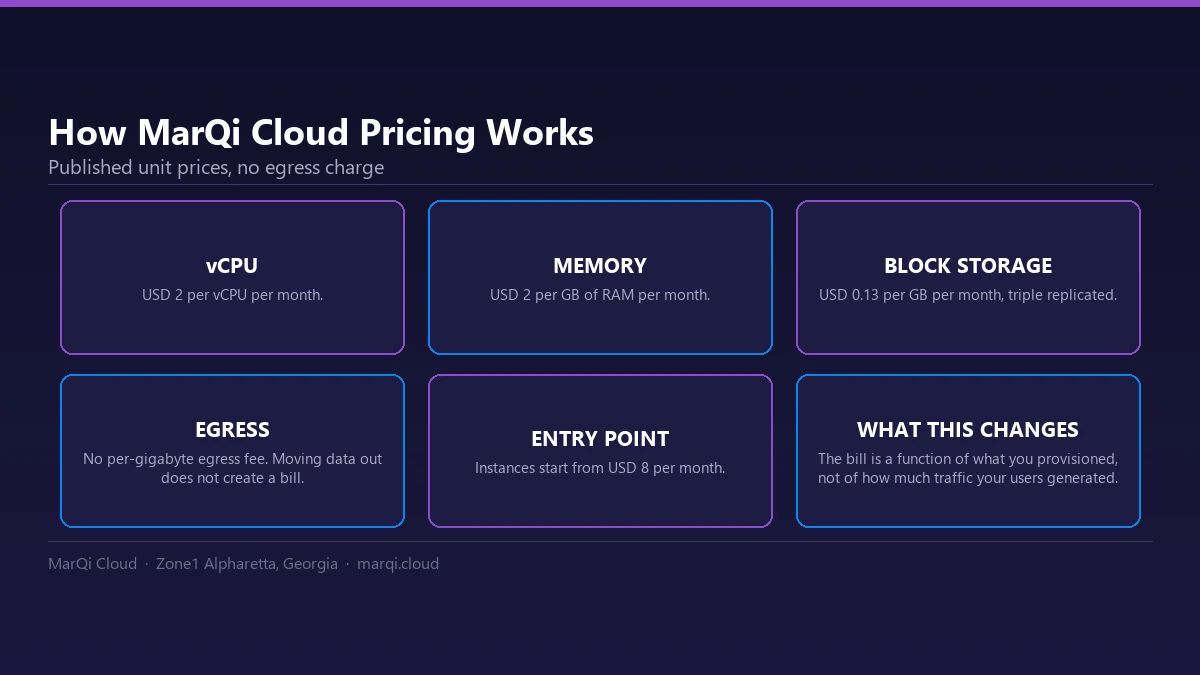
The concept of zero egress fees represents a paradigm shift in the cloud computing landscape. By eliminating these fees, cloud providers like MarQi Cloud are transforming the economics of cloud computing, making it more accessible and budget-friendly for enterprises.
Zero egress fees mean that organizations can transfer data freely without incurring additional costs, allowing for more fluid data movement between applications, users, and external stakeholders. This approach fosters innovation and agility, enabling companies to respond to market demands quickly and efficiently.
Comparative Analysis: Traditional vs. Zero Egress Fee Models
| Feature | Traditional Egress Fee Model | Zero Egress Fee Model |
|---|---|---|
| Cost Predictability | Unpredictable due to variable rates | Highly predictable; no additional costs |
| Budgeting | Complicated by hidden costs | Simplified budgeting with fixed costs |
| Data Transfer Flexibility | Limited by cost concerns | Unlimited data transfer without extra charges |
| Scalability | Hindered by rising egress costs | Enhanced scalability with no financial barriers |
| Innovation | Stifled by budget constraints | Encouraged through free data movement |
This comparison highlights how zero egress fees can revolutionize enterprise cloud economics. By removing the financial barriers associated with data transfer, organizations can harness the full potential of cloud technologies.
Benefits of Zero Egress Fees for Enterprises
The shift towards zero egress fees offers numerous benefits for enterprises:
- Cost Savings: By eliminating egress fees, organizations can save significant amounts on their cloud bills, allowing for reallocation of funds to other critical projects.
- Enhanced Scalability: Organizations can scale their operations without the fear of escalating costs associated with data transfers, enabling them to grow and adapt quickly.
- Increased Flexibility: With zero egress fees, companies can transfer data as needed, facilitating collaboration and integration between applications and services.
- Improved Innovation: Organizations can invest more in innovation, as they can freely experiment with data-driven projects without worrying about the financial implications of data movement.
- Better Budgeting: Predictable costs lead to better financial planning and allocation of resources.
How MarQi Cloud Implements Zero Egress Fees
MarQi Cloud is at the forefront of this transformation, offering enterprise-grade cloud infrastructure without the burden of egress fees. By implementing a zero egress fee model, MarQi Cloud empowers businesses to leverage cloud computing fully.
Organizations can enjoy a transparent pricing structure that eliminates unexpected costs and encourages data mobility. This is particularly beneficial for businesses in sectors such as healthcare, finance, and e-commerce, where data transfer is integral to operations.
For instance, a SaaS company utilizing MarQi Cloud’s infrastructure can seamlessly transfer data between its various applications without incurring additional charges, ultimately improving operational efficiency and customer satisfaction. This approach not only enhances service delivery but also positions MarQi Cloud as a trusted partner for enterprises seeking flexible and scalable cloud solutions.
Conclusion
Zero egress fees represent a significant shift in the economics of enterprise cloud computing. By eliminating these costs, cloud providers like MarQi Cloud are enabling businesses to operate more efficiently and effectively. As organizations continue to embrace digital transformation, the financial advantages of zero egress fees will become increasingly critical in shaping cloud adoption strategies.
Enterprises looking to optimize their cloud investments should consider the benefits of zero egress fees as part of their overall strategy. By aligning with providers that offer transparent and predictable pricing, organizations can unlock the full potential of cloud technologies and drive innovation. To learn more about how MarQi Cloud can help your organization thrive in the cloud, contact us today.
FAQs
What are egress fees?
Egress fees are charges incurred when data is transferred out of a cloud service provider’s infrastructure, impacting the total cost of cloud services.
Why are zero egress fees important?
Zero egress fees eliminate unexpected costs associated with data transfers, allowing organizations to budget more effectively and scale their operations without financial barriers.
How do zero egress fees benefit enterprises?
They provide cost savings, increased scalability, enhanced flexibility, and improved budget predictability, fostering innovation within organizations.
What types of organizations benefit from zero egress fees?
All types of organizations, especially those that rely heavily on data transfer, such as SaaS companies and enterprises in healthcare and finance, can benefit from zero egress fees.
How can MarQi Cloud help with zero egress fees?
MarQi Cloud offers enterprise-grade cloud solutions with zero egress fees, enabling businesses to transfer data freely without incurring additional costs.
Are there any downsides to zero egress fees?
While zero egress fees present numerous advantages, organizations should ensure that they fully understand the pricing model and any potential limitations on data transfer speeds or bandwidth.
How do I calculate potential savings from zero egress fees?
To calculate potential savings, analyze your current data transfer costs and compare them to the projected costs under a zero egress fee model. Use tools provided by cloud service providers to assist with these calculations.
Where can I find more information about cloud pricing models?
For more information, consider visiting resources from authoritative organizations like the NIST or Cloud.gov.