Hybrid-Ready Infrastructure for Modern Cloud Workloads
December 7, 2025
How to Choose the Right Cloud-Native App Development Partner
December 11, 2025

Scaling LLM Training with Dedicated GPU Cluster Solutions
Introduction – Why Scaling LLM Training Matters Today
As Large Language Models (LLMs) continue to advance, the amount of computing power needed to train them is rising just as quickly. This has made reliable, high-performance infrastructure more important than ever for anyone working in AI.
Dedicated GPU Clusters offer the strength and scalability required to support these massive workloads, making it possible to train bigger and more complex models efficiently. In this space, MarQi Cloud provides a strong foundation with its independent data center, powerful storage systems, and fully redundant network fabric—designed to handle large-scale AI training with ease.
What Is a Dedicated GPU Cluster?
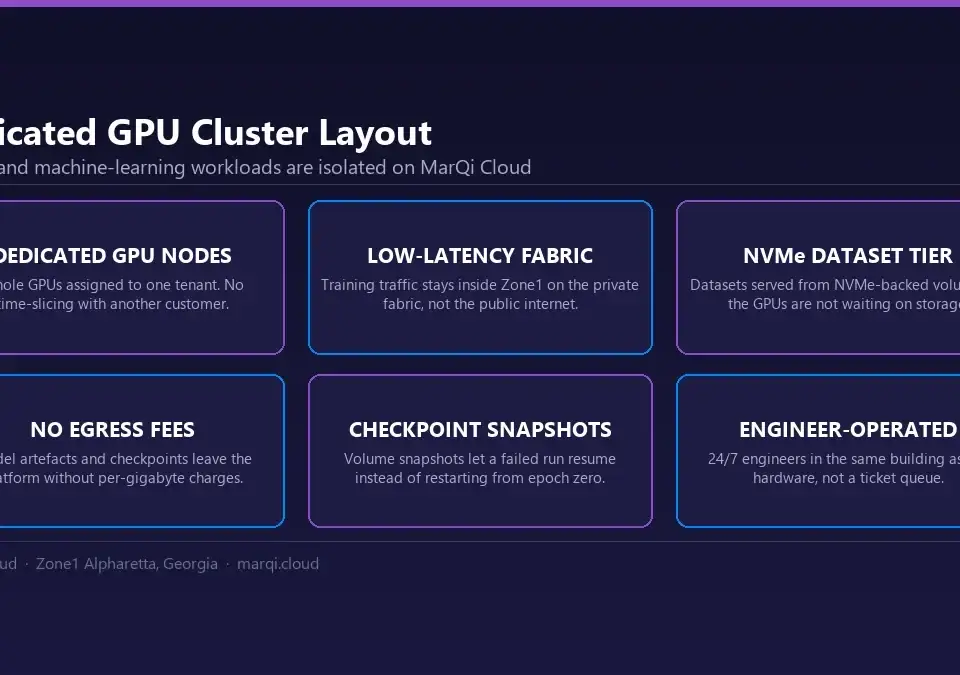
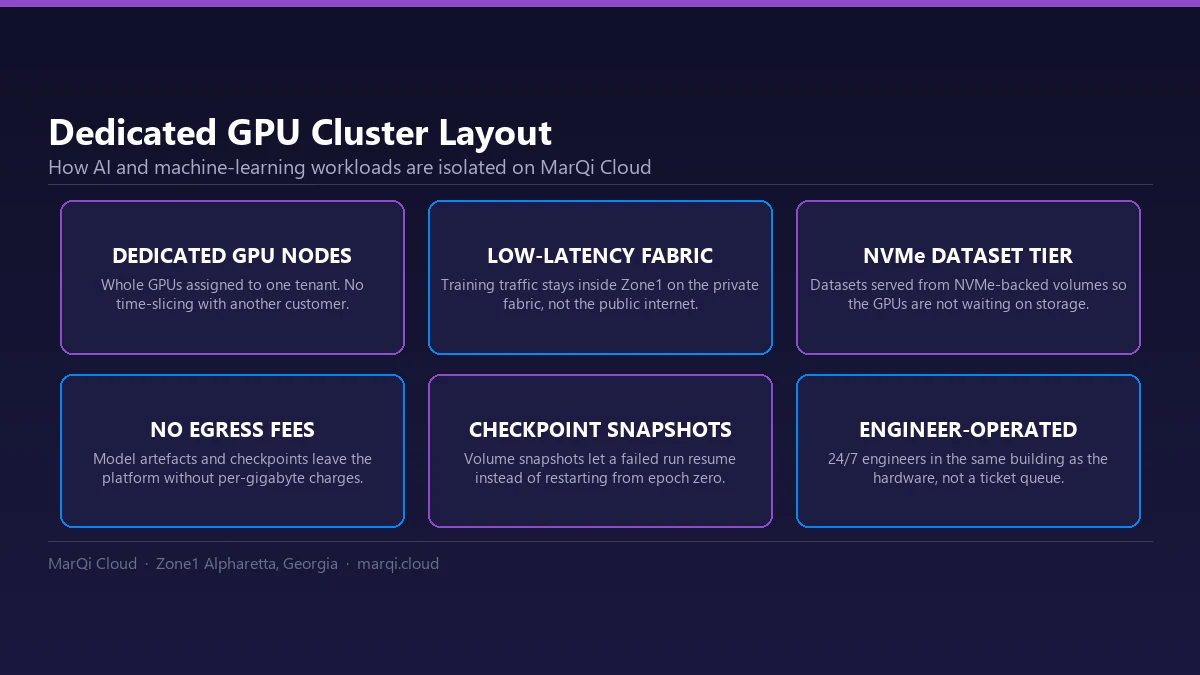
A dedicated GPU cluster is a powerful setup of interconnected servers (nodes), each equipped with high-performance GPUs designed specifically for deep learning, LLM training, and advanced AI workloads. Unlike shared cloud GPU environments where multiple users compete for the same resources, a dedicated cluster is reserved entirely for one organization. This means you get consistent performance, full control, and a secure environment for running large-scale AI and HPC tasks.
Core Components and Architecture
Dedicated GPU clusters are built with several essential components that work together to deliver high-speed, reliable performance:
- High-performance GPUs optimized for training deep learning models, LLMs, and complex neural networks.
- Multi-node compute environment that supports distributed training across multiple machines for faster, efficient results.
- High-speed networking (InfiniBand / 100GbE) to ensure low-latency communication between nodes and seamless scaling.
- High-capacity storage clusters that manage large datasets, model checkpoints, and real-time data.
These core elements allow the cluster to handle heavy computational workloads with ease while maintaining smooth performance at scale.
Why MarQi Cloud Is the Top Choice for Dedicated GPU Clusters
MarQi Cloud provides dedicated GPU clusters designed for fast, reliable, and secure AI workloads, including large language model (LLM) training.
- Independent Data Center: Full control of infrastructure and strong security without third-party dependencies.
- High-Performance Storage: Handles large datasets quickly with redundant design for high availability.
- Reliable Network: Multi-path routing and fail-safe connectivity ensure zero downtime.
- Powerful GPU Clusters: High-density servers, scalable configurations, and support for cloud or hybrid AI deployments.
MarQi Cloud delivers speed, reliability, and security, making it ideal for demanding AI and LLM workloads.
Benefits of Dedicated Clusters with MarQi Cloud
With MarQi Cloud, your dedicated GPU cluster becomes even more powerful and efficient, offering exclusive bare-metal access to next-generation AI hardware.
Predictable, High-Performance Computing
- No competing workloads or resource sharing.
- Guaranteed GPU cycles and memory bandwidth.
- Perfect for LLM training, inference, and HPC operations.
Enhanced Security & Compliance
- Fully isolated infrastructure with reduced attack surface.
- Easier compliance with regulations like HIPAA, PCI DSS, and industry security standards.
- Ideal for sensitive datasets, proprietary models, and enterprise-level AI development.
Cost Efficiency for Heavy Workloads
- Better long-term value for teams with continuous high compute needs.
- Predictable budgeting with no public
Understanding the Costs of Distributed AI Training
Training large AI models is extremely expensive, with costs ranging from thousands of dollars to hundreds of millions, depending on the size of the model and the resources required. As models grow, so do the costs—GPT-3 cost millions to train, GPT-4 ran into tens of millions, and future AI models could reach billions of dollars.
The main factors driving these costs include:
- High-performance hardware: GPUs like NVIDIA A100/H100 or Google TPUs are essential for training.
- Cloud pricing: Costs vary depending on whether you use on-demand, reserved, or spot instances.
- Data requirements: Large-scale datasets require significant storage and preprocessing.
- Model complexity: Bigger, more complex models need longer training times and more compute power.
Because of these demands, distributed AI training is typically feasible only for well-funded companies and large tech organizations.
How MarQi Cloud Helps Control Training Costs
MarQi Cloud provides strategies to optimize costs while maintaining high performance:
Hardware Optimization
- Uses fast, next-generation GPUs like H100s, which reduce training time.
- Faster GPUs may cost more per hour but can lower overall expenses by finishing jobs quicker.
Cloud Savings
- Supports spot instances, reserved capacity, and savings plans to reduce cloud costs.
- Makes large-scale AI training more affordable without sacrificing performance.
Model Efficiency
- Implements methods to reduce data and computation needs.
- Techniques like mixed-precision training, better data sampling, and model pruning cut total compute requirements.
In short, distributed AI training is capital-intensive, with costs increasing sharply as models become more ambitious. MarQi Cloud helps organizations manage these expenses efficiently, making advanced AI training faster, more predictable, and more accessible for serious AI projects.
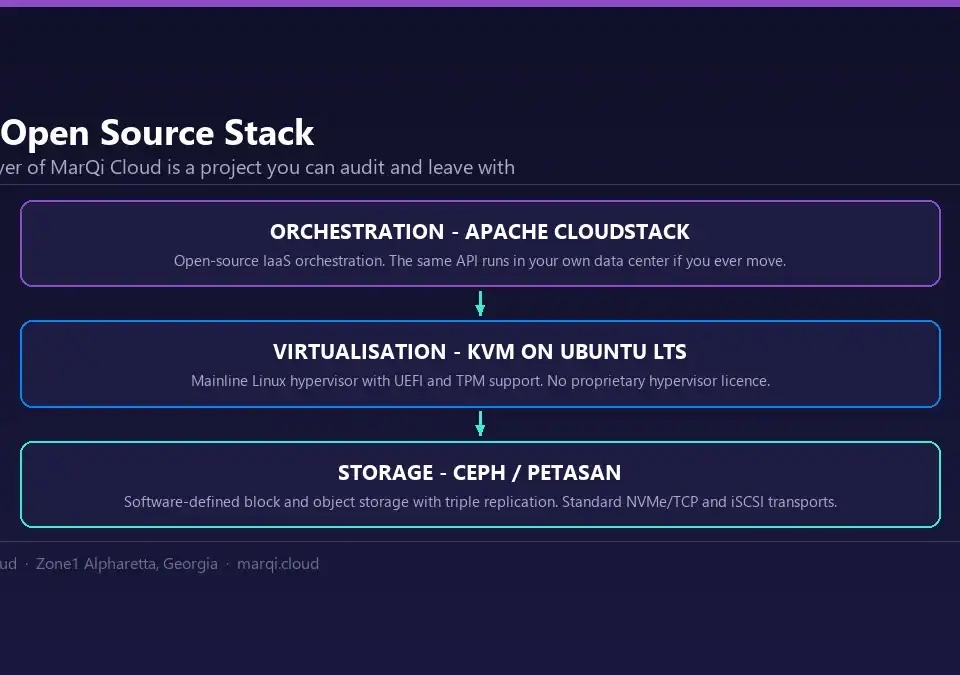
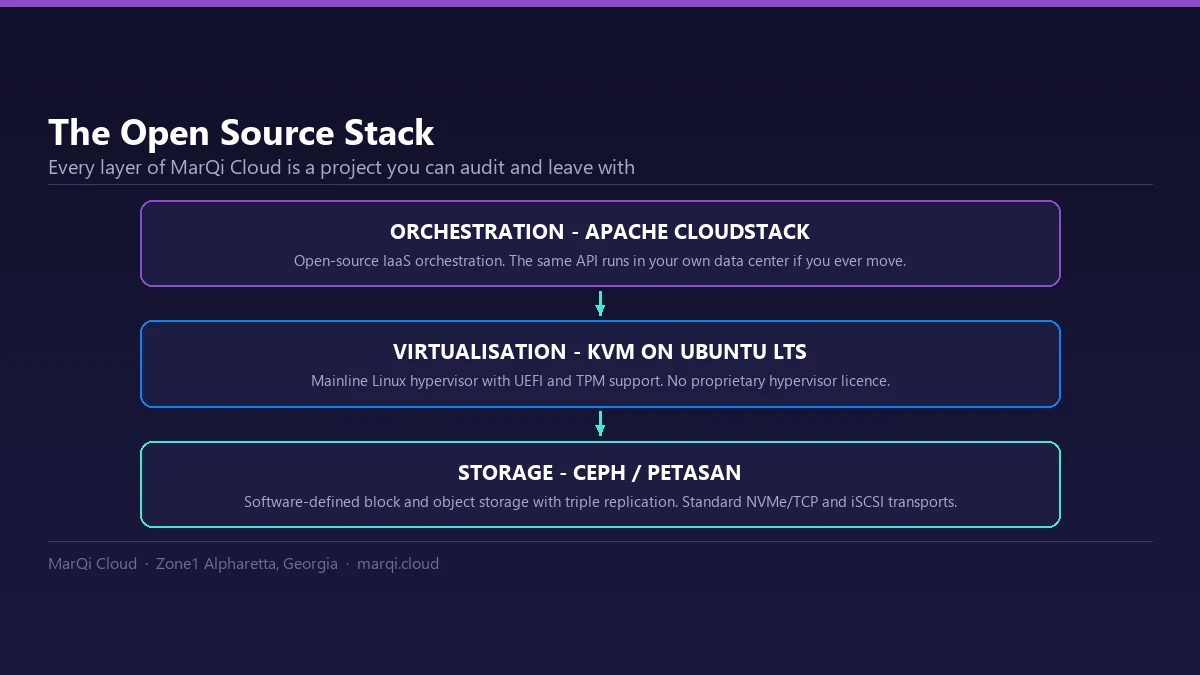
Open Source GPU Cluster Management – Full Control for AI Workloads
Open source GPU cluster management is the practice of using open source software to organize, optimize, and monitor networks of computers equipped with GPUs. These systems are essential for accelerating AI, machine learning (ML), and high-performance computing (HPC) workloads, allowing tasks to run in parallel across multiple GPUs. By leveraging open source GPU cluster management, organizations gain full control over their infrastructure, improve efficiency, and simplify complex AI operations.
Key Functions of Open Source GPU Cluster Management
Open source tools help manage large-scale GPU clusters by providing critical capabilities:
- Resource Scheduling and Allocation: Efficiently assign GPU resources to jobs or users, maximizing utilization and minimizing idle time.
- Monitoring and Observability: Track GPU health, performance, memory usage, and power consumption for proactive optimization.
- Automation: Automate the setup, configuration, scaling, and recovery of cluster nodes and software.
- Container Orchestration: Manage containerized AI workloads for seamless deployment and portability.
- Workload Management: Handle job queues, batch processing, and distributed tasks such as model training, fine-tuning, and inference.
With these features, open source GPU cluster management ensures clusters operate reliably and efficiently, even for demanding AI workloads.
Benefits of Open-Source GPU Cluster Management
Using open source GPU cluster management offers several key advantages:
- Customizable and Transparent: Open code allows full flexibility to adapt to unique AI workloads.
- Cost-Effective: Eliminates expensive licensing fees while delivering powerful features.
- Seamless AI/ML Integration: Built-in support for machine learning frameworks and distributed training pipelines.
By adopting open source GPU cluster management, organizations can efficiently run large-scale AI and HPC workloads while maintaining full control over their hardware and software infrastructure, reducing costs, and improving scalability.
GPU Cloud for LLM Training – On-Demand Power and Flexibility
A GPU cloud for LLM training provides access to powerful remote servers equipped with GPUs over the internet, enabling organizations to train, fine-tune, and deploy large language models (LLMs) like ChatGPT efficiently. Unlike traditional CPU-based setups, GPUs deliver massive parallel processing power, drastically reducing training times. Platforms such as AWS, Google Cloud, Azure, and specialized providers like MarQi Cloud enable developers to scale resources on demand and pay only for what they use, making high-performance AI accessible without the need for costly on-premises hardware.
How GPU Cloud for LLM Training Works
- Access: Connect securely to the cloud provider’s GPU infrastructure over the internet.
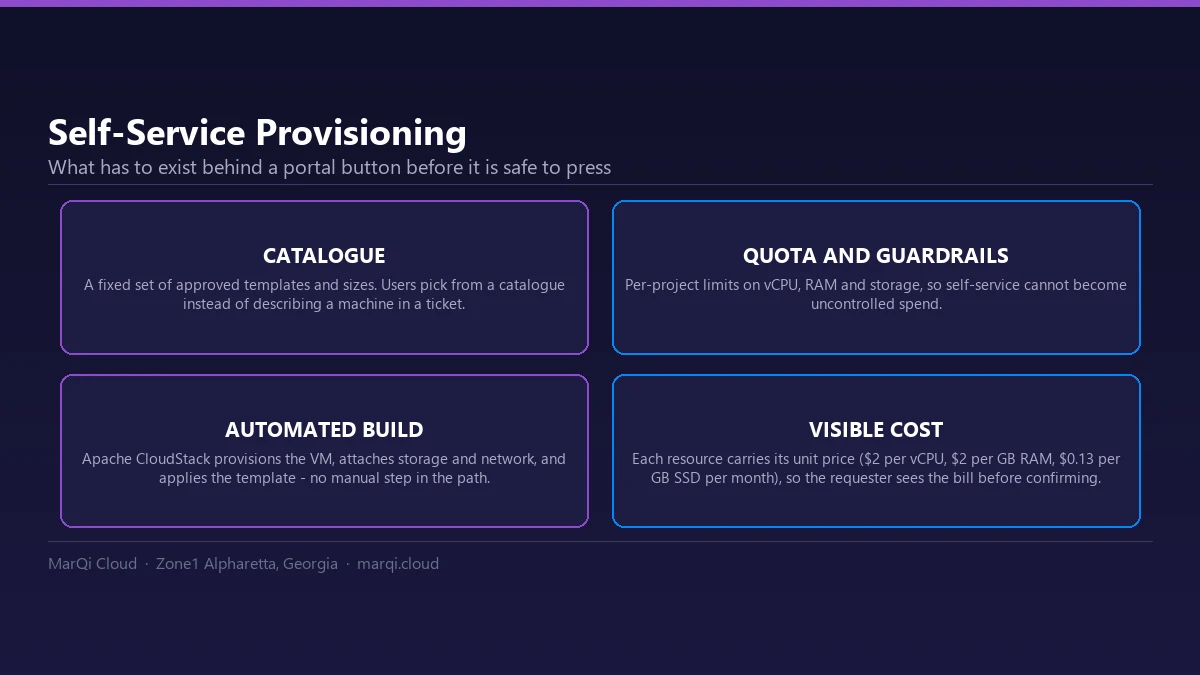
- Provision: Request virtual machines with high-end GPUs like NVIDIA H100 or A100 via a web interface or API.
- Develop: Run LLM training scripts using frameworks like PyTorch or TensorFlow.
- Scale: Easily expand or reduce GPU resources based on model size and computational needs.
Benefits of GPU Cloud Solutions
- Instant Access: Get powerful GPUs ready in minutes, no setup required.
- Elastic Scalability: Expand resources for peak workloads and scale down when not needed.
- Cost-Effective: Avoid large upfront hardware costs with pay-as-you-go models.
- Managed Infrastructure: Providers handle hardware maintenance, letting teams focus entirely on model development.
Why Choose MarQi Cloud for GPU LLM Training
MarQi Cloud offers specialized GPU cloud solutions designed for large-scale AI and LLM workloads, providing a unique combination of performance, reliability, and flexibility:
- Cutting-Edge GPUs: Access NVIDIA H100 and A100 GPUs optimized for LLM training and deep learning.
- Scalable Resources: Instantly increase or decrease GPU capacity to match project demands.
- Cost Efficiency: Pay only for what you use, reducing operational costs compared to owning hardware.
- Secure & Reliable: Fully managed infrastructure with redundant networking and robust security.
- Optimized for AI Workflows: Supports distributed training, fine-tuning, and inference with seamless integration into ML pipelines.
How MarQi Cloud Supports AI Workflows
- Data Preprocessing: Handle large datasets quickly and efficiently.
- Model Training: Train LLMs faster with scalable GPU resources.
- Validation & Fine-Tuning: Optimize models effectively using high-performance GPUs.
A GPU cloud for LLM training, especially through MarQi Cloud, gives organizations the speed, scalability, and flexibility needed to develop cutting-edge AI models. By combining high-performance hardware with managed infrastructure and cost-effective pricing, MarQi Cloud makes advanced AI development accessible, efficient, and reliable.
Hybrid Cloud AI – Smarter, Flexible AI Workloads
Hybrid Cloud AI combines public cloud, private cloud, and on-premises resources to run AI workloads efficiently. It allows organizations to place workloads where they make the most sense, training large models in the scalable public cloud while keeping sensitive data on-premises for security and compliance. MarQi Cloud’s Hybrid Cloud AI makes this seamless, managing the movement of data and workloads automatically to ensure efficiency, cost savings, and high performance.
How MarQi Cloud’s Hybrid Cloud AI Works
- Unified Management: MarQi Cloud connects public clouds (like AWS, Azure, or GCP) with private clouds and your on-premises servers. You manage everything through a single dashboard with consistent APIs.
- Smart Workload Placement: Large AI models can be trained in the public cloud, then deployed on-premises for sensitive tasks. The system decides where to run workloads based on efficiency, cost, and security.
- Data Gravity Handling: Data stays where it is—no unnecessary transfers. MarQi Cloud brings AI processing to the data, keeping sensitive information secure while still using the cloud for heavy computations.
Key Benefits of Hybrid Cloud AI with MarQi Cloud
- Adaptable & Expandable: Quickly adjust GPU resources as needed.
- Cost Optimization: Run workloads in the most economical environment, cloud for heavy training, on-premises for secure processing.
- Security & Compliance: Sensitive data remains on-premises or in private clouds to meet regulations, while non-sensitive workloads use public cloud resources.
- Innovation: Easily support advanced AI like large language models (LLMs), predictive analytics, generative AI, and automation.
How MarQi Cloud Combines On-Premise and Cloud GPU Clusters
- Workloads run seamlessly across on-premise servers and cloud GPU clusters.
- MarQi Cloud automatically optimizes for both cost and performance.
- Temporary GPU expansion in the cloud handles bursts of AI training without affecting on-site resources.
Use Cases for MarQi Cloud’s Hybrid AI
- Burst AI Training Jobs: Train large models in the cloud without overloading local hardware.
- Sensitive Data Training: Keep regulated or private data secure while still using cloud power for heavy computation.
- Temporary GPU Expansion: Quickly scale up GPU resources on-demand for large or complex AI workloads.
MarQi Cloud’s Hybrid Cloud AI gives organizations the best of both worlds: the scalability and speed of the public cloud for training massive models, and the security and control of on-premises infrastructure for sensitive tasks. It makes AI operations faster, smarter, and more cost-effective, letting teams focus on building and improving models instead of managing complex infrastructure.
Conclusion
Dedicated GPU clusters are at the core of AI innovation, providing the speed and reliability needed to train large language models (LLMs). With hybrid cloud solutions and open-source GPU cluster management, AI workloads can be scaled easily, securely, and cost-effectively.
MarQi Cloud gives businesses, researchers, and enterprises a powerful, AI-ready infrastructure. Its high-performance GPU clusters, flexible cloud options, and managed services help teams train models faster, simplify workflows, and stay ahead in the world of AI.