
Private Circuits & Peering: How to Connect Your Data Center to Your Cloud (Without the Internet)
February 19, 2026
KVM Virtualization for Enterprises: Why It’s Still a Power Move
February 19, 2026
GPU Cloud for AI/ML: Training vs Inference—How to Choose the Right Cluster
In the evolving landscape of artificial intelligence (AI) and machine learning (ML), the demand for high-performance computing resources has surged. As organizations increasingly rely on data-driven insights, the significance of GPU cloud infrastructure for AI/ML applications cannot be overstated. This article explores the differences between training and inference in AI/ML, and how to select the appropriate GPU cloud cluster for your needs.
Understanding AI/ML Workloads
Before delving into the specifics of GPU cloud clusters, it’s essential to understand the two primary phases of AI/ML workloads: training and inference.
Training
Training is the process of teaching a machine learning model using large datasets. This phase involves running algorithms that adjust model parameters to minimize errors in predictions. Training typically requires significant computational power, as it involves complex mathematical calculations and iterations across vast datasets.
Inference
Inference, on the other hand, refers to the phase where the trained model makes predictions or classifications based on new input data. Inference requires less computational power than training but must be optimized for speed and efficiency, especially in real-time applications.
The Role of GPUs in AI/ML
Graphics Processing Units (GPUs) are pivotal in accelerating both training and inference processes in AI/ML. Their architecture allows them to handle multiple operations simultaneously, making them ideal for the parallel processing required in machine learning tasks.
Benefits of Using GPU Cloud
- Scalability: GPU cloud solutions allow organizations to scale resources up or down based on demand, providing flexibility in managing workloads.
- Cost-Effectiveness: By utilizing cloud infrastructure, organizations can avoid the high upfront costs of purchasing and maintaining physical hardware.
- Performance: GPU cloud services often provide access to the latest GPU technologies, ensuring optimal performance for AI/ML tasks.
Choosing the Right GPU Cluster: Training vs Inference
When selecting a GPU cloud cluster, it’s crucial to consider whether the primary use case is training or inference. Each task has different requirements and considerations.
Considerations for Training Clusters
Training clusters should be designed for high performance and resource availability. Key factors include:
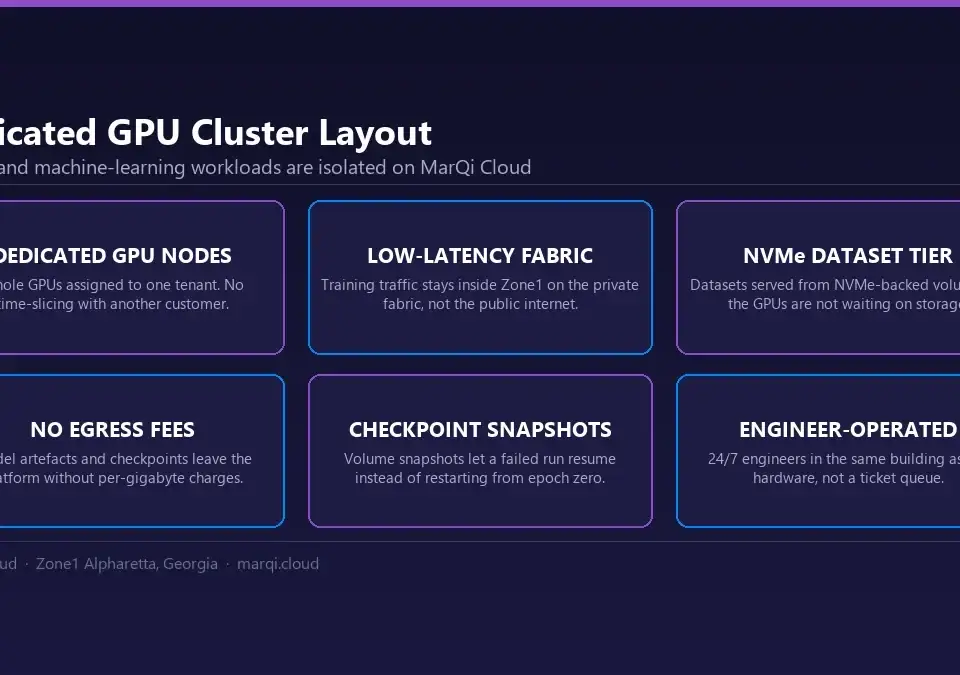
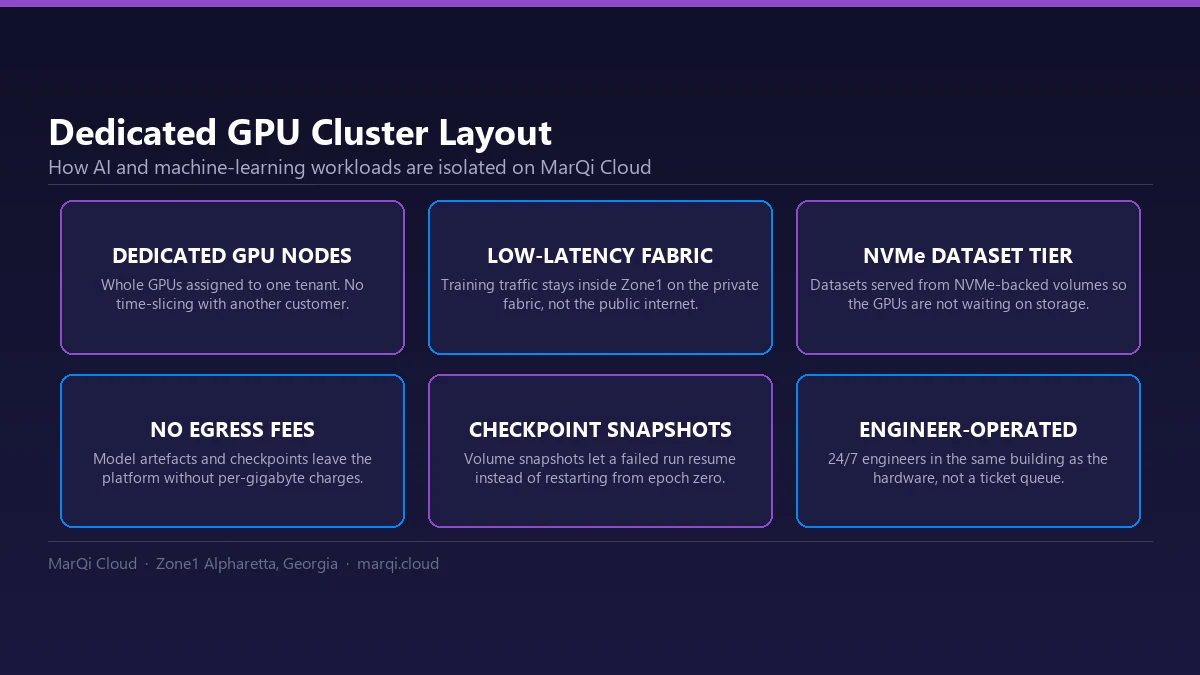
- GPU Type: Select high-end GPUs designed for deep learning tasks, such as NVIDIA A100 or V100.
- Memory Requirements: Ensure sufficient GPU memory to handle large datasets and complex models.
- Network Bandwidth: High-speed network connectivity is essential to facilitate data transfer between GPUs and storage.
- Storage Solutions: Utilize fast storage solutions such as NVMe SSDs to reduce data loading times.
Considerations for Inference Clusters
Inference clusters focus on speed and efficiency. Important factors to consider include:
- Latency: Choose configurations that minimize latency to ensure quick response times for real-time applications.
- Cost Efficiency: Optimize for cost by selecting lower-tier GPUs that still meet performance benchmarks.
- Scalability: Ensure the cluster can scale to handle varying loads, especially during peak usage times.
- Deployment Options: Consider using serverless architectures or containers for flexible deployment of inference models.
Hybrid Cloud Solutions for Flexibility
Many organizations are adopting hybrid cloud solutions to balance the benefits of public and private cloud infrastructures. This approach allows businesses to:
- Utilize Public Clouds for Training: Leverage public cloud resources for high-demand training tasks.
- Implement Private Clouds for Inference: Use private cloud environments to maintain control over sensitive data during inference processes.
Performance Optimization Strategies
Regardless of whether you are focusing on training or inference, optimizing performance is key. Here are some strategies to consider:
For Training
- Distributed Training: Implement distributed training techniques to leverage multiple GPUs across different machines.
- Data Augmentation: Enhance the training dataset through augmentation techniques, which can improve model accuracy.
For Inference
- Model Optimization: Utilize model quantization and pruning techniques to reduce the model size and improve inference speed.
- Batch Processing: Implement batch processing to handle multiple inference requests simultaneously, increasing throughput.
Conclusion
Selecting the right GPU cloud cluster for AI/ML applications hinges on understanding the distinct requirements of training and inference processes. By evaluating your specific needs and leveraging the appropriate cloud infrastructure, you can optimize performance and drive more effective outcomes for your AI initiatives.
FAQ
1. What is the difference between training and inference in AI/ML?
Training involves teaching a model using data, while inference is the process of making predictions based on that trained model.
2. Why are GPUs important for AI/ML tasks?
GPUs are designed for parallel processing, making them highly effective for the computations required in AI/ML tasks.
3. How do I know if I need a GPU cluster for my AI/ML projects?
If your projects involve large datasets and complex models, a GPU cluster can significantly speed up training and inference.
4. What are the benefits of using a cloud-based GPU solution?
Cloud-based GPU solutions offer scalability, cost-effectiveness, and access to the latest technology without the need for physical hardware.
5. Can I use the same GPU cluster for both training and inference?
While possible, optimizing a cluster for specific tasks can lead to better performance. Consider separate configurations for each task.
6. What are some common GPU models used for AI/ML?
Popular GPU models include NVIDIA A100, V100, and T4, each designed for different levels of performance and workload types.
7. How can I optimize my training process?
Consider using distributed training, data augmentation, and optimizing hyperparameters to improve your training efficiency.
8. What is a hybrid cloud solution?
A hybrid cloud solution combines public and private cloud infrastructures, allowing organizations to leverage the benefits of both for different workloads.
9. How do I determine the right pricing model for GPU cloud resources?
Evaluate your usage patterns and budget. Many providers offer flexible pricing models, including pay-as-you-go and reserved instances.
10. What is model optimization, and why is it important?
Model optimization involves techniques to enhance model performance and efficiency, which is crucial for faster inference and reduced resource utilization.