Unveiling the Atlanta AI Market Growth Statistics: Trends and Insights
March 28, 2026
Cost Savings with Dedicated GPU Clusters: Unlocking Efficiency and Performance
March 28, 2026
Understanding GPU Hosting SLAs: What You Need to Know
As businesses increasingly rely on high-performance computing for tasks such as artificial intelligence, machine learning, and data analysis, the demand for GPU hosting has surged. However, with this demand comes the necessity for a clear understanding of Service Level Agreements (SLAs) associated with GPU hosting services. This article will explore what GPU Hosting SLAs are, why they matter, and how to choose the right provider for your needs.
What is GPU Hosting?
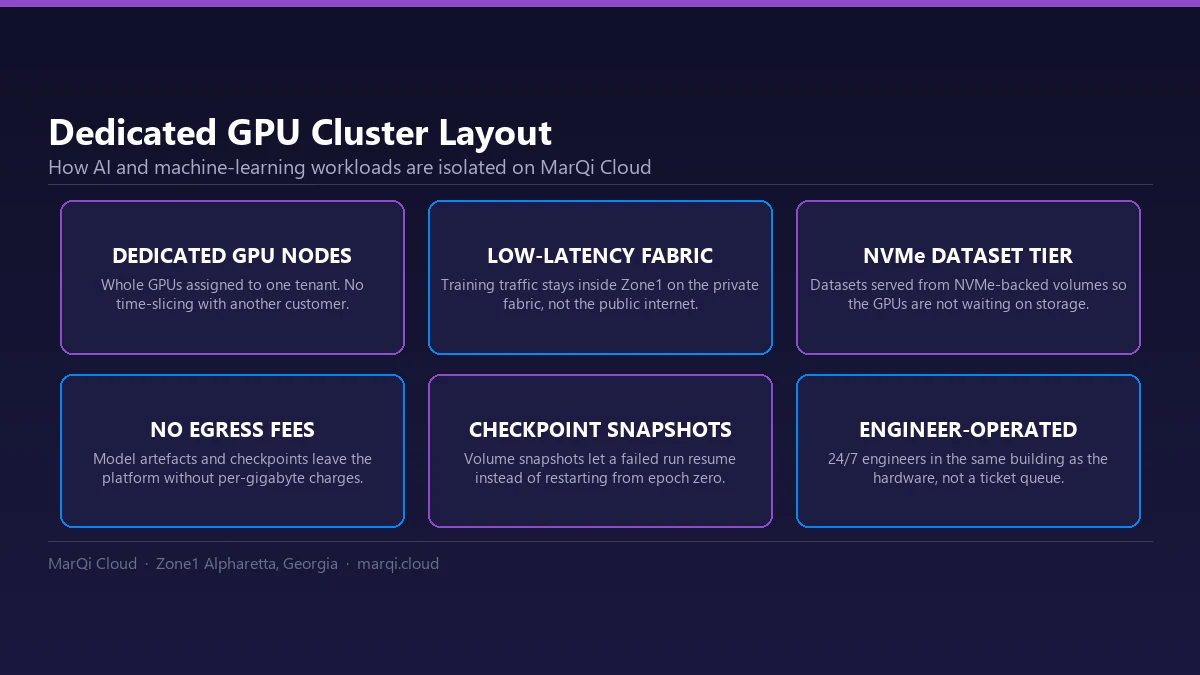
GPU hosting refers to the provision of computing resources that are equipped with Graphics Processing Units (GPUs). Unlike traditional CPU hosting, GPU hosting is tailored to handle complex calculations and data processing tasks that require parallel processing capabilities. This makes it ideal for:
- Machine Learning and AI Model Training
- 3D Rendering and Graphics Processing
- Big Data Analytics
- Gaming and Game Development
GPU hosting empowers businesses to leverage powerful computing resources without the need for significant upfront investment in hardware.
What is a Service Level Agreement (SLA)?
A Service Level Agreement (SLA) is a formal contract between a service provider and a customer that outlines the expected level of service. It details the services provided, performance metrics, and the consequences if the agreed-upon standards are not met. In the context of GPU hosting, an SLA typically includes:
- Uptime Guarantees
- Performance Benchmarks
- Support Response Times
- Security Measures
- Data Backup and Recovery Procedures
Key Components of GPU Hosting SLAs
1. Uptime Guarantees
One of the most critical components of any SLA is the uptime guarantee. Uptime refers to the amount of time that the services are operational and available to users. Most reputable GPU hosting providers offer uptime guarantees of 99.9% or higher. This metric is crucial for businesses that rely on continuous access to their GPU resources.
2. Performance Benchmarks
Performance benchmarks are metrics that define the expected performance levels of the hosted GPU resources. These benchmarks may include:
- GPU type and specifications (e.g., NVIDIA, AMD)
- Compute power (measured in teraflops)
- Memory capacity
- Network bandwidth
Understanding these benchmarks is essential for ensuring that the GPU hosting service meets the specific needs of your applications.
3. Support Response Times
In the event of an issue with the GPU hosting service, timely support is crucial. SLAs typically specify the response times for different levels of support requests. For example, critical issues might have a response time of less than one hour, while non-critical issues may have a response time of 24 hours or more. Choosing a provider with robust support response times can significantly reduce downtime and ensure business continuity.
4. Security Measures
Security is a top concern for businesses utilizing GPU hosting services, especially when handling sensitive data. SLAs should detail the security measures in place, including:
- Data encryption
- Access controls
- Firewalls and intrusion detection systems
- Compliance with industry standards (e.g., GDPR, HIPAA)
A thorough understanding of the security measures outlined in the SLA will help businesses mitigate risks associated with data breaches and other security threats.
5. Data Backup and Recovery Procedures
Data loss can have devastating effects on a business. Therefore, it is critical to evaluate the data backup and recovery procedures included in the SLA. Key aspects to consider include:
- Frequency of backups
- Storage locations for backups
- Restoration time objectives (RTO)
- Restoration point objectives (RPO)
These elements will help ensure that your data is protected and can be restored in a timely manner in case of an incident.
Why GPU Hosting SLAs Matter
Understanding GPU hosting SLAs is vital for several reasons:
- Risk Management: Knowing what to expect from your GPU hosting provider helps you manage risks associated with service interruptions and data loss.
- Performance Assurance: A well-defined SLA provides assurance that the GPU hosting service will meet your performance needs, which is crucial for resource-intensive applications.
- Accountability: SLAs hold service providers accountable for their performance and service delivery, providing recourse if they fail to meet agreed-upon standards.
How to Choose the Right GPU Hosting Provider
When selecting a GPU hosting provider, consider the following factors:
1. Assess Your Needs
Before evaluating providers, assess your specific needs, including the type of applications you plan to run, performance requirements, and budget constraints. This will help you narrow your options.
2. Compare SLAs
Review the SLAs of different providers. Look for clear and specific terms regarding uptime, performance, support, and security. Pay attention to any penalties or credits offered for service level failures.
3. Evaluate Customer Support
Test the responsiveness of customer support by reaching out with questions. Choose a provider that offers multiple channels for support, such as phone, email, and live chat.
4. Read Customer Reviews
Research customer reviews and case studies to gauge the reliability and performance of potential providers. Look for feedback that aligns with your specific needs and concerns.
5. Consider Scalability
Your business may grow, and your GPU hosting needs may change. Choose a provider that offers scalable solutions, allowing you to easily adjust resources as needed.
Conclusion
In today’s data-driven landscape, understanding the importance of GPU hosting SLAs is essential for businesses looking to leverage high-performance computing. By thoroughly evaluating SLAs, assessing your specific needs, and choosing a reputable provider, you can ensure that your GPU hosting services align with your business goals while mitigating risks associated with performance and security.
FAQs
1. What is the typical uptime guarantee for GPU hosting services?
Most reputable providers offer uptime guarantees of 99.9% or higher.
2. What are the key components of a GPU hosting SLA?
Key components include uptime guarantees, performance benchmarks, support response times, security measures, and data backup procedures.
3. Why is performance benchmarking important in GPU hosting?
Performance benchmarks ensure that the GPU resources meet the specific needs of your applications.
4. How can I ensure data security in GPU hosting?
Review the security measures outlined in the SLA, including data encryption and access controls.
5. What should I look for in customer support from a GPU hosting provider?
Look for responsive support across multiple channels and clear support response time commitments in the SLA.
6. What are RTO and RPO in data recovery?
RTO is the maximum acceptable time to restore data, while RPO is the maximum acceptable data loss measured in time.
7. Can I scale my GPU hosting resources as my business grows?
Choose a provider that offers scalable solutions to adjust resources as needed.
8. What should I do if my GPU hosting provider fails to meet SLA commitments?
Refer to the SLA for any penalties or credits and consider discussing the issues directly with the provider.