Hybrid Cloud Architecture: How to Design a Scalable and Resilient Infrastructure
May 1, 2026
The MarQi Cloud Pricing Calculator: Build Your Stack and See the Total Before You Buy
May 1, 2026

Cloud Infrastructure Security for Startups: What You Need to Protect from Day One
How do I secure my startup's cloud infrastructure?
Start with identity: enforce MFA, remove shared accounts, and give every service its own least-privilege role. Then close the network edge, encrypt data in transit and at rest, centralise logs so an incident can be reconstructed, and automate backups with a restore you have actually tested at least once.
Most startups think about security the same way — later. Ship the product first, lock things down when there is more time, more budget, and more people. That logic has a consistent outcome: breaches, compliance failures, and costly rework that could have been avoided entirely.
The reality is that cloud infrastructure for startups does not come secured by default. Every cloud environment is open until you configure it otherwise. And the longer you wait, the more technical debt piles up around insecure defaults, over-permissioned accounts, and unmonitored access paths.
This guide covers the security decisions you need to make from day one — not when you reach Series B.
Why Startup Cloud Security Is a Different Problem
Startups operate under constraints that larger organizations do not face. Small teams wear multiple hats. There is rarely a dedicated security engineer in the first two years. And speed — getting to market, shipping features, closing deals — consistently outranks security in sprint planning.
That pressure creates specific vulnerabilities. Shared admin credentials. Public S3 buckets left open during testing and never closed. API keys committed to version control. These are not exotic attack vectors. They are the most common causes of cloud breaches in 2026, and they affect startups disproportionately because the shortcuts that feel small early on compound into serious exposure as the product scales.
The starting point is accepting that security and speed are not opposites. When you build on the right cloud infrastructure for startups — one that has secure defaults, proper tooling, and transparent cloud pricing with no hidden fees — you move faster, not slower, because you are not constantly cleaning up incidents that should never have happened.
Layer 1: Identity and Access Management
Access control is where most cloud security failures begin. If the wrong person — or the wrong automated process — has too much permission, everything else becomes harder to protect.
The foundational principle is least privilege: every user, service account, and automated process should have exactly the permissions it needs to do its job and nothing more. No shared root accounts. No “admin everything” roles handed out because it was easier than scoping permissions correctly.
Practical steps for startups:
- Use multi-factor authentication (MFA) on every account, starting with admin accounts and extending to all team members.
- Separate environments from the start. Development, staging, and production should have distinct accounts with distinct permission sets. A misconfiguration in dev should not be able to touch production data.
- Audit permissions quarterly. Roles that made sense at five employees often become dangerously broad at fifty. Build a review cadence before you need one.
- Use short-lived credentials over static access keys. Rotate regularly and revoke immediately when team members leave.
Layer 2: Network Security
Your network configuration determines how exposed your environment is by default. In cloud environments, this means security groups, firewall rules, and network segmentation — and the default setting on most platforms is more open than any startup should be comfortable with.
Key network security decisions to lock down early:
- Never expose databases directly to the public internet. Use private subnets and bastion hosts or VPN-based access for any direct database connections.
- Segment your network. Separate workloads into distinct network zones. If an attacker compromises one service, segmentation limits how far they can move laterally. That containment is the whole point of the design — how network segmentation stops lateral movement goes through the patterns in detail.
- Restrict inbound ports aggressively. Only open what is actively in use. Every open port that is not needed is an unnecessary attack surface.
- Use a Zero Trust model for internal traffic. Do not assume that traffic inside your network is safe. Every request — internal or external — should be authenticated and authorized before access is granted.
When evaluating an open source cloud platform provider, look for one that gives you visibility into network configuration and enforces secure defaults out of the box rather than leaving everything open until you manually close it.
Layer 3: Data Protection
Data is what attackers are after. Protecting it means encrypting it, controlling who can access it, and knowing exactly where it lives at all times.
Encrypt everything — at rest and in transit. Most cloud providers offer encryption by default for storage services, but verify it is actually enabled rather than assuming. For data in transit, enforce TLS 1.2 or higher across all services and APIs.
Manage secrets properly. API keys, database passwords, and service credentials should never live in environment files, version control, or hard-coded in application code. Use a dedicated secrets manager — HashiCorp Vault, AWS Secrets Manager, or the equivalent on your platform — from your first production deployment.
Classify your data early. Not all data carries the same risk. Knowing which data is personally identifiable, which is financial, and which is publicly safe informs where it should be stored, who can access it, and how it should be handled during a breach or audit.
Layer 4: Choosing the Right Cloud Platform
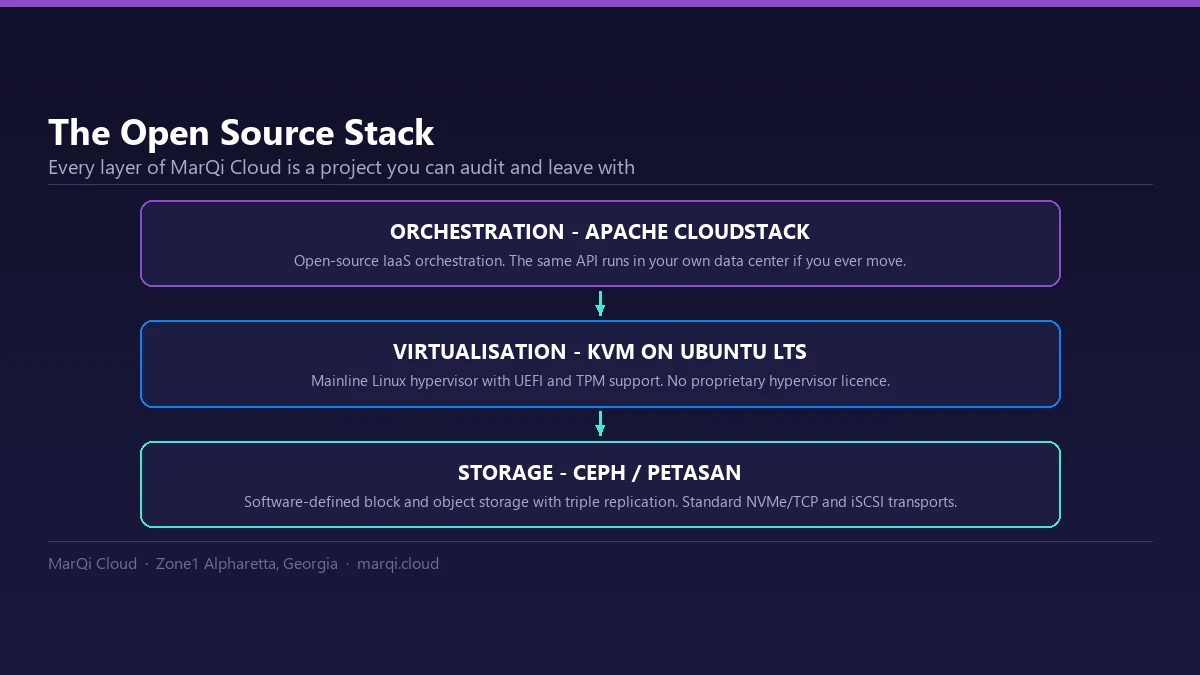
The platform you build on shapes your security posture from the start. This is where choosing an open source cloud platform provider has real advantages for startups — open source infrastructure tooling is auditable, has no black-box dependencies, and typically has a larger community catching and patching vulnerabilities.
When evaluating platforms, look for:
- Transparent cloud pricing with no hidden fees. Surprise egress charges and opaque billing structures are not just a financial problem — they make it harder to scope your infrastructure correctly, which creates security blind spots. A platform with transparent cloud pricing and no hidden fees gives you clear visibility into what you are running and what it costs, which supports better infrastructure hygiene.
- Built-in compliance tooling. SOC 2, ISO 27001, and GDPR requirements are not going away. A platform that bakes compliance monitoring into the infrastructure rather than requiring you to bolt it on separately saves significant time and reduces audit risk.
- Strong IAM and network controls. The platform should make secure defaults easy, not something you have to fight the tooling to achieve.
Layer 5: AI Workload Security
As more startups integrate machine learning into their products, AI infrastructure introduces a new category of security concern. Training data contains sensitive information. Model endpoints are exposed services that need protection. GPU-intensive workloads can rack up significant cost if a billing anomaly goes undetected.
For startups building AI products, choosing a cloud platform with GPU AI managed services matters for security as much as performance. A cloud platform with GPU AI managed services that handles patching, monitoring, and access control for GPU instances reduces the surface area your team needs to manage directly — critical when you do not have a dedicated ML infrastructure engineer.
Key AI-specific security considerations:
- Restrict access to model training pipelines and data pipelines the same way you would production databases.
- Monitor inference endpoints for unusual traffic patterns that could indicate abuse or data extraction attempts.
- Audit what data is being used for training and where it is stored — especially if it includes user-generated content.
Layer 6: Monitoring and Incident Response
You cannot respond to an incident you cannot see. Continuous monitoring is not optional at any stage — it is how you know when something is wrong before a customer or a regulator tells you.
At minimum, startups should have:
- Centralized logging across all services and environments, with log retention policies that align with your compliance requirements.
- Alerting on anomalous behavior — unusual login locations, unexpected data exports, permission escalation attempts, and traffic spikes to sensitive endpoints.
- A documented incident response plan, even a simple one. Who gets paged? What is the first step? Who has authority to take a service offline? These decisions should not be made for the first time during an active breach.
Tools like Datadog, Grafana, and cloud-native monitoring services make this achievable for small teams without a full-time security operations function.
Layer 7: Compliance as Infrastructure, Not Paperwork
Compliance is not something you prepare for when a customer asks for your SOC 2 report. It is an ongoing state your infrastructure should always be in.
For startups targeting enterprise customers or operating in regulated industries, compliance requirements arrive earlier than most founders expect. Building compliant infrastructure from the start — encrypted storage, audit logs, access controls, data residency controls — is significantly cheaper than retrofitting it later under deadline pressure.
Automated compliance tools like Vanta continuously check your infrastructure against security rules and produce audit evidence as a byproduct of normal operations. This approach eliminates most of the manual overhead that makes compliance feel like a burden.
Conclusion
Building secure cloud infrastructure for startups does not require a security team or an enterprise budget. It requires making the right decisions early — on identity, network, data, and platform — and treating security as a property of your infrastructure rather than a layer added on top.
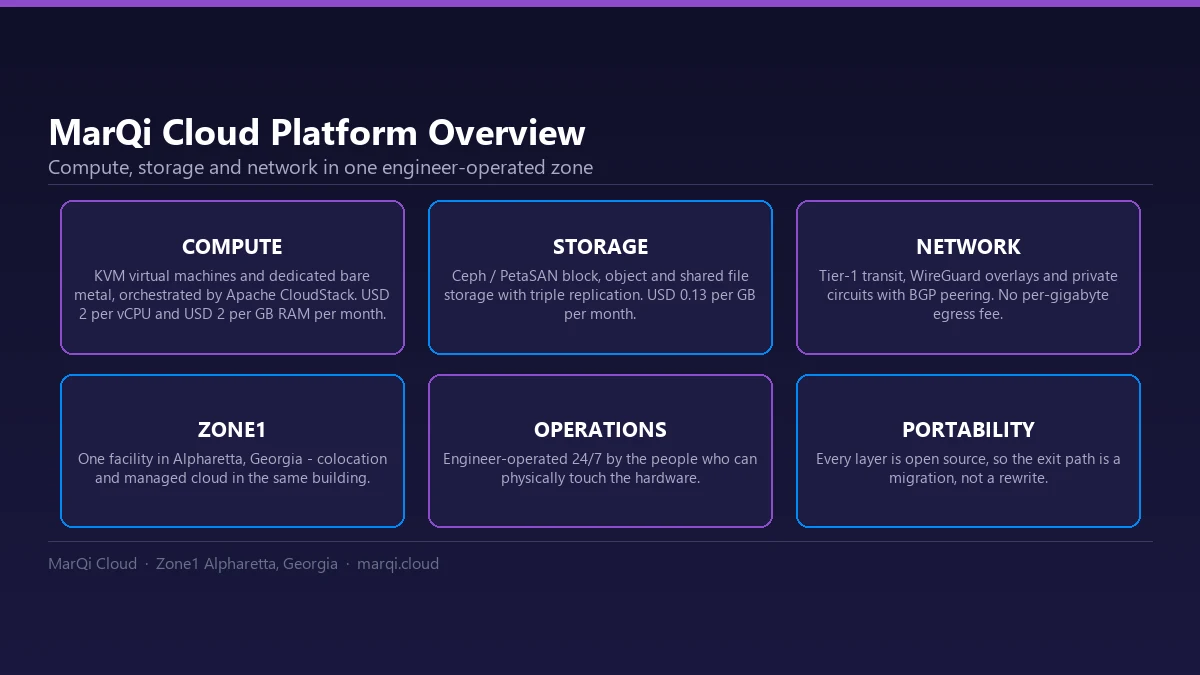
If you are looking for a platform built with startup security needs in mind — one with an open source cloud platform provider model, transparent cloud pricing with no hidden fees, and a cloud platform with GPU AI managed services for teams building AI products — MarQi Cloud is worth exploring as a foundation for your cloud infrastructure from day one.
Frequently Asked Questions
What should a startup secure first in cloud infrastructure?
Identity, before anything else. Access control is where most cloud security failures begin: if the wrong person – or the wrong automated process – holds more permission than the job needs, every other control becomes harder to rely on. Once identity is tight, the next layer is the network, because the default settings on most platforms are more open than a small team would choose deliberately: security groups, firewall rules and segmentation decide how exposed the environment is before any attacker does anything clever. Data protection – encryption and knowing exactly where data lives – follows from those two.
Do you need a dedicated security engineer to run secure cloud infrastructure?
No, and most startups do not have one in the first two years. What secure infrastructure actually requires is a small number of decisions made early and kept: least privilege on identity, segmentation so one compromised service cannot reach everything, encryption for data at rest and in transit, a platform whose behaviour you can inspect, and monitoring that tells you something is wrong before a customer does. None of those need a security team or an enterprise budget – they need to be decided before the environment grows past the point where changing them is expensive.