The MarQi Cloud TCO Report: What 12 Months of Hosting Actually Costs You
April 30, 2026
Cloud Infrastructure Security for Startups: What You Need to Protect from Day One
May 1, 2026

Hybrid Cloud Architecture: How to Design a Scalable and Resilient Infrastructure
How do you design a resilient hybrid cloud architecture?
Design for failure at the connection layer first: link on-premises and cloud with redundant private circuits rather than a single tunnel, keep identity unified so a failover cannot lock users out, centralise observability across both sides, and place each workload where its data gravity and latency budget say it belongs.
Modern businesses are no longer choosing between public and private cloud — they are building bridges between both. A well-designed hybrid cloud infrastructure gives organizations the flexibility to run workloads where they perform best, without sacrificing control, security, or cost predictability. But getting the architecture right from the start is where most teams struggle.
This guide walks through the core principles, design decisions, and best practices you need to build a hybrid cloud infrastructure that scales with your business and holds up under real-world pressure.
What Is Hybrid Cloud Architecture?
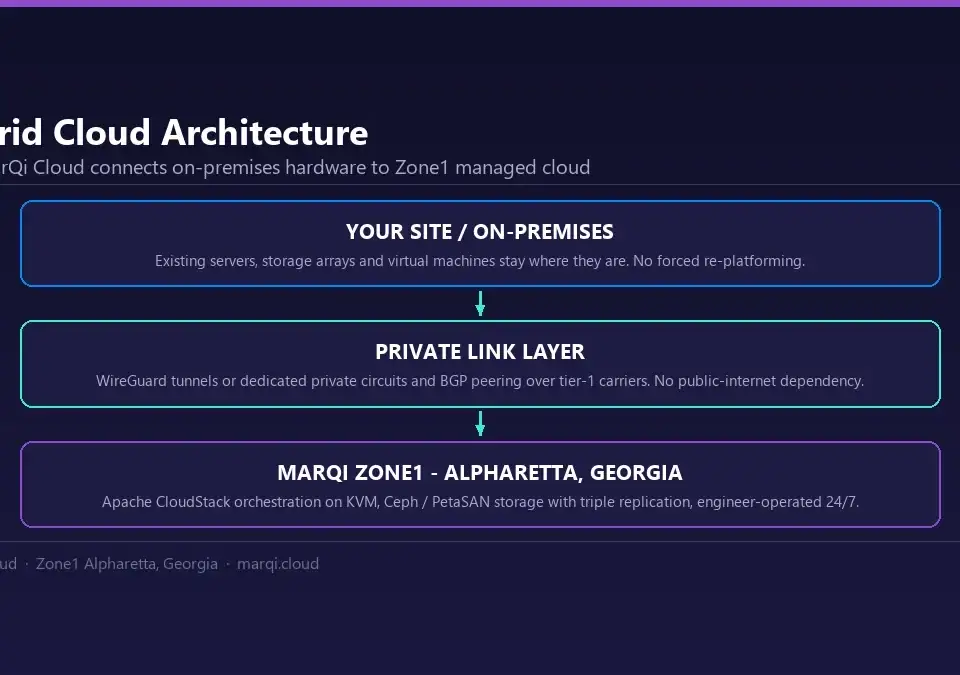
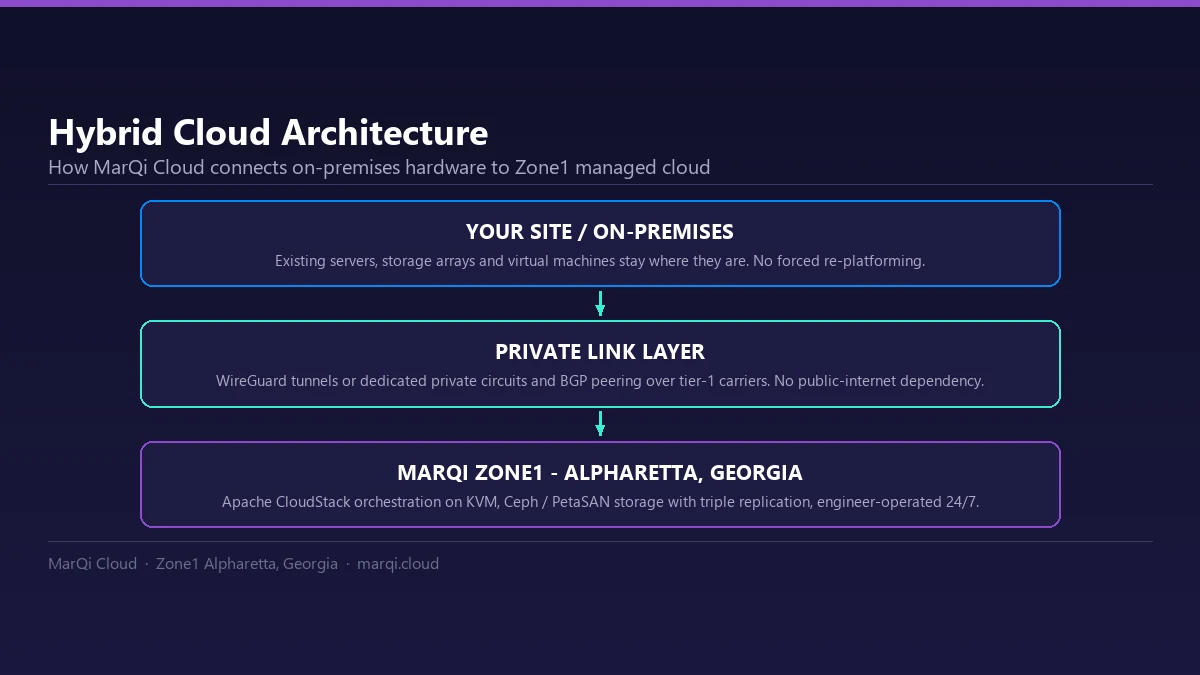
At its core, hybrid cloud architecture connects on-premises data centers (or private cloud environments) with one or more public cloud platforms — allowing workloads, data, and applications to move between them based on business needs.
Unlike a purely public cloud setup, hybrid cloud services give you the ability to keep sensitive or latency-sensitive workloads on private infrastructure while using public cloud resources for burst capacity, analytics, or development environments.
The result is an IT model that is both flexible and pragmatic — combining the cost efficiency of the cloud with the control that regulated industries, large enterprises, and data-heavy organizations often require.
Key Components of a Strong Hybrid Cloud Infrastructure
Before you design anything, you need to understand the building blocks that make hybrid cloud infrastructure function as a unified system rather than two disconnected environments.
1. Network Connectivity
The connection between your on-premises environment and the public cloud is foundational. Options include:
- Dedicated private connections — such as AWS Direct Connect, Azure ExpressRoute, or Google Cloud Interconnect — which offer predictable latency and higher throughput than public internet links.
- Site-to-site VPN — suitable for lower-traffic or cost-sensitive workloads where some variability is acceptable.
The right choice depends on your data transfer volumes, latency requirements, and budget. For most production environments, a dedicated connection backed by a VPN failover is the most resilient combination.
2. Unified Identity and Access Management
Security starts with identity. In a hybrid setup, users and systems need consistent access controls whether they are operating in the cloud or on-premises. Federated identity using SAML, OAuth, or OpenID Connect lets you extend your existing directory (Active Directory, Okta, etc.) across environments without creating isolated silos.
3. Centralized Monitoring and Observability
You cannot manage what you cannot see. A reliable hybrid cloud infrastructure requires unified monitoring that pulls metrics, logs, and traces from both cloud and on-premises systems into a single view. Tools like Datadog, Grafana, and Azure Monitor support cross-environment visibility and are essential for maintaining uptime and diagnosing incidents quickly.
4. Workload Portability via Containers and Kubernetes
Containers are the practical answer to workload portability in hybrid environments. By packaging applications in containers and orchestrating them with Kubernetes — whether through a managed service like Amazon EKS, Azure AKS, or Google GKE, or a self-managed cluster — teams can deploy the same application consistently across different infrastructure.
Designing for Scalability
Scalability in a hybrid cloud deployment is not just about handling more traffic — it is about doing so efficiently without architectural rework every time your requirements change.
Workload Placement Strategy
Start by categorizing workloads:
- Steady, predictable workloads with consistent resource needs are often more cost-effective on private infrastructure or reserved cloud instances.
- Variable or burst workloads — seasonal traffic spikes, batch processing, CI/CD pipelines — are ideal candidates for public cloud elasticity.
- Data gravity workloads — large datasets where moving data is expensive — should run close to where the data lives.
This placement strategy should be reviewed periodically, not treated as a one-time decision. As your applications evolve, where they belong may also shift.
Cloud Bursting
Cloud bursting is one of the most powerful patterns in hybrid cloud services. When on-premises capacity reaches a defined threshold, workloads automatically overflow to the public cloud. This lets you right-size your private infrastructure for baseline demand, not peak demand — which reduces capital expenditure significantly.
Infrastructure as Code (IaC)
Consistency and speed at scale come from automation. Using IaC tools like Terraform, Pulumi, or AWS CloudFormation means your infrastructure can be provisioned, modified, and torn down programmatically across both environments. This eliminates configuration drift and makes your architecture repeatable.
Designing for Resilience
A scalable architecture that cannot survive failures is incomplete. Resilience in a hybrid cloud deployment means planning for the unexpected — cloud provider outages, network disruptions, hardware failures — before they happen.
Multi-Zone and Multi-Region Distribution
Do not rely on a single availability zone or a single region. Distribute critical workloads across zones within a region, and for the highest availability requirements, across multiple geographic regions. Many organizations use their on-premises environment as a natural failover target when a cloud region experiences issues.
Data Backup and Disaster Recovery
Define your Recovery Time Objective (RTO) and Recovery Point Objective (RPO) before selecting a DR strategy. Common approaches in hybrid environments include:
- Active-passive — primary workloads run on-prem, with cloud as a warm standby.
- Active-active — workloads run simultaneously in both environments, with traffic distributed via load balancing or DNS-based routing.
Automated failover, regular DR drills, and documented runbooks are non-negotiable in a production-grade setup.
Avoiding Single Points of Failure
Map out your architecture and identify every single point of failure — network gateways, identity providers, storage systems. Each one should have a redundant counterpart or a clearly defined failover path.
The Role of Managed Hybrid Cloud
For many organizations, managing all of this in-house is not realistic. Managed hybrid cloud services abstract much of the operational complexity — network management, patching, monitoring, and security operations — so internal teams can focus on application development and business outcomes rather than infrastructure maintenance.
Providers offering managed hybrid cloud typically handle:
- Unified management across cloud and on-premises environments
- Proactive monitoring and alerting
- Compliance and security posture management
- Cost optimization and usage reporting
The trade-off is some loss of direct control, but for organizations without deep infrastructure expertise on staff, the operational gains typically outweigh that concern.
Common Pitfalls to Avoid
Even well-funded teams make predictable mistakes in hybrid cloud projects:
- Skipping governance early. Who owns cost accountability? What triggers a workload review? Without defined governance, hybrid environments accumulate technical debt and budget overruns quickly.
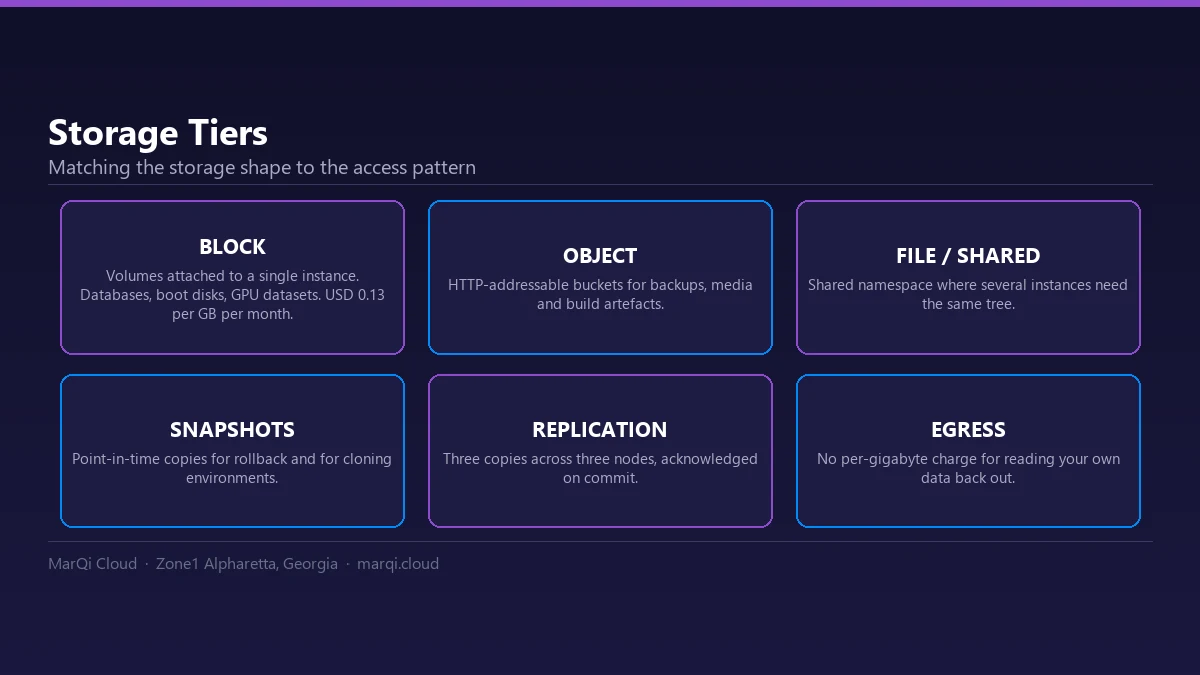
- Underestimating egress costs. Moving large volumes of data between cloud and on-premises generates significant per-gigabyte fees. Model this before committing to an architecture.
- Treating hybrid as a permanent middle ground. Hybrid is a valid long-term strategy for many workloads, but some applications should eventually migrate fully to the cloud. Regularly re-evaluate placement decisions.
- Inconsistent security policies. Different tools and processes between cloud and on-prem create gaps attackers can exploit. Standardize security tooling across environments wherever possible.
Conclusion
Designing a scalable and resilient hybrid cloud infrastructure is not a one-size-fits-all exercise. It requires honest workload analysis, deliberate architectural decisions, and ongoing governance to stay effective as your business evolves. Whether you are moving regulated workloads to a private environment, bursting to the cloud during peak demand, or building a full managed hybrid cloud operating model, the principles are the same: plan for failure, automate for consistency, and monitor everything.
If you are looking for a partner to design and operate a reliable hybrid cloud deployment for your organization, MarQi Cloud offers architecture consulting and managed services built around the specific demands of your workloads — not a generic template.
If you are planning the workload placement side of this architecture, our complete guide to designing a hybrid cloud strategy for enterprise workloads walks through the same decisions in more depth.
Frequently Asked Questions
What connects the on-premises side to the public cloud in a hybrid architecture?
The link is the foundation, and there are three common shapes. A dedicated private connection gives predictable bandwidth and latency because it does not share the public internet path. A site-to-site VPN tunnel is quicker to stand up and runs over circuits you already have. Beyond the pipe itself, the parts that make two environments behave as one system are federated identity so access rules are the same on both sides, unified monitoring that pulls metrics, logs and traces from both, and containers with orchestration so a workload can move without being rebuilt.
Which workloads should stay on-premises in a hybrid setup?
Sort them by how predictable they are. Steady workloads with consistent resource needs are usually more cost-effective on private infrastructure or reserved capacity, because you are paying for something you use continuously. Variable or seasonal workloads suit the public side, where capacity can be released when the peak passes. Cloud bursting is the pattern that joins the two: when on-premises capacity reaches a defined threshold, the overflow runs in the public cloud instead of forcing you to buy hardware for a peak that occurs a few times a year.