How Enterprises Modernize Legacy Systems with Cloud Native Apps
February 19, 2026
Disaster Recovery for Hybrid Cloud: A Practical Runbook (Snapshots, Backups, HA)
February 19, 2026

Why Open Source Hybrid Cloud Providers Fit Regulated Industries
What makes a hybrid cloud fit a regulated industry?
Three properties, all of which this article describes: sensitive information stays on private on-site infrastructure while the public side handles temporary spikes in demand; open code allows easy auditing and regulatory reporting; and open source systems let an organization switch providers without limitations. Kubernetes, OpenStack, OpenShift and Apache CloudStack are the tools that run workloads across both sides.
Introduction:
Regulated industries need solid and compliant cloud systems for sensitive data. Traditional clouds often lack control and flexibility. An open source hybrid cloud provider combines private and public clouds with open technology. With open source cloud services and a multi-cloud management platform open source, organizations can manage data safely and stay compliant.
Understanding an Open Source Hybrid Cloud Provider:
An open source hybrid cloud provider combines private on-site infrastructure with public cloud platforms using open source technology. This setup gives businesses flexibility, transparency, and control over their workloads while avoiding vendor lock-in. Tools like Kubernetes, OpenStack, and OpenShift help manage applications and resources smoothly across both private and public clouds.
Advantages of Choosing an Open Source Hybrid Cloud Provider:
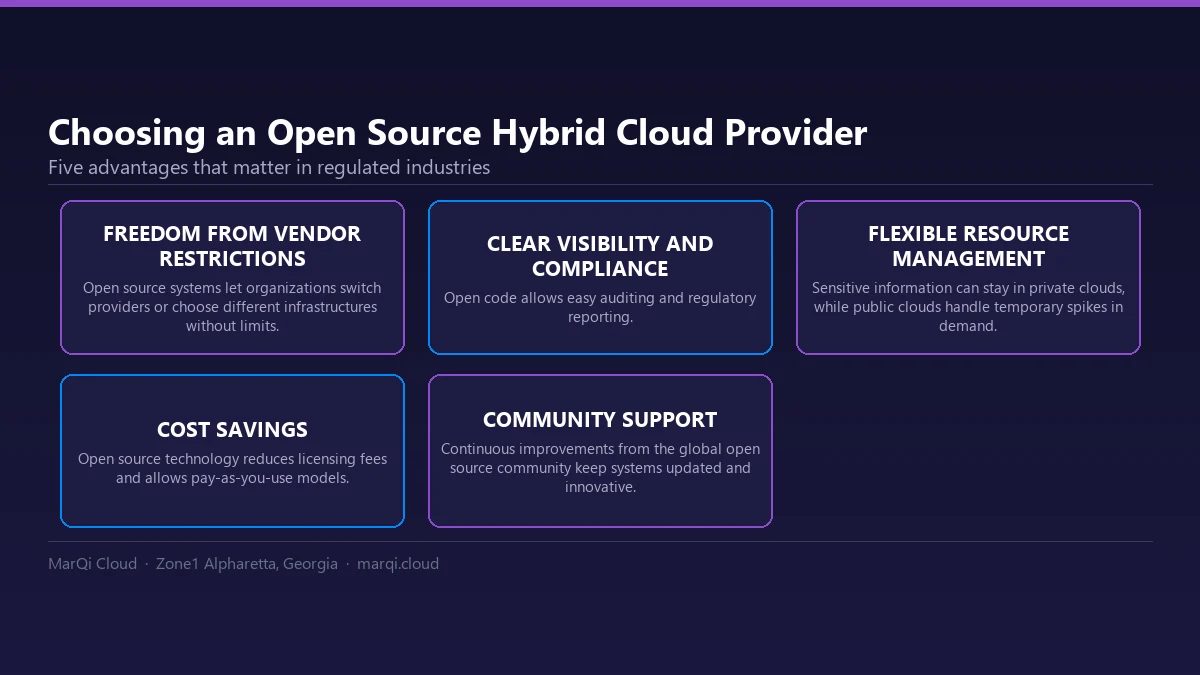
- Freedom from Vendor Restrictions: Open source systems let organizations switch providers or choose different infrastructures without limitations.
- Clear Visibility and Compliance: Open code allows easy auditing and regulatory reporting.
- Flexible Resource Management: Sensitive information can stay in private clouds, while public clouds handle temporary spikes in demand.
- Cost Savings: Open source technology reduces licensing fees and allows pay-as-you-use models.
- Community Support: Continuous improvements from the global open source community keep systems updated and innovative.
Features:
- Upgrade Security and Control: Keep critical data in private infrastructure while safely using public cloud resources.
- Scalability on Demand: Scale resources up or out quickly during peak periods.
- High Reliability: Extra storage and network setups help prevent downtime and protect data during issues.
Core Tools and Technologies of an Open Source Hybrid Cloud Provider:
- Kubernetes: Orchestrates containers across multiple cloud environments.
- OpenStack: Builds private clouds that integrate with public cloud platforms.
- Open Shift: Provides consistent deployment of applications across hybrid clouds.
- Apache Cloud Stack: Manages virtual machines and large-scale cloud networks.
Why do businesses rely on it?
Organizations use an open source hybrid cloud provider to manage complex infrastructure while maintaining compliance, security, and flexibility. It allows them to optimize workloads, control costs, and safely store sensitive data.
| Open source tool | What it does in a hybrid/multi-cloud setup |
|---|---|
| Kubernetes | Orchestrates containers across multiple cloud environments |
| OpenStack | Builds private clouds that integrate with public cloud platforms |
| OpenShift | Provides consistent deployment of applications across hybrid clouds |
| Apache CloudStack | Manages virtual machines and large-scale cloud networks |
| Terraform | Automates infrastructure setup and management across different cloud providers |
| Ansible | Automates application deployment, configuration and repetitive tasks |
Role of Multi Cloud Management Platform Open Source in Compliance:
An open source multi-cloud management platform is a software tool that helps businesses manage, monitor, and optimize resources across multiple cloud providers, including public clouds like AWS, Azure, Google Cloud, and private clouds. It gives a single, centralized interface to control workloads, automate tasks, track costs, and maintain security. Reducing reliance on a single vendor, it simplifies the management of complex cloud environments.
Key Tools for Managing a Multi-Cloud Management Platform:
- Terraform (Hashi Corp): Automates infrastructure setup and management across different cloud providers.
- Ansible (Red Hat): Automates application deployment, configuration, and repetitive tasks.
- OpenStack: Builds and manages private clouds that can connect seamlessly to public clouds.
Benefits:
- Centralized Monitoring: See all cloud resources in one dashboard.
- Cost Efficiency: Track spending, remove unused resources, and optimize cloud usage.
- Protection & Regulations: Ensure all cloud environments follow consistent rules to stay safe and compliant.
- Automation: Simplify deployments, updates, and routine tasks.
- Workload Portability: Move applications easily between clouds using tools like Kubernetes.
Why Organizations Use Multi-Cloud?
- Flexibility: Use the best features of each cloud provider for specific workloads.
- Avoid Vendor Lock In: Switch providers or spread workloads freely.
- Reliability: Reduce downtime by distributing workloads across multiple clouds.
- Scalable and Cost-Effective: Scale resources up or down as needed to save costs.
- Access to Latest Technology: Take advantage of new tools and innovations from different providers.
Common Uses:
- Disaster Recovery: Backup critical applications across multiple clouds.
- Better Global Performance: Place workloads closer to users for faster access.
- Regulatory Compliance: Meet regional rules by storing data in the required locations.
- Control Shadow IT: Provide employees with secure and approved cloud tools.
Multi Cloud Management Challenges:
- Operational Complexity: Each cloud platform has its own tools and systems.
- Integration Needs: Applications may require extra work to run across clouds.
- Security Risks: Different security models can create gaps.
- Talent Requirements: Teams must be skilled in multiple cloud platforms.
- Limited Visibility: Tracking resources and costs across clouds is challenging without centralized tools.
Open Source Cloud Services for risk-free and scalable infrastructure:
Open source cloud services are cloud platforms, applications, or infrastructure built using open source technology. They let businesses access, modify, and deploy resources freely without being tied to a single vendor. These services can run on private, public, or hybrid cloud models, offering flexibility, cost savings, and smooth integration with other systems.
Key Advantages of Open Source Cloud Services:
- No Vendor Lock-in: Move workloads between providers without restrictions.
- Flexible & Clear: Companies can rely on the system to meet their needs and maintain full control over how it works.
- Community Support: Regular updates and security improvements from a global developer community.
- Cost Savings: Reduce licensing fees compared to proprietary solutions.
- Easy Integration: Works well with other software and cloud systems.
Popular Tools and Platforms:
- OpenStack: Build and manage private and public clouds.
- Kubernetes (K8s): Helps automatically deploy, scale, and manage applications that run in containers.
- Terraform: An Infrastructure as Code tool for managing resources across clouds.
- Rumble Cloud: Example of an open source cloud provider offering compute, storage, and networking.
- Next cloud / Own Cloud: Open source file sharing and collaboration platforms.
- MinIO: Object storage compatible with S3 for private cloud setups.
Features of Open Source Cloud Services:
- Flexible Infrastructure: Supports private, public, and hybrid deployments.
- Container Support: Run applications anywhere, easily and reliably.
- Resource Management: Efficiently manage virtual machines, storage, and networks.
- Automation: Simplifies deployment, updates, and scaling of applications.
- Security & Compliance: Transparent frameworks make audits and regulatory compliance easier.
Why do businesses choose these Services?
- Cost Efficient: Lower fees and no expensive licenses.
- Better Control: Full visibility over data, infrastructure, and operations.
- Flexible & Dependable: Easily increase resources when needed while keeping systems running smoothly.
- Encourages Innovation: Easily integrate new tools and technologies.
- Compliance Ready: Monitor security and follow regulations with ease.
Why are Open Source Cloud Service Providers gaining popularity?
Open source cloud service providers give businesses access to cloud resources like servers, storage, and networking using open source software such as OpenStack or Kubernetes. These platforms allow more control, customization, and freedom from being tied to a single vendor. They support public, private, and hybrid cloud models, letting users scale, share, and manage infrastructure easily.
Understanding Cloud Service Providers and Their Key Types:
A cloud service provider (CSP) is a company that delivers computing power, storage, and software over the internet. The main types are:
- IaaS (Infrastructure as a Service): Offers virtual servers, storage, and networks. You are in charge of handling and maintaining your own applications.
- PaaS (Platform as a Service): Provides tools and services to build and run applications, while the provider manages the infrastructure.
- SaaS (Software as a Service): Delivers fully managed, ready-to-use applications like Gmail or Google Docs.
CSPs can also provide hybrid, multi-cloud, or edge cloud solutions and often support modern technologies such as containers, Kubernetes, and AI.
Advantages:
- Business agility: Focus on growth while the provider handles hardware and maintenance.
- Pay-as-you-go: pay for what you use without big upfront investments.
- Scalability: Easily add or remove resources based on demand.
- Reliability: Providers maintain uptime and performance.
- Centralized access: Manage services and data in one place.
- Future-ready: Stay up to date with the latest cloud technologies.
- Offsite Connectivity: Access your work safely from any location with an internet connection.
- Disaster recovery: Backup and recovery systems minimize downtime.
Key Benefits of Open Source Cloud Service Providers:
- Freedom from vendor lock-in: Move workloads between different cloud platforms without restrictions.
- Customizable: Adapt cloud resources to fit specific business needs.
- Cost-effective: Save money on licenses and pay only for what you use.
- Community support: Benefit from updates and improvements from open source communities.
- Easy integration: Works well with other tools and systems.
Examples:
- Open Metal: On-demand private clouds built with OpenStack.
- Rumble Cloud: Provides virtual machines and storage using open source technology.
- Red Hat: Offers hybrid cloud management and infrastructure solutions.
- ICN Global: Decentralized cloud storage powered by blockchain.
MarQi Cloud: Reliable Open Source Hybrid Cloud Solutions:
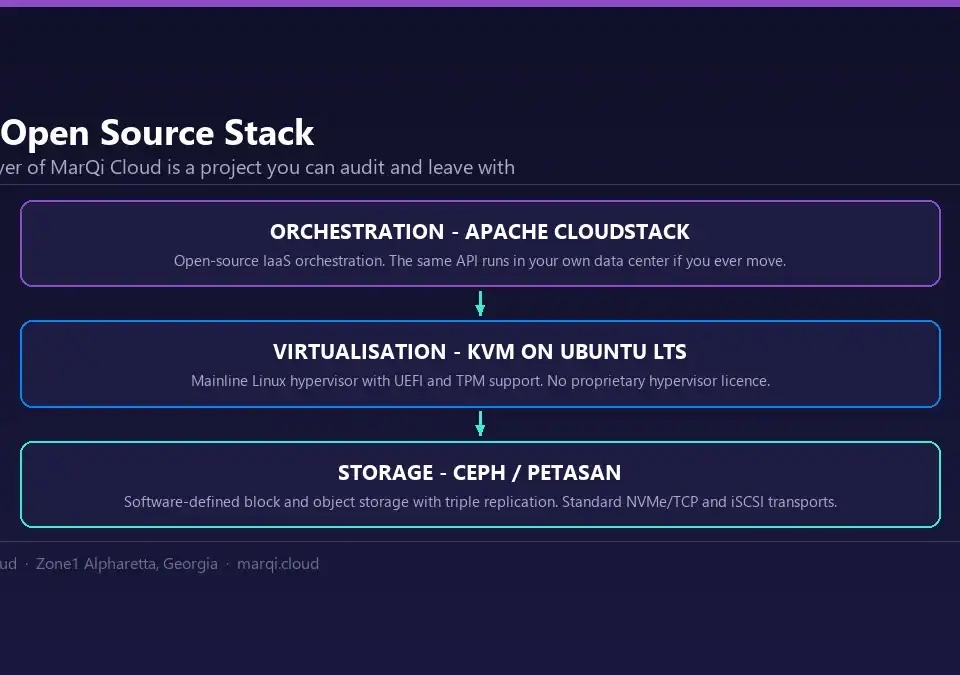
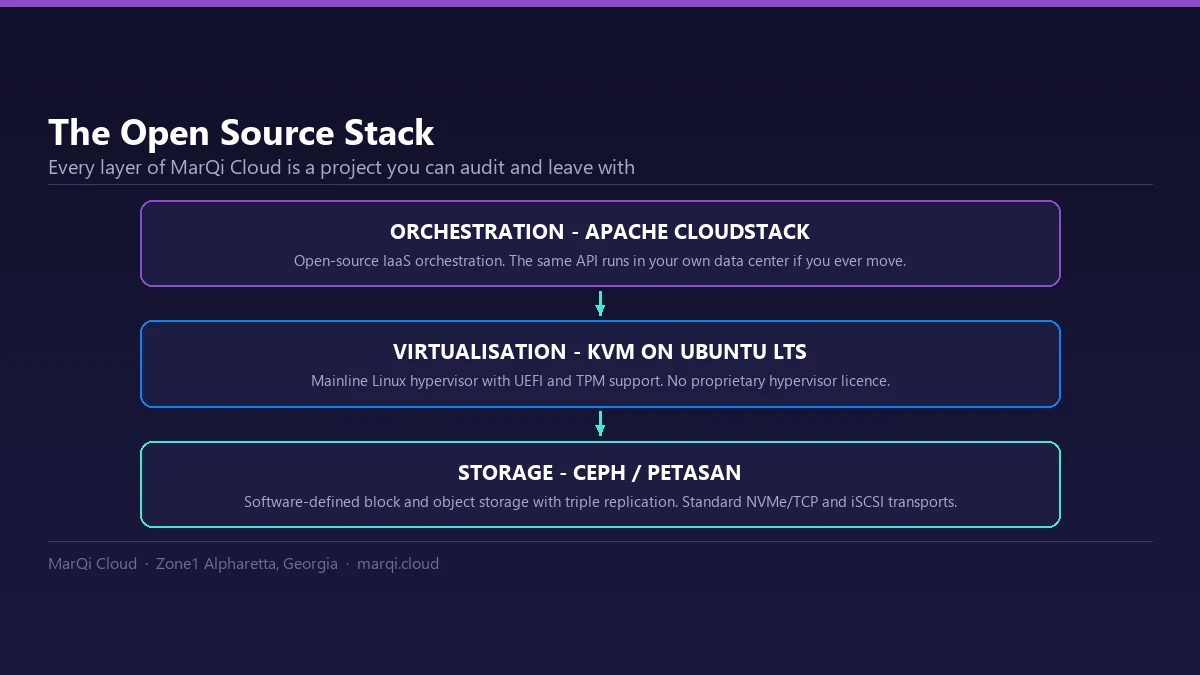
MarQi Cloud is a dependable hybrid cloud provider that uses open source technology to offer safe, flexible, and high-performing cloud services. Their solutions give businesses complete control over data and infrastructure while providing compliance, scalability, and seamless integration with multi-cloud environments.
Full Control Over Data and Storage:
- Manage your infrastructure and data independently.
- Safe and scalable storage designed for regulated industries.
Highly Reliable Network:
- Strong uptime and fault tolerance.
- Robust disaster recovery to keep systems running.
Compliant and Flexible Cloud Services:
- Ideal for industries with strict compliance needs.
- Works easily with multi-cloud management platform open source tools.
- Stable and adaptable hybrid cloud deployments.
Conclusion:
Open source hybrid cloud offers regulated industries a secure and flexible solution with strong compliance and transparency. It provides long-term scalability, cost savings, and reliability. Choosing the right open source cloud service providers helps organizations build a safe, efficient, and future-ready cloud infrastructure.
Frequently asked questions
What should a regulated industry look for in a hybrid cloud provider?
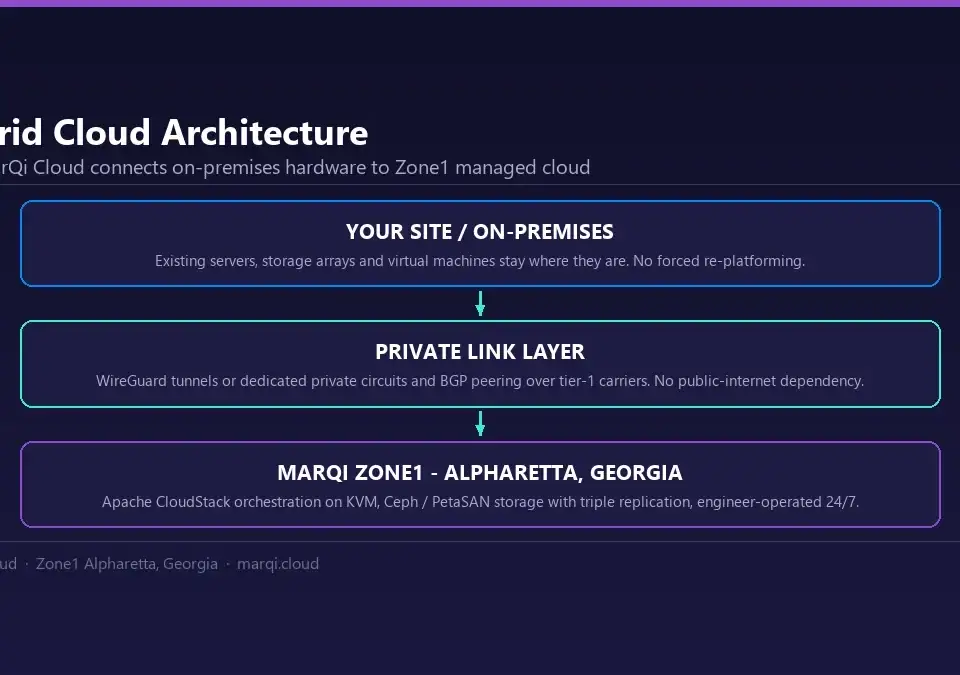
Three properties matter more than the brochure. First, whether the stack is portable: MarQi Cloud runs Apache CloudStack orchestrating KVM with Ceph storage, all open source, so the same platform can be run elsewhere if the relationship ends. Second, where the data physically sits and who operates the facility. Third, whether the link between your own hardware and the provider crosses the public internet at all — a WireGuard tunnel or a dedicated private circuit with BGP peering keeps it off that path. Certification questions are separate and belong to your auditor, not to a provider page.
Where does the data sit in a MarQi Cloud hybrid deployment?
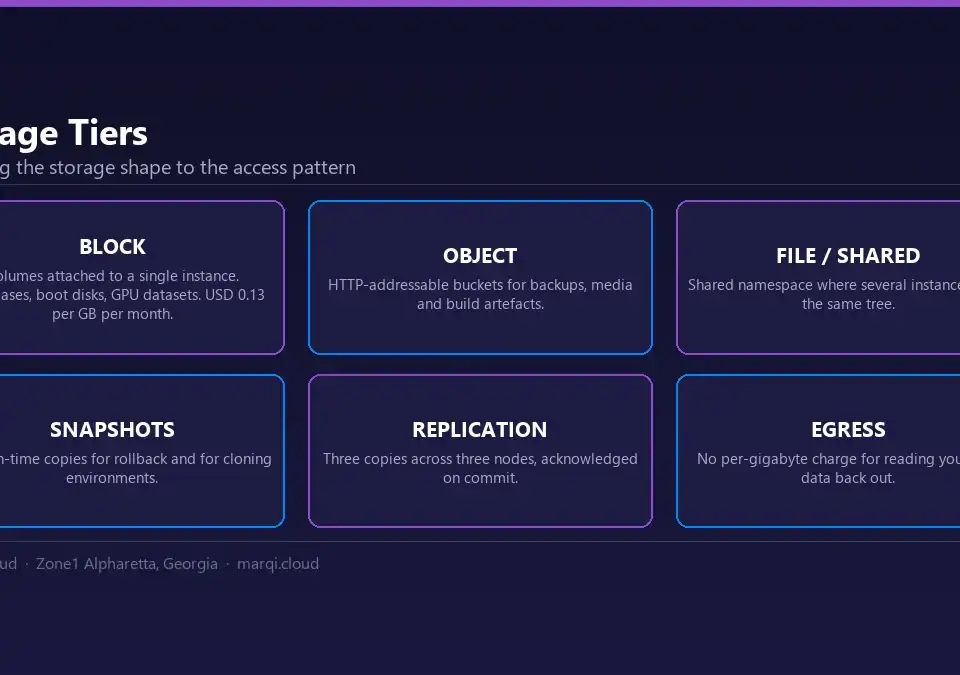
The cloud half runs in Zone1, the data center in Alpharetta, Georgia, inside the Southeast US technology corridor, with sub-5ms latency across the Atlanta metro. The on-premises half stays exactly where it is — hybrid here means joining the two, not moving one into the other. Traffic between them rides a WireGuard site-to-site tunnel or a dedicated private circuit rather than the open internet, and moving data between the halves does not carry an egress charge.