The MarQi Cloud Security Hardening Checklist: Lock Down Your Infrastructure Today
April 27, 2026
MarQi Cloud for Go Developers: Fast Deployment, Full Control, Zero Overhead
April 27, 2026
How MarQi Cloud Enables GitOps Workflows for Modern Infrastructure Teams
In today’s fast-paced digital landscape, organizations are continuously seeking ways to improve their infrastructure management and deployment processes. One methodology that has gained immense traction is GitOps. This approach leverages Git repositories as the single source of truth for infrastructure and application deployments, allowing teams to manage their environments in a more efficient and consistent manner. At MarQi Cloud, we understand the importance of GitOps workflows and provide the necessary tools and infrastructure to support modern infrastructure teams in adopting this innovative methodology.
What is GitOps?
GitOps is a set of practices that uses Git pull requests to manage infrastructure and application deployment. By utilizing Git as the central repository for configuration files, teams can implement version control, audit trails, and collaboration capabilities that are foundational to DevOps practices. This approach enables teams to automate operational tasks, reduce manual errors, and increase deployment frequency.
The Core Principles of GitOps
1. Declarative Configuration: All infrastructure configurations are defined declaratively, typically through YAML or JSON files. This allows teams to describe the desired state of the system without detailing the steps to achieve that state.
2. Version Control: By storing configuration files in a Git repository, teams can track changes, roll back to previous configurations, and collaborate more effectively.
3. Automated Deployment: Changes to the Git repository trigger automated deployment processes, ensuring that the infrastructure matches the configurations stored in Git.
4. Continuous Monitoring: Systems continuously monitor the state of the infrastructure and compare it with the desired state defined in Git. If discrepancies are detected, automated remediation processes can be initiated.
The Benefits of GitOps for Infrastructure Teams
GitOps offers numerous advantages that resonate with modern infrastructure teams:
Enhanced Collaboration
By using Git as the single source of truth, teams can easily collaborate on infrastructure changes. Pull requests facilitate discussions and reviews, ensuring that changes are vetted before they are applied.
Increased Deployment Velocity
Automation plays a crucial role in speeding up deployment processes. With GitOps, infrastructure changes can be rolled out quickly and reliably, allowing teams to respond to business needs more swiftly.
Improved Stability and Reliability
Declarative configurations and automated monitoring significantly reduce the risk of human error. Teams can confidently deploy changes, knowing that they can quickly revert to a previous stable state if needed.
Streamlined Compliance and Auditing
Every change made to the infrastructure is recorded in Git, providing a comprehensive audit trail that simplifies compliance efforts. Teams can demonstrate adherence to policies and procedures with ease.
How MarQi Cloud Supports GitOps Workflows
At MarQi Cloud, we recognize that effective GitOps implementation requires a robust infrastructure and support system. Our enterprise-grade cloud infrastructure is designed to facilitate seamless GitOps workflows, providing the necessary resources and tools for modern infrastructure teams.
Enterprise-Grade Cloud Infrastructure
Our cloud infrastructure is built to handle the demands of GitOps workflows, offering scalable compute and storage resources to accommodate varying workloads. Whether you are managing a small application or a complex microservices architecture, MarQi Cloud can support your needs.
Hybrid Cloud Deployment Models
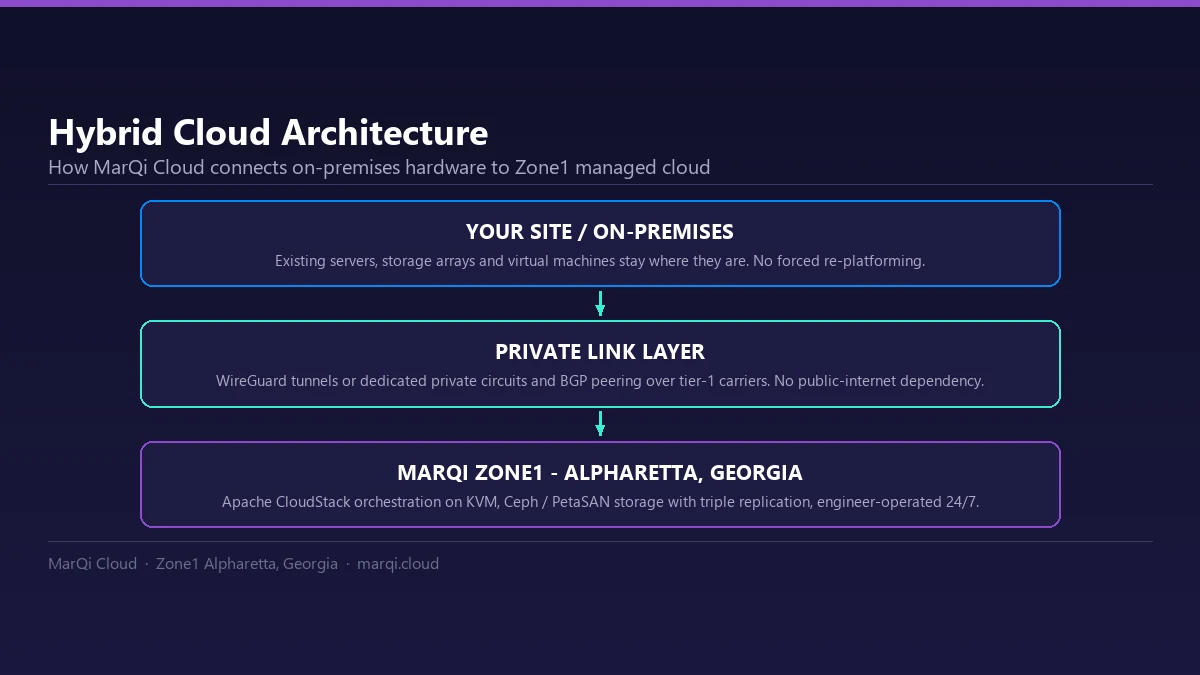
With MarQi Cloud’s hybrid cloud deployment models, teams can leverage both on-premises and cloud resources as needed. This flexibility allows organizations to optimize their infrastructure for performance, security, and cost-effectiveness while adhering to GitOps principles.
Private and Secure Hosting Environments
Security is paramount in any infrastructure deployment. MarQi Cloud provides private and secure hosting environments that protect sensitive data and ensure compliance with industry regulations. This secure foundation is essential for GitOps workflows, where changes to infrastructure configurations can have far-reaching implications.
Business Continuity and Disaster Recovery Solutions
To ensure the availability and reliability of your applications, MarQi Cloud offers comprehensive business continuity and disaster recovery solutions. In the context of GitOps, these solutions enable teams to maintain operational resilience and swiftly recover from disruptions, ensuring that infrastructure remains aligned with desired configurations.
Performance-Driven Infrastructure Design
MarQi Cloud’s performance-driven infrastructure design ensures that your applications run efficiently and effectively. By optimizing resource allocation and performance tuning, we enable teams to focus on delivering value rather than managing infrastructure.
US-Based Infrastructure and Support
With MarQi Cloud, your infrastructure is hosted in the United States, ensuring compliance with local regulations. Additionally, our dedicated support team is available to assist you with any challenges you may encounter while implementing GitOps workflows.
Flexible Pricing Models
We understand that cost management is a critical aspect of any cloud strategy. MarQi Cloud offers flexible pricing models that allow you to pay only for the resources you use. This flexibility makes it easier for teams to adopt GitOps without incurring unnecessary costs.
Implementing GitOps with MarQi Cloud
To successfully implement GitOps workflows using MarQi Cloud, teams can follow these steps:
Step 1: Define Your Infrastructure as Code
Begin by defining your infrastructure configurations declaratively using YAML or JSON files. These configurations should encompass all aspects of your infrastructure, from networking to application deployment.
Step 2: Set Up Your Git Repository
Create a Git repository to store your infrastructure code. Ensure that all team members have access to this repository and understand the importance of version control.
Step 3: Integrate CI/CD Tools
Utilize Continuous Integration and Continuous Deployment (CI/CD) tools to automate the deployment process. Popular tools include Argo CD, Flux, and Jenkins, which can monitor your Git repository for changes and apply them to your MarQi Cloud infrastructure.
Step 4: Monitor and Validate Deployments
Implement monitoring tools to continuously assess the state of your infrastructure. This will help you identify discrepancies between the desired and actual states, allowing for automated remediation.
Step 5: Iterate and Improve
As with any workflow, continuous improvement is essential. Gather feedback from your team, assess the effectiveness of your GitOps processes, and make adjustments as needed.
Conclusion
GitOps represents a paradigm shift in how modern infrastructure teams manage their deployments and configurations. By leveraging Git as a single source of truth, teams can enhance collaboration, increase deployment velocity, and improve stability. At MarQi Cloud, we are committed to providing enterprise-grade cloud infrastructure and support to empower your GitOps workflows. Our scalable resources, secure environments, and flexible pricing models ensure that your infrastructure is not only efficient but also cost-effective. Embrace the future of infrastructure management with MarQi Cloud and unlock the full potential of GitOps for your organization.
FAQs
1. What is GitOps?
GitOps is a set of practices that uses Git as the single source of truth for managing infrastructure and application deployments, enabling automation and collaboration.
2. How does MarQi Cloud support GitOps workflows?
MarQi Cloud provides enterprise-grade infrastructure, hybrid cloud deployment models, secure hosting environments, and flexible pricing to support GitOps workflows.
3. What are the benefits of using GitOps?
Benefits include enhanced collaboration, increased deployment velocity, improved stability and reliability, and streamlined compliance and auditing.
4. What tools are commonly used for GitOps?
Common tools include Argo CD, Flux, and Jenkins, which automate the deployment process and monitor Git repositories for changes.
5. How can I start implementing GitOps with MarQi Cloud?
Define your infrastructure as code, set up a Git repository, integrate CI/CD tools, monitor deployments, and continuously improve your processes.
6. Is MarQi Cloud’s infrastructure compliant with regulations?
Yes, MarQi Cloud offers US-based infrastructure, ensuring compliance with local regulations and industry standards.
7. What kind of support does MarQi Cloud offer?
MarQi Cloud provides dedicated US-based support to assist with any challenges you may encounter during your GitOps implementation.
8. Are there flexible pricing options with MarQi Cloud?
Yes, MarQi Cloud offers flexible pricing models that allow you to pay only for the resources you use, making GitOps adoption more cost-effective.
9. What is the role of Continuous Integration in GitOps?
Continuous Integration automates the process of testing and deploying changes, ensuring that infrastructure updates are applied quickly and reliably.
10. Can I use GitOps for both applications and infrastructure?
Yes, GitOps can be applied to manage both application deployments and infrastructure configurations, improving consistency and collaboration.