The Complete Guide to Cloud Infrastructure Sizing for Mid-Size Organizations
July 9, 2026
How White-Glove Managed Services Transform the Enterprise Cloud Experience
July 10, 2026
How MarQi Cloud’s Open Source Stack Eliminates Vendor Lock-In for Enterprise Clients
In today’s rapidly evolving digital landscape, enterprise clients face numerous challenges, from managing costs to ensuring compliance and scalability. One of the most pressing issues is vendor lock-in, which can severely limit an organization’s flexibility and growth potential. As an enterprise cloud provider, MarQi Cloud recognizes these challenges and leverages its open source stack to provide clients with a robust solution that eliminates vendor lock-in while fostering innovation and agility.
This comprehensive guide will delve into how MarQi Cloud’s open source infrastructure empowers enterprises to maintain control over their data, applications, and overall cloud strategy. We’ll explore the nuances of vendor lock-in, the benefits of open source technology, and how MarQi Cloud’s unique offerings position it as a leader in the cloud infrastructure space.
Understanding Vendor Lock-In
Vendor lock-in refers to a situation where a customer becomes dependent on a specific vendor for products and services, making it challenging to switch to another provider without incurring substantial costs or operational disruptions. This phenomenon is particularly prevalent in cloud computing, where organizations invest heavily in proprietary solutions that may not be easily transferable to other platforms.
Organizations can face materially higher costs when switching cloud providers, because of the complexities involved in data migration, retraining staff, and potential downtime. As enterprises increasingly adopt multi-cloud strategies, the risks associated with vendor lock-in become even more pronounced.
The Benefits of Open Source Technology
Open source technology stands in stark contrast to proprietary solutions, offering a myriad of advantages that can significantly mitigate the risks associated with vendor lock-in. Here are some compelling benefits:
- Flexibility and Customization: Open source software is inherently customizable, allowing enterprises to tailor solutions to their specific needs without being constrained by a vendor’s limitations.
- Community Support: Open source projects often have a vibrant community of developers and users who contribute to the software’s continuous improvement, ensuring that issues are addressed promptly and effectively.
- Cost-Effectiveness: By utilizing open source solutions, organizations can reduce licensing fees associated with proprietary software, leading to significant cost savings over time.
- Interoperability: Open source technologies are designed to work with a wide range of systems and platforms, making it easier for organizations to integrate different tools without compatibility issues.
- Transparency and Security: Open source software allows organizations to inspect the code for vulnerabilities, ensuring a higher level of security and compliance.
How MarQi Cloud’s Open Source Stack Works
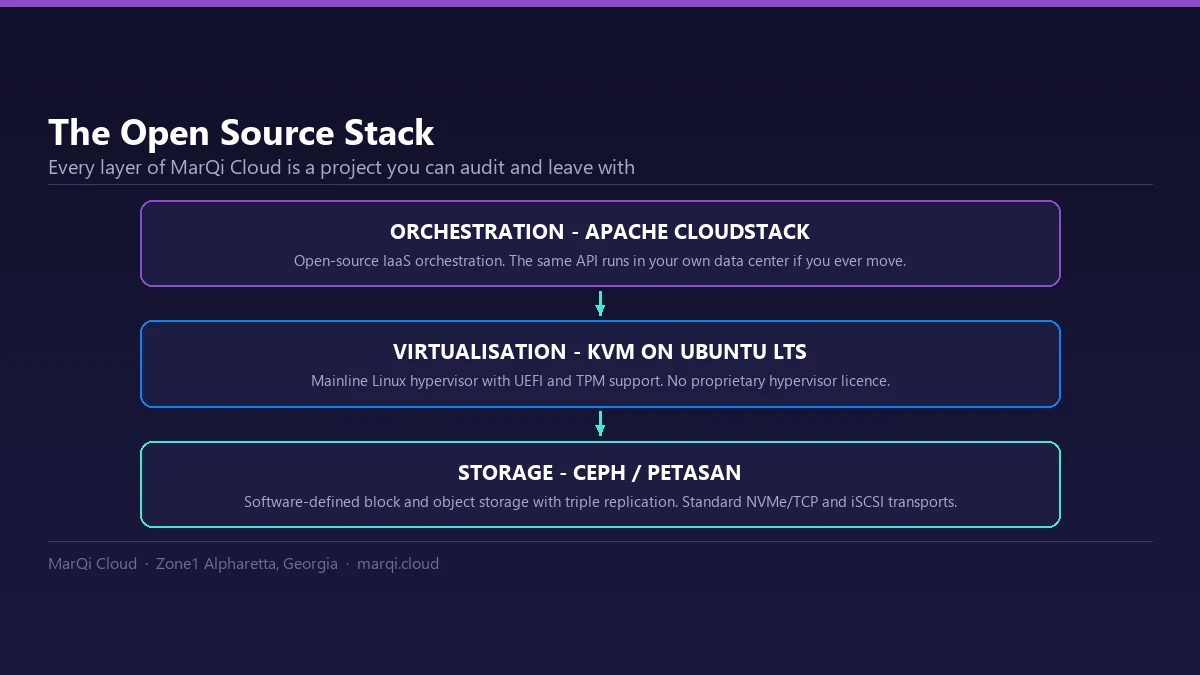
MarQi Cloud’s commitment to open source technology is evident in its infrastructure and service offerings. Here’s how our open source stack eliminates vendor lock-in:
1. Modularity
Our open source architecture is modular, meaning clients can choose the components that best fit their needs. This modularity allows for seamless integration with existing systems, reducing the friction often associated with migrating to a new platform.
2. Compatibility
MarQi Cloud supports a wide range of open source tools and frameworks, making it easy for businesses to transition their applications without losing critical functionality. For instance, our platform is compatible with Kubernetes, enabling organizations to manage containerized applications effectively.
3. Data Portability
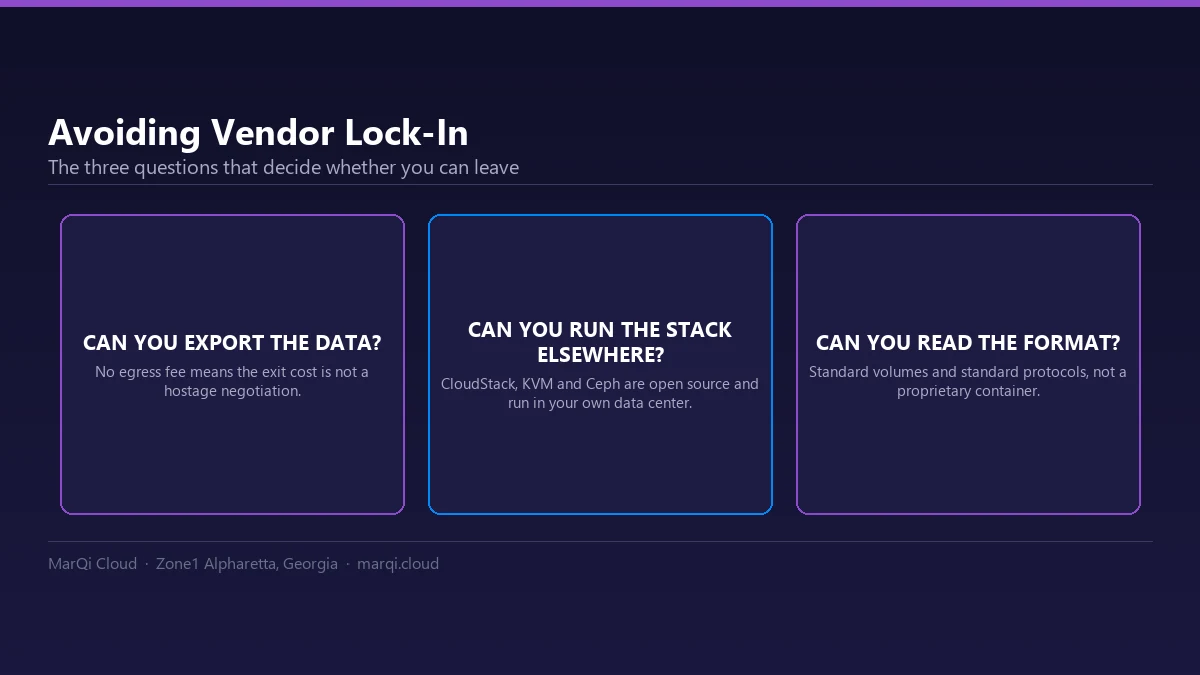
Data portability is a key feature of our open source stack. Clients can easily move their data in and out of the MarQi Cloud environment without the constraints imposed by proprietary systems. This capability is essential for organizations looking to adopt a multi-cloud strategy.
4. Cost Transparency
With MarQi Cloud, there are no hidden fees or unexpected costs. Our transparent pricing model allows enterprises to understand their expenses clearly, making budgeting and financial planning more straightforward.
5. Community-Driven Innovation
By leveraging open source technologies, MarQi Cloud benefits from community-driven innovation. Our clients can access the latest advancements in cloud computing without being tied to a particular vendor’s release schedule.
Case Studies: Real-World Applications
To illustrate the effectiveness of MarQi Cloud’s open source stack in eliminating vendor lock-in, let’s explore a few case studies:
Case Study 1: Healthcare Provider
A healthcare provider faced significant challenges with its previous proprietary cloud solution, including high costs and limited flexibility. After migrating to MarQi Cloud’s open source stack, the organization achieved a 30% reduction in operational costs and improved its ability to comply with HIPAA regulations due to enhanced data security features.
Case Study 2: E-Commerce Platform
An e-commerce platform struggled with vendor lock-in, preventing it from scaling effectively. By transitioning to MarQi Cloud, the company utilized our open source tools to create a customized, scalable solution that allowed for rapid growth and a 50% decrease in downtime.
| Client | Initial Challenges | Results After Migration |
|---|---|---|
| Healthcare Provider | High costs, limited flexibility | 30% reduction in operational costs, improved HIPAA compliance |
| E-Commerce Platform | Vendor lock-in, scaling issues | Customized solution, 50% decrease in downtime |
Expert Insights: Avoiding Vendor Lock-In
To further empower enterprises in avoiding vendor lock-in, we gathered insights from industry experts:
Additionally, regularly audit your cloud infrastructure to identify any potential dependencies on proprietary software. This proactive approach will help you mitigate risks and maintain flexibility.
Conclusion
MarQi Cloud’s open source stack offers a robust solution for enterprises looking to eliminate vendor lock-in and maintain control over their cloud infrastructure. By leveraging modularity, compatibility, and data portability, we empower organizations to innovate and scale without the constraints imposed by proprietary systems. As the cloud landscape continues to evolve, adopting an open source strategy will be crucial for enterprises aiming to remain competitive and agile.
For more information on how MarQi Cloud can help your organization navigate the complexities of cloud migration and infrastructure management, contact us today.
FAQs
What is vendor lock-in?
Vendor lock-in occurs when a customer becomes dependent on a specific vendor for products and services, making it difficult to switch to another provider.
How can open source technology help avoid vendor lock-in?
Open source technology allows for greater flexibility, customization, and data portability, reducing dependency on a single vendor.
What are the benefits of using MarQi Cloud’s open source stack?
MarQi Cloud’s open source stack offers modularity, compatibility, data portability, cost transparency, and community-driven innovation.
Can I migrate my existing applications to MarQi Cloud?
Yes, MarQi Cloud supports a wide range of open source tools and frameworks, making it easy to migrate existing applications.
How does MarQi Cloud ensure data security?
MarQi Cloud employs robust security measures, including encryption and compliance with industry regulations, to protect client data.
What industries can benefit from MarQi Cloud’s solutions?
MarQi Cloud’s solutions are ideal for various industries, including healthcare, e-commerce, finance, and more.
Is there a risk of vendor lock-in with MarQi Cloud?
MarQi Cloud’s open source stack is designed to minimize vendor lock-in, allowing for seamless data migration and integration.
How can I get started with MarQi Cloud?
You can get started by visiting our Getting Started page or contacting our support team for assistance.