MarQi Cloud for Agencies: Host 50+ Client Sites Efficiently
June 29, 2026
Why MarQi Cloud Is the Ultimate Choice for GPU-Intensive Deep Learning Projects
June 30, 2026
How MarQi Cloud’s Open Source Stack Prevents Vendor Lock-In Forever
In today’s rapidly evolving digital landscape, businesses are increasingly reliant on cloud solutions to drive innovation and maintain competitive advantages. However, a prevalent concern among organizations is the risk of vendor lock-in, which can severely restrict flexibility and increase costs. This article delves into how MarQi Cloud‘s open source stack provides a robust framework to prevent vendor lock-in forever, ensuring that enterprises maintain control over their infrastructure and applications.
Understanding Vendor Lock-In
Vendor lock-in occurs when a customer becomes dependent on a vendor for products and services, making it challenging to switch providers without incurring significant costs or operational disruptions. This dependency can arise from various factors, including proprietary technologies, unique data formats, and contractual obligations.
Organizations face higher costs when switching cloud providers, driven by data transfer fees, the need for retraining staff, and potential downtime. Thus, preventing vendor lock-in is essential for maintaining operational agility and cost efficiency.
The Benefits of Open Source Technology
Open source technology refers to software whose source code is made available for modification and enhancement by anyone. This approach fosters innovation and collaboration, leading to numerous advantages:
- Flexibility: Organizations can customize open source solutions to meet their specific needs.
- Cost-Effectiveness: Open source software typically has lower licensing fees, reducing overall IT expenditure.
- Community Support: A vibrant community of developers often contributes to ongoing improvements and support.
- Transparency: Open source code allows for thorough examination and auditing, enhancing security and trust.
By leveraging open source technologies, businesses can avoid being locked into a single vendor’s ecosystem, facilitating smoother transitions and integrations with other systems.
MarQi Cloud’s Open Source Stack Explained
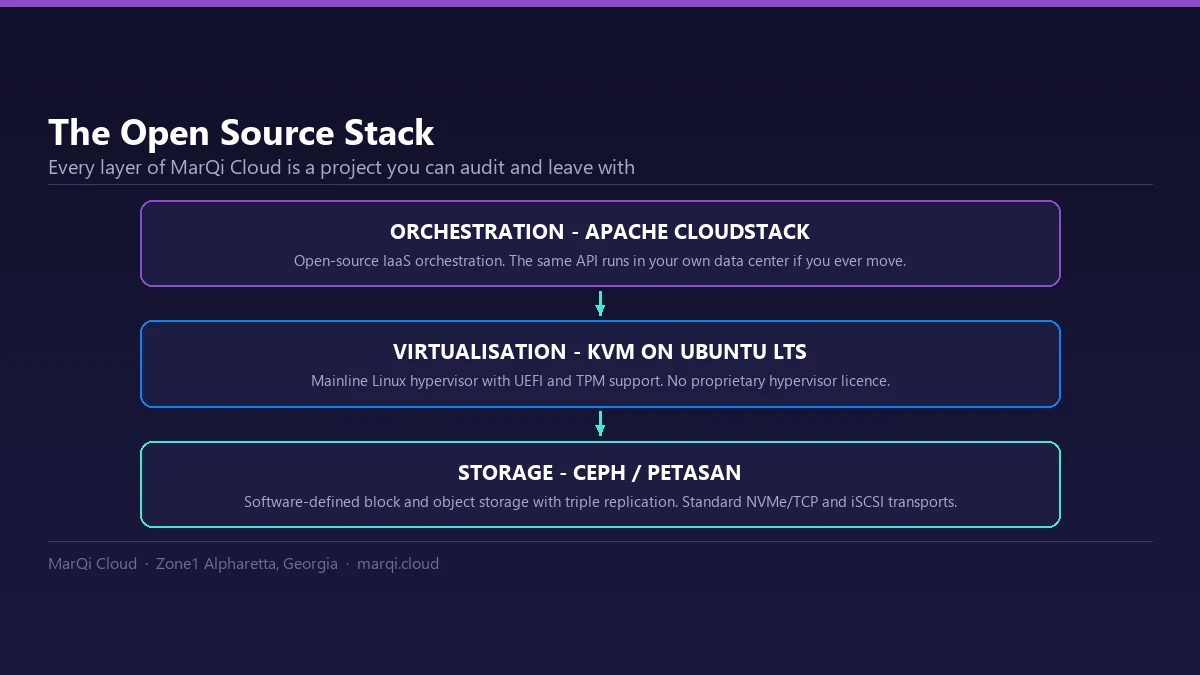
MarQi Cloud is committed to providing enterprise-grade cloud infrastructure through its open source stack. This stack includes a variety of components designed to enhance performance, security, and scalability while ensuring that organizations retain control over their data and applications.
Key components of MarQi Cloud’s open source stack include:
- Kubernetes: For container orchestration, enabling seamless scalability and management of applications.
- Apache CloudStack: A platform for cloud computing that allows users to deploy and manage cloud services.
- Ceph: A distributed storage system that provides scalable and fault-tolerant storage solutions.
- Terraform: An infrastructure as code tool that allows for automated provisioning and management of cloud resources.
By utilizing these technologies, MarQi Cloud empowers organizations to build and manage their cloud environments without the constraints typically associated with proprietary solutions.
How Open Source Prevents Vendor Lock-In
MarQi Cloud’s open source stack mitigates the risks of vendor lock-in in several key ways:
1. Interoperability
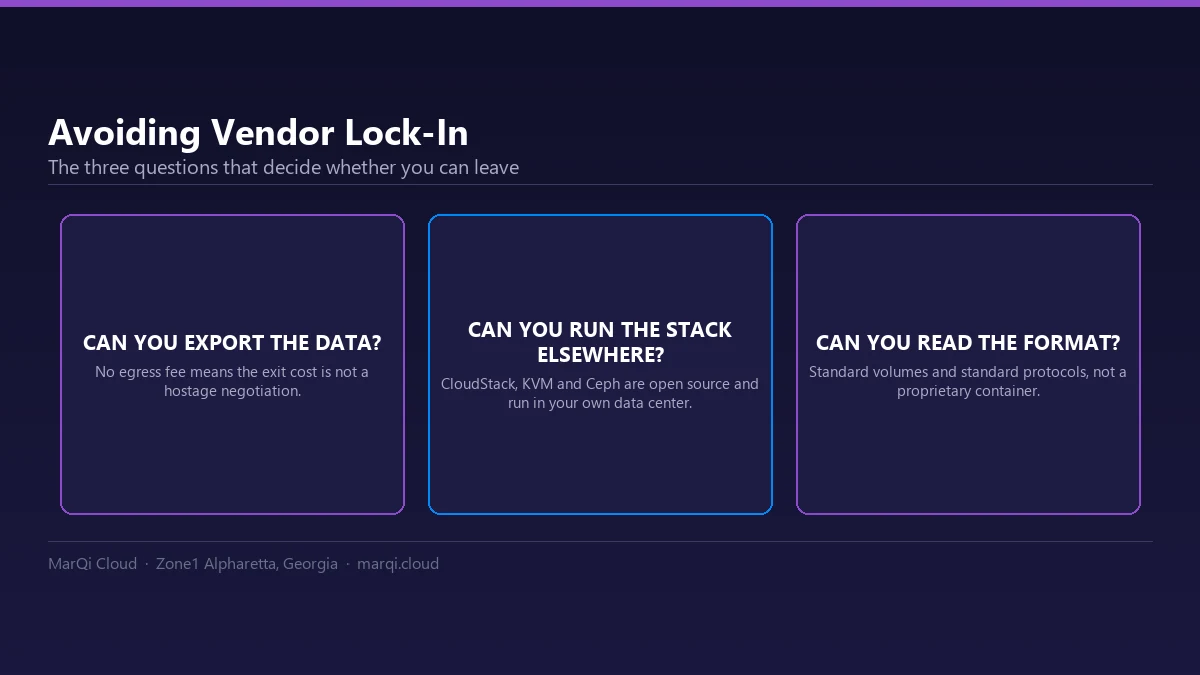
Open source solutions are designed to work with a wide range of technologies. This interoperability allows organizations to integrate their existing systems with new applications without being tied to a specific vendor’s proprietary technology.
2. Data Portability
With open source solutions, data is often stored in standard formats, making it easier to migrate data between platforms. This portability means that businesses can switch providers without worrying about losing access to critical data.
3. Customization
Organizations can tailor open source software to meet their unique requirements, enabling them to innovate and adapt quickly. This customization reduces the reliance on vendor-specific features that can lead to lock-in.
4. Community Support and Resources
The open source community provides a wealth of resources, including documentation, forums, and development tools. This support network enables organizations to troubleshoot issues independently, further reducing the dependency on any single vendor.
5. Cost Control
By eliminating proprietary software costs and licensing fees, businesses can allocate their budgets more effectively. This financial flexibility allows for more investment in innovation rather than being constrained by vendor pricing models.
Real-World Applications of MarQi Cloud’s Open Source Stack
Numerous organizations across various industries have successfully implemented MarQi Cloud’s open source stack to enhance their operational capabilities while avoiding vendor lock-in. Below are a few case studies:
Case Study 1: A Healthcare Provider
A healthcare organization migrated its applications to MarQi Cloud to leverage the scalability of Kubernetes and the security of OpenStack. By doing so, they achieved HIPAA compliance while maintaining the flexibility to switch cloud providers if needed.
Case Study 2: An E-Commerce Platform
By utilizing MarQi Cloud’s Ceph storage solution, an e-commerce company improved its data availability and redundancy. The open source nature of the solution allowed them to customize their storage architecture without being locked into a vendor’s infrastructure.
Case Study 3: A Financial Services Firm
A fintech startup utilized MarQi Cloud’s Terraform to automate their infrastructure provisioning. This automation not only saved time but also ensured that the startup could scale efficiently without being tied to a single vendor.
| Case Study | Challenge | Solution | Outcome |
|---|---|---|---|
| Healthcare Provider | Achieve HIPAA compliance | Kubernetes & OpenStack | Improved scalability and compliance |
| E-Commerce Platform | Data availability issues | Ceph Storage | Enhanced redundancy and flexibility |
| Financial Services Firm | Manual provisioning challenges | Terraform | Automated, scalable infrastructure |
Expert Insights and Tips
Here are some actionable steps organizations can take to leverage MarQi Cloud’s open source stack effectively:
- Conduct a Needs Assessment: Evaluate your organization’s specific requirements and how open source technologies can meet them.
- Engage with the Community: Participate in forums and discussions to gain insights and support from the open source community.
- Implement Infrastructure as Code: Use tools like Terraform to automate infrastructure provisioning, enhancing flexibility and reducing manual errors.
- Regularly Review Your Stack: Periodically assess your technology stack to ensure it remains aligned with your business goals and does not lead to lock-in.
Conclusion
In a world where agility and flexibility are paramount, MarQi Cloud’s open source stack stands as a formidable solution against vendor lock-in. By providing a range of customizable, interoperable, and transparent technologies, MarQi Cloud empowers organizations to maintain control over their infrastructure and applications. This not only enhances operational efficiency but also fosters a culture of innovation and adaptability. For businesses looking to break free from the constraints of vendor lock-in, MarQi Cloud offers a compelling and secure pathway forward.
FAQs
What is vendor lock-in?
Vendor lock-in refers to a situation where a customer becomes reliant on a vendor for products and services, making it difficult to switch providers without incurring high costs or operational disruptions.
How does open source technology prevent vendor lock-in?
Open source technology facilitates interoperability, data portability, and customization, allowing organizations to adapt their systems and switch providers more easily.
What are the benefits of using MarQi Cloud’s open source stack?
MarQi Cloud’s open source stack offers flexibility, cost-effectiveness, community support, and transparency, enabling organizations to avoid vendor lock-in.
Can I migrate my existing applications to MarQi Cloud?
Yes, MarQi Cloud provides cloud migration services that make it easy to transition your existing applications to their open source stack.
What industries benefit from MarQi Cloud’s open source solutions?
Industries such as healthcare, finance, and e-commerce have successfully implemented MarQi Cloud’s open source solutions to enhance their operations.
Is MarQi Cloud compliant with industry regulations?
MarQi Cloud does not publish compliance certifications. Tell our team which framework your workload must meet and we will go through what the environment supports before you commit to a design.
How does MarQi Cloud ensure data security?
MarQi Cloud employs robust security measures, including encryption and access controls, to protect data in their open source stack.
What support options are available for MarQi Cloud users?
MarQi Cloud offers various support options, including managed services and community resources, to assist users in optimizing their cloud environments.