NVMe over TCP vs iSCSI for Cloud SAN: Which Storage Protocol Wins in 2026?
May 14, 2026
Why NVIDIA Blackwell on MarQi Cloud Is 3x More Cost Efficient Than Renting Cloud GPUs
May 14, 2026

Software-Defined Storage and Cloud SAN: Why SDS Is Rewriting the Rules of Enterprise Storage
Enterprise storage used to be simple in a frustrating kind of way: you bought expensive proprietary hardware from a single vendor, paid whatever they charged for support, and accepted the performance ceiling they handed you. The storage array was a black box — you didn’t question it; you just paid for it. That model is collapsing fast, and the shift starts at the storage architecture layer.
Software-Defined Storage (SDS) is the architectural shift pulling the rug out from under legacy storage vendors. When combined with a Cloud SAN infrastructure, SDS gives IT teams the kind of flexibility, visibility, and control that purpose-built appliances never could. The global SDS market is on track to grow from roughly $66 billion in 2026 to over $260 billion by 2032.
What Is Software-Defined Storage?
Software-Defined Storage decouples the storage management software from the underlying physical hardware. Instead of relying on proprietary firmware baked into a vendor’s appliance, SDS runs as a software layer on commodity servers, virtual machines, or directly on cloud infrastructure.
This separation has real operational consequences. With SDS, you can swap or scale underlying hardware without rebuilding your storage environment, apply consistent storage policies across heterogeneous hardware, manage block, file, and object storage through a single control plane, and automate provisioning, snapshots, replication, and tiering through APIs.
The result is a storage infrastructure that behaves more like software — programmable, version-controlled, and auditable — rather than a monolithic appliance with a support contract and a five-year refresh cycle.
How SDS and Cloud SAN Work Together
A Storage Area Network (SAN) creates a dedicated high-speed network between servers and shared storage pools. Historically, SANs required expensive Fibre Channel switches, vendor-specific HBAs, and proprietary management tools — keeping enterprise-grade storage out of reach for smaller organizations.
Cloud SAN changes this calculus. By delivering SAN-style block storage over standard Ethernet and modern protocols like NVMe over Fabrics, Cloud SAN makes high-performance shared storage accessible without specialized hardware. SDS provides the intelligence layer on top: a unified management plane that presents consistent block volumes to bare metal servers, VMs, and containers; automates data placement across performance tiers; replicates data across availability zones; and applies QoS policies to prioritize latency-sensitive workloads.
This pairing — Cloud SAN as the transport layer, SDS as the intelligence layer — is how modern enterprise storage environments achieve agility that traditional SANs never could.
The Key Workloads That Benefit Most
Database Workloads
Relational databases like PostgreSQL and MySQL, and analytical engines like ClickHouse and Spark, demand consistent low-latency block I/O. SDS policies can dedicate IOPS budgets to these workloads, keeping query times predictable even when adjacent storage consumers spike. Inconsistent storage I/O is one of the top contributors to tail latency — SDS QoS policies are a direct architectural fix for that problem.
Kubernetes Persistent Volumes
Stateful Kubernetes workloads need persistent storage that survives pod restarts and node failures. SDS platforms expose a CSI (Container Storage Interface) driver that allows Kubernetes to dynamically provision and manage persistent volumes backed by Cloud SAN block storage. When you pair that with a capable compute platform, the storage layer stays policy-driven and the cluster scales without manual intervention.
AI and ML Training Data Pipelines
GPU-accelerated training jobs consume data at rates that saturate traditional NAS or shared file systems. SDS can stripe reads across multiple Cloud SAN volumes, multiplying available throughput. For organizations running high-throughput data ingestion pipelines, pairing SDS with dedicated GPUs for AI/ML closes the gap between compute throughput and storage throughput.
Hybrid Cloud Data Replication
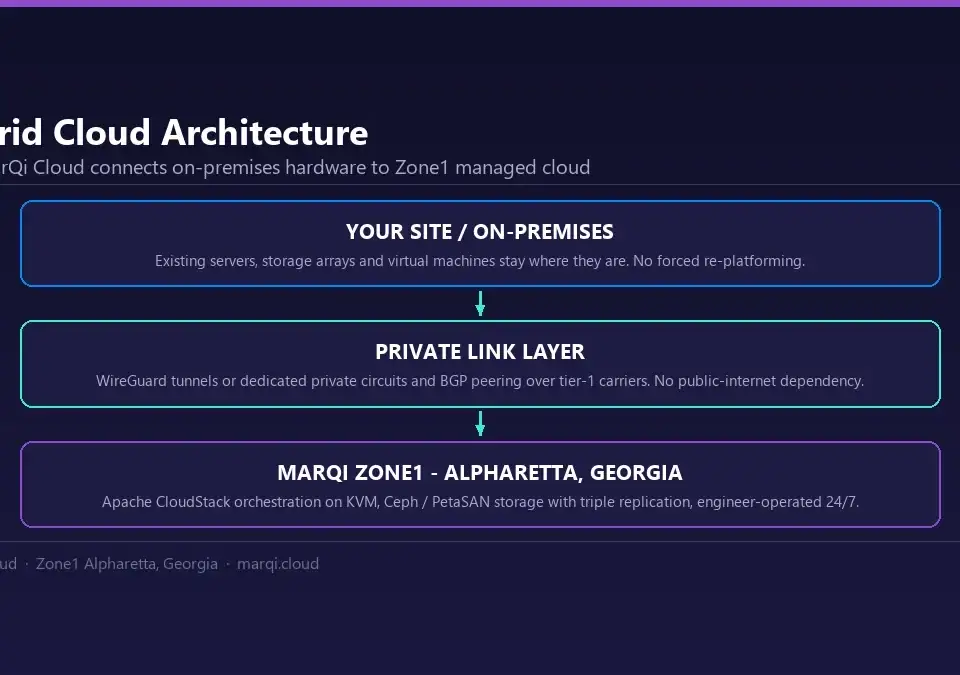
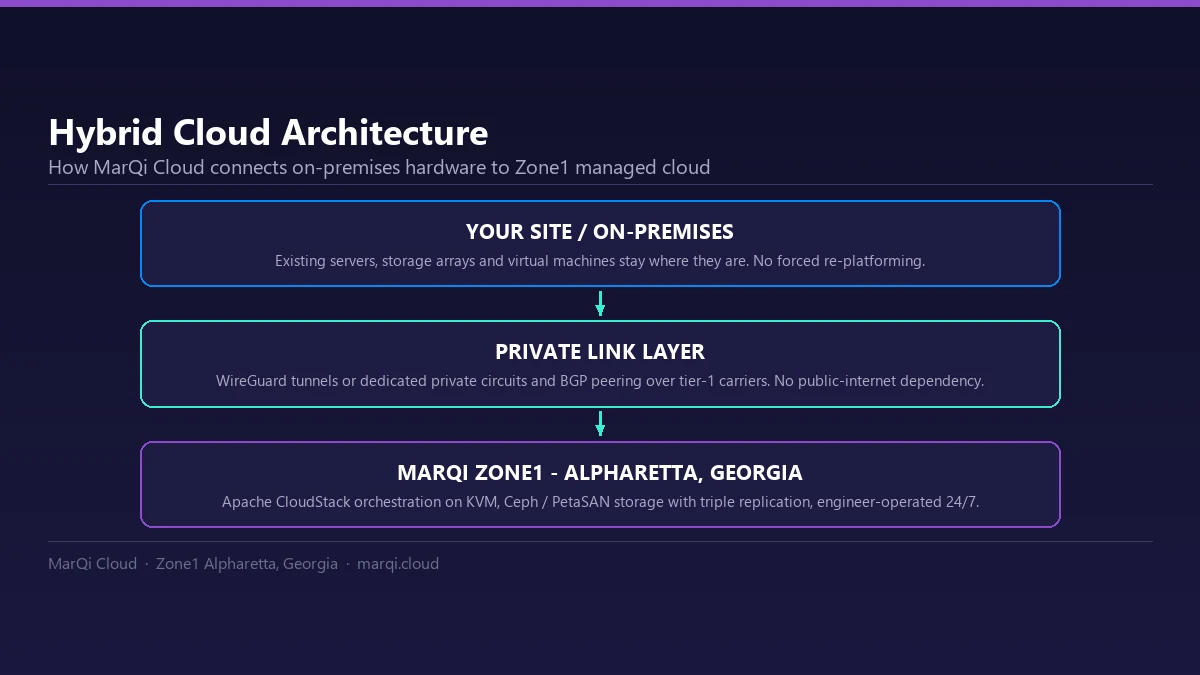
Organizations bridging on-premises and cloud environments need storage that spans both consistently. SDS platforms with hybrid capabilities replicate volumes, manage failover, and synchronize snapshots across environments through a single policy engine. If you’re already running a hybrid cloud setup, SDS is the layer that makes storage behaviour predictable on both sides of the boundary.
What Separates Good SDS from Commodity Storage Management
The SDS market has matured enough that meaningful quality differences exist between platforms. Here’s what to evaluate:
Protocol breadth. The best SDS platforms support iSCSI, NVMe-oF/TCP, and SMB/NFS from a single management layer — so you can provision different protocols to different workloads without deploying separate storage stacks.
Thin provisioning and deduplication. Production SDS platforms ship with thin provisioning as standard — you allocate logical capacity that maps dynamically to physical space. Deduplication and compression reduce the physical footprint of databases, VM images, and backup volumes.
Snapshot and replication granularity. Enterprise workloads need crash-consistent snapshots, not just periodic volume copies. Look for platforms that snapshot at sub-minute intervals and replicate asynchronously without blocking primary I/O. MarQi Cloud’s snapshots and backups infrastructure is built around exactly this requirement.
API-first management. Any SDS platform worth deploying in 2026 exposes a full REST API for provisioning, monitoring, and policy management — table stakes for teams moving toward infrastructure-as-code and GitOps workflows.
Observability hooks. IOPS, throughput, latency, and queue depth metrics should export to standard tools like Prometheus and Grafana. Storage that can’t be observed can’t be optimized.
The Cost Argument for SDS on Cloud SAN
Legacy SAN vendors price their platforms assuming captive customers: hardware lock-in, proprietary licenses, annual support agreements, and refresh cycles on the vendor’s schedule rather than yours.
SDS on Cloud SAN flips this. Compute and storage scale independently. You pay for what you use. When workload requirements change, you adjust a policy — not a hardware purchase order. Before committing to any storage platform, it’s worth reviewing transparent infrastructure pricing to understand what you’re actually paying per GB and per IOPS at scale.
The savings typically come from three places: eliminating proprietary hardware premiums, reducing the operational overhead of siloed storage stacks, and right-sizing capacity in near real-time rather than over-provisioning for projected peak demand.
Where This Is Headed
Hardware-defined storage systems are losing ground in every market segment where software-defined alternatives are viable. The vendors who see this are building SDS layers on top of flash and cloud infrastructure. The vendors who don’t are losing customers.
For organizations evaluating Cloud SAN options in 2026, the question isn’t whether to adopt SDS — it’s which SDS platform and which storage network to build it on. The combination of a modern Cloud SAN with a mature SDS layer delivers the performance of a traditional SAN, the flexibility of cloud infrastructure, and the operational simplicity of a software-managed system.
If you’re ready to move your storage architecture in this direction, MarQi Cloud provides the Cloud SAN infrastructure to run it on — without vendor lock-in, proprietary hardware tax, or surprise line items.
Frequently Asked Questions
What is software-defined storage?
Software-defined storage decouples the storage management software from the underlying physical hardware. Instead of proprietary firmware baked into a vendor’s appliance, it runs as a software layer on commodity servers, virtual machines or directly on cloud infrastructure, so the hardware underneath can be swapped or scaled independently.
How do SDS and Cloud SAN work together?
A SAN creates a dedicated high-speed network between servers and shared storage pools, which historically meant Fibre Channel switches and vendor-specific hardware. Cloud SAN delivers SAN-style block storage over standard Ethernet and modern protocols such as NVMe over Fabrics, and SDS provides the intelligence layer on top: one management plane presenting consistent block volumes to bare metal, VMs and containers.
Which workloads benefit most from software-defined storage?
Databases such as PostgreSQL and MySQL and analytical engines such as ClickHouse and Spark, which need consistent low-latency block I/O; stateful Kubernetes workloads, through a CSI driver for persistent volumes; AI and ML training pipelines, where reads can be striped across volumes to multiply throughput; and hybrid cloud replication across on-premises and cloud environments.