Why MarQi Cloud Is the Best Infrastructure Choice for Headless CMS Platforms
May 21, 2026
Storage QoS in Cloud SAN: How to Control IOPS and Latency for Enterprise Workloads
May 21, 2026

Thin Provisioning vs Thick Provisioning in Cloud SAN: Which One Is Right for Your Enterprise?
When you provision storage in a Cloud SAN environment, the method you choose has real consequences — for performance, capacity planning, cost, and operational complexity. Provisioning is one half of SAN performance; the other is the protocol — compare NVMe/TCP and iSCSI on the same backend. Thin provisioning and thick provisioning are the two fundamental approaches, and the choice between them is not always obvious. On a Ceph-backed cloud SAN the platform has often answered it already: RBD images are thin-provisioned, so capacity is consumed as blocks are written rather than at creation, and the behaviour is documented in the Ceph block device documentation.
Many teams default to whichever option their platform suggests without thinking through the downstream effects. This post walks through exactly how each model works, where each one earns its place, and how to make the decision in the context of modern enterprise workloads. If you’re already thinking about how your underlying storage architecture handles capacity allocation, this comparison will help you make a more informed call.
What Is Thick Provisioning?
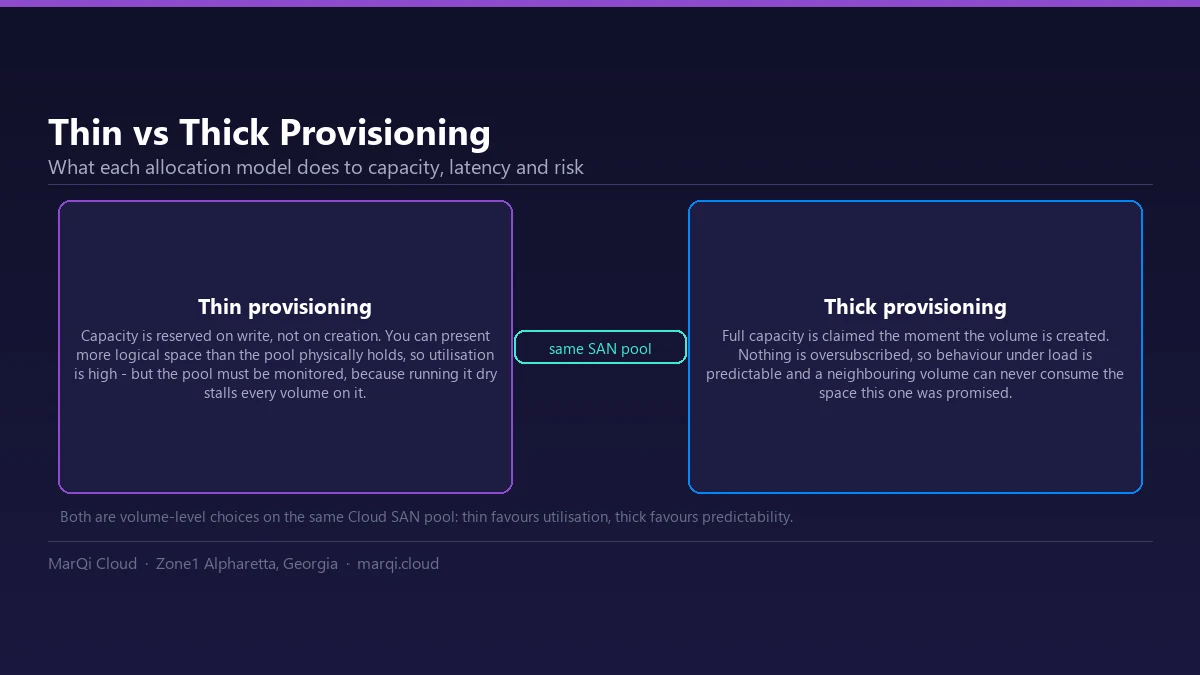
Thick provisioning, sometimes called eager zeroing or pre-allocation, reserves the full amount of storage a virtual disk claims at the moment of creation. On Linux the machinery behind the thin alternative is device-mapper’s thin provisioning target, and the details that actually bite in production — shared blocks between snapshots, the separate metadata device, and what the pool does when it runs out of space — are set out in the kernel thin provisioning guide. If you create a 500 GB volume, the SAN immediately carves out 500 GB of physical capacity — even if the workload only uses 10 GB on day one.
There are two variants of thick provisioning in most platforms:
Lazy Zeroed Thick: Capacity is reserved at creation but the disk blocks are zeroed out on first write, not upfront. This is faster to create but slightly slower on initial writes.
Eager Zeroed Thick: All disk blocks are zeroed at creation time. This takes longer to initialize but delivers the most consistent write performance afterwards — important for latency-sensitive databases and high-throughput applications.
The defining characteristic of thick provisioning is predictability. You always know exactly how much physical storage is consumed, because the reservation is explicit. There is no overcommitment, no risk of capacity exhaustion from competing workloads, and no performance surprises caused by allocation-on-write operations.
What Is Thin Provisioning?
Thin provisioning allocates storage capacity on-demand rather than upfront. A thin-provisioned 500 GB volume might only consume 12 GB of actual physical space on day one, growing gradually as data is written.
The SAN presents the full 500 GB logical capacity to the host while the physical storage pool only hands out blocks as they are actually used. This creates the ability to overcommit storage — provisioning more logical capacity across your environment than you physically have — on the assumption that not every volume will fill to its stated size simultaneously.
Thin provisioning is widely used because it dramatically improves storage utilization rates. In environments where thick provisioning was the default, it was common to find that 40–60% of pre-allocated storage was sitting empty. Thin provisioning reclaims that wasted space and lets the same physical pool serve more workloads.
The trade-off is operational overhead. When a thin-provisioned pool approaches physical capacity, performance can degrade or workloads can fail if the storage controller cannot allocate additional blocks. Good monitoring and alerting practices are non-negotiable when running thin provisioning at scale.
Performance: Where the Difference Actually Shows Up
For most general workloads — web servers, development environments, file shares, containerized apps — the performance difference between thin and thick provisioning is negligible under normal conditions. Modern SAN controllers handle block allocation efficiently enough that the overhead is rarely perceptible.
The gap opens up in three specific scenarios:
High-Frequency Random Writes: Applications that generate a constant stream of small, random write operations — high-frequency trading systems, OLTP databases, real-time analytics pipelines — can experience latency spikes on thin-provisioned volumes when block allocation happens mid-operation. Eager-zeroed thick provisioning eliminates this class of latency entirely.
Storage Pool Saturation: As a thin-provisioned pool fills toward capacity, the controller begins spending more cycles managing which blocks are available. This creates a non-linear degradation curve. At 80% physical utilization, performance is usually fine. At 90–95%, you may start seeing measurable latency increases. This is why most storage teams set capacity alerts at 75–80%.
Snapshot and Clone Operations: Thin provisioning interacts closely with snapshot mechanics. When you snapshot a thin-provisioned volume, the storage system must track which blocks have changed since the snapshot was taken. If both the base volume and its snapshots are thin-provisioned, the metadata overhead grows considerably over time. The snapshots and backups layer of your cloud infrastructure needs to account for this relationship from the start.
Storage Efficiency and Cost Implications
This is where thin provisioning wins decisively for most enterprise environments.
A thick-provisioned environment tends to see real utilization rates of 40–65% across the storage pool. In a 100 TB SAN, that means 35–60 TB of purchased capacity sits empty at any given time. At cloud infrastructure pricing, that is a significant and recurring cost.
Thin provisioning can push real utilization rates to 80–90%, meaning you can serve more workloads from the same physical footprint. The savings compound when you factor in replication — because thin-provisioned volumes only replicate actual data blocks (not zeroed space), replication traffic and secondary storage requirements are also reduced.
However, the efficiency gains only materialize if the environment is properly managed. Over-commitment without discipline turns thin provisioning from a cost optimization into a reliability risk. The rule most storage architects follow: never allow the committed logical capacity to exceed 2x the physical pool size without robust monitoring and growth plans in place.
When to Use Thick Provisioning
Thick provisioning earns its place in several specific scenarios:
Mission-Critical Databases: Oracle, SQL Server, and other high-IOPS transactional databases benefit from the write predictability of eager-zeroed thick provisioning. When every millisecond of latency matters, eliminating allocation-on-write overhead is worth the upfront capacity cost.
Compliance Workloads With Predictable Footprints: Some regulated industries require that storage allocations be explicit and auditable. Thick provisioning makes capacity accounting unambiguous — useful for environments that go through infrastructure audits.
Latency-Sensitive AI/ML Training Runs: Large model training workloads that stream data continuously to GPU memory benefit from knowing that the storage allocation is guaranteed and will not be interrupted by a thin pool allocation event mid-epoch.
Isolated High-Performance Zones: Many enterprises run hybrid provisioning strategies — thick provisioning for a small, designated tier of performance-critical workloads, thin provisioning everywhere else. This gives the best of both models without wholesale overcommitment.
When to Use Thin Provisioning
Thin provisioning is the default choice for:
Dev/Test/Staging Environments: Developers routinely spin up environments that consume only a fraction of their stated size. Thick provisioning these workloads is pure waste. Thin provisioning lets you run dozens of dev environments from the same pool that would otherwise support only a handful.
Multi-Tenant Cloud Infrastructure: Platforms serving multiple tenants need to maximize the workloads each storage node can support. Thin provisioning with intelligent monitoring is the standard approach across every major cloud provider.
Workloads With Unpredictable Growth: When you genuinely do not know how large a volume will become, thin provisioning lets the volume grow into its capacity rather than forcing a guess at initial allocation.
Object Storage-Adjacent Block Tiers: When block storage volumes are feeding data into an object storage layer — for ingest, transformation, or staging — thin provisioning the block tier reduces the physical footprint while the object layer handles long-term retention cost-effectively.
For teams building workloads that mix block and object storage patterns, the distinction between these two provisioning models connects directly to how you architect the full storage tier. A deeper look at how software-defined storage in Cloud SAN handles pool management can help you see where provisioning decisions interact with controller-level policy.
The Hybrid Approach: How Enterprise Teams Actually Deploy This
In practice, most mature enterprise storage environments do not pick one or the other — they run tiered provisioning strategies.
A typical pattern:
- Tier 1 (NVMe SSD block storage): Eager-zeroed thick provisioning for databases, trading systems, and AI workloads with strict latency SLAs
- Tier 2 (SSD block storage): Thin provisioning for production application servers, containers, and virtualized workloads with burst tolerance
- Tier 3 (High-density storage or cold block tiers): Thin provisioning with aggressive overcommitment ratios, used for archival, backup staging, and dev environments
This tiered structure lets you allocate the right provisioning model to the right workload class without forcing a one-size-fits-all decision. The storage controller handles the policy enforcement; the infrastructure team sets the rules.
The underlying network connecting these tiers matters enormously. High-throughput thin provisioning across multiple workloads generates significant metadata traffic in addition to data traffic. A well-designed network fabric with dedicated storage VLANs and sufficient bandwidth headroom prevents the network from becoming the bottleneck in a mixed-provisioning environment.
Monitoring Requirements for Thin-Provisioned Environments
Thin provisioning introduces failure modes that thick provisioning does not have. The most important operational practice is treating capacity thresholds as real-time alerts, not weekly checks.
Key metrics to monitor continuously:
- Physical pool utilization %: Alert at 75%, escalate at 85%
- Committed vs. physical ratio: Track overcommitment ratios per pool
- Write latency trends: Early indicator of a pool approaching saturation
- Snapshot chain depth: Long chains on thin volumes amplify metadata overhead
- Reclaim efficiency: Are deleted volumes actually returning space to the pool?
Most enterprise storage platforms expose these metrics via SNMP, REST APIs, or native telemetry integrations. If you are running a Cloud SAN environment and these metrics are not wired into your observability stack, you are operating without the safety net that makes thin provisioning sustainable long-term.
Making the Decision for Your Environment
The choice comes down to workload profile, not ideology. Ask three questions:
- Is this workload latency-sensitive with high random write rates? If yes — thick provisioning, eager zeroed.
- Is this workload well-understood with a stable, predictable footprint? If yes — thick provisioning is reasonable and simplifies capacity planning.
- Does anything else apply? Thin provisioning, managed with proper monitoring and a conservative overcommitment ratio.
For teams planning a migration or greenfield deployment, the getting started resources can help you map your workload types before making provisioning decisions that are difficult to reverse once data is on the volume.
Conclusion
Thin and thick provisioning each solve a real problem. Thick provisioning eliminates allocation uncertainty and delivers the most consistent write performance for the workloads that need it most. Thin provisioning reclaims the efficiency losses that come with over-allocated storage pools, letting the same physical infrastructure serve more workloads at lower cost.
The most effective enterprise storage environments use both — thick where latency predictability is non-negotiable, thin everywhere the flexibility and efficiency gains outweigh the added monitoring burden. Getting the policy right from the start, before volumes are filled and workloads are in production, is far easier than retrofitting provisioning decisions after the fact.
MarQi Cloud provides flexible block storage that supports both provisioning models, letting your team apply the right policy at the workload level without locking into a platform-wide compromise.
Frequently Asked Questions
Is thin or thick provisioning faster?
For most general workloads – web servers, development environments, file shares, containerised applications – the difference is close to negligible, and choosing on performance grounds alone usually means optimising something that is not the bottleneck. The gap appears in a narrower case: latency-sensitive workloads with high random write rates, where thick provisioning removes the allocation step from the write path and delivers more consistent behaviour. That is why mission-critical transactional databases are the usual example, not the usual case.
What can go wrong with thin provisioning?
It introduces a failure mode that thick provisioning does not have: the pool can be oversubscribed, so the sum of what volumes claim exceeds what physically exists. Nothing is wrong until utilisation climbs, and then it is wrong suddenly. The operational answer is to treat capacity thresholds as real-time alerts rather than monthly reports, so the pool is extended before volumes start failing writes. In exchange you get the efficiency: thick-provisioned environments typically run at only 40 to 65 per cent real utilisation, and that gap is capacity paid for and not used.