Why DR Testing Cadence Determines Whether Your Plan Actually Works
July 21, 2026
How Snapshot-Based Recovery Provides Granular Restore Points for Cloud Workloads
July 21, 2026
What is the difference between a hot, warm and cold site?
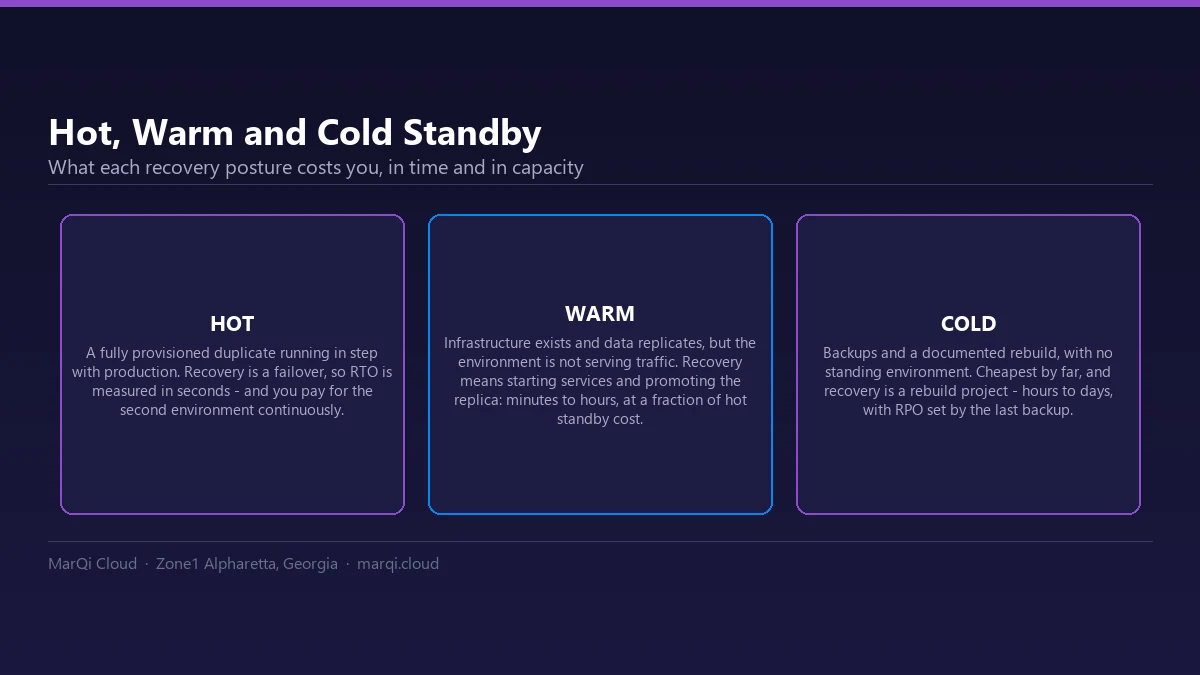
A hot site runs in step with production and fails over in seconds. A warm site has the infrastructure and replicated data but is not serving traffic, so recovery takes minutes to hours. A cold site is backups plus a documented rebuild: cheapest to hold, and measured in hours to days.
The Complete Guide to Warm, Hot, and Cold Disaster Recovery Standby Options
In today’s digital landscape, ensuring business continuity is paramount. Understanding the different disaster recovery (DR) standby options—warm, hot, and cold—can help organizations safeguard their data and maintain operations during unexpected events. Whether you’re a mid-sized enterprise or a large organization, selecting the right disaster recovery strategy is crucial for minimizing downtime and protecting your assets. In this comprehensive guide, we will delve into the intricacies of warm, hot, and cold disaster recovery standby options, highlighting their benefits, drawbacks, and best practices to help you make informed decisions.
What is Disaster Recovery?
Disaster recovery refers to the strategies, policies, and procedures that organizations implement to protect and restore their IT infrastructure and operations following a disruptive event. This can include natural disasters, cyberattacks, hardware failures, or human error. Effective disaster recovery plans ensure that critical business functions can continue with minimal interruption, safeguarding both data integrity and organizational reputation.
The Importance of Disaster Recovery
According to a study by the National Archives and Records Administration, 93% of companies that experience a significant data loss go out of business within five years. Furthermore, the average cost of downtime is estimated to be around $5,600 per minute for enterprises. These statistics underscore the importance of having a robust disaster recovery plan in place. By investing in disaster recovery, organizations can:
- Minimize downtime and operational disruption
- Protect sensitive data and maintain compliance with regulations
- Enhance customer trust and brand loyalty
- Reduce financial losses associated with data loss
Types of Disaster Recovery Standby Options
When it comes to disaster recovery, organizations typically choose between three primary standby options: hot, warm, and cold. Each option varies in terms of cost, implementation complexity, and recovery time objectives (RTO). Understanding the differences between these options is crucial for selecting the best fit for your organization’s needs.
Hot Disaster Recovery
Hot disaster recovery involves maintaining a fully operational secondary site that mirrors the primary site in real-time. This setup allows for immediate failover in the event of a disaster, ensuring minimal downtime and business continuity. Key characteristics of hot disaster recovery include:
- Real-Time Data Replication: Data is continuously replicated to the secondary site, keeping it up-to-date.
- Immediate Failover: In the event of a failure, operations can switch to the secondary site without delay.
- Higher Costs: Due to the need for a fully operational site and ongoing maintenance, hot disaster recovery is typically the most expensive option.
Hot disaster recovery is ideal for organizations that require zero downtime, such as financial institutions and e-commerce platforms. For example, a financial services company might use hot disaster recovery to ensure that trading platforms remain operational during a systems failure.
Warm Disaster Recovery
Warm disaster recovery strikes a balance between cost and recovery speed. In this model, a secondary site is set up with some level of data replication, but it may not be continuously updated. Instead, data is backed up at regular intervals, which can range from minutes to hours. The key characteristics of warm disaster recovery include:
- Periodic Data Replication: Data is replicated at scheduled intervals, which may lead to some data loss in case of a failure.
- Moderate Failover Time: Failover can take longer compared to hot disaster recovery, depending on the last backup.
- Cost-Effective: Warm standby solutions are generally more affordable than hot options, making them suitable for many organizations.
Warm disaster recovery is suitable for businesses that can tolerate some downtime, such as small to mid-sized enterprises. For example, a SaaS company may opt for warm disaster recovery to maintain service availability without the high costs associated with hot standby solutions.
Cold Disaster Recovery
Cold disaster recovery involves maintaining a secondary site that is not actively operational. In this model, data backups are stored off-site, and the infrastructure is only powered up when a disaster occurs. Key characteristics of cold disaster recovery include:
- Manual Activation: The secondary site must be manually activated during a disaster, which can lead to considerable downtime.
- Cost-Effective: Cold standby solutions are the most affordable option, as they require minimal ongoing maintenance.
- Data Backup Frequency: Backups may occur daily or weekly, which can result in significant data loss in case of a failure.
Cold disaster recovery is suitable for organizations with less critical operational needs or those with limited budgets. For example, a non-profit organization may rely on cold disaster recovery to save costs while still protecting essential data.
Comparison of Disaster Recovery Options
| Feature | Hot Disaster Recovery | Warm Disaster Recovery | Cold Disaster Recovery |
|---|---|---|---|
| Data Replication | Real-Time | Periodic | Manual Backup |
| Failover Time | Immediate | Moderate | Extended |
| Cost | High | Moderate | Low |
| Operational Status | Always On | Standby | Powered Off |
| Best For | Critical Operations | Moderate Needs | Budget-Conscious |
Best Practices for Disaster Recovery Planning
Implementing a successful disaster recovery plan requires careful planning and execution. Here are some best practices to consider:
- Conduct a Business Impact Analysis: Identify critical business functions and the potential impact of downtime.
- Define Recovery Time Objectives (RTO) and Recovery Point Objectives (RPO): Establish clear goals for how quickly systems should be restored and how much data loss is acceptable.
- Regularly Test Your DR Plan: Conduct regular drills to ensure your team is prepared and that systems operate as expected during a disaster.
- Document Everything: Maintain detailed documentation of your disaster recovery procedures, including contact information for key personnel.
- Engage with a Trusted Provider: Partner with a reliable cloud service provider, such as MarQi Cloud, to leverage their expertise in disaster recovery solutions.
For more insights on disaster recovery strategies, check out our article on how MarQi Cloud handles disaster recovery without breaking the bank.
Frequently Asked Questions
1. What is the difference between RTO and RPO?
Recovery Time Objective (RTO) refers to the maximum acceptable amount of time that a system can be down after a disaster, while Recovery Point Objective (RPO) indicates the maximum amount of data loss measured in time. For example, if the RTO is two hours and the RPO is 30 minutes, the organization must restore systems within two hours and ensure that no more than 30 minutes of data is lost.
2. How often should I test my disaster recovery plan?
It is recommended to test your disaster recovery plan at least once a year. However, if your organization undergoes significant changes, such as new technology implementations or changes in personnel, you should conduct tests more frequently.
3. Can I use a combination of disaster recovery options?
Yes, many organizations choose to implement a hybrid approach that combines hot, warm, and cold disaster recovery strategies to meet their specific needs and budget constraints.
4. What is the most cost-effective disaster recovery option?
Cold disaster recovery is typically the most cost-effective option, as it requires minimal ongoing maintenance and infrastructure costs. However, it may come with longer recovery times and potential data loss.
5. How can I ensure my data is secure during disaster recovery?
Implement encryption for data at rest and in transit, regularly update your security protocols, and ensure that your disaster recovery provider adheres to industry compliance standards.
6. What role does cloud computing play in disaster recovery?
Cloud computing provides flexibility and scalability for disaster recovery solutions. Many organizations leverage cloud services to create cost-effective, geographically diverse recovery sites that can be activated quickly in case of a disaster.
7. How do I choose the right disaster recovery provider?
When selecting a disaster recovery provider, consider their experience, reputation, service offerings, and support capabilities. Look for a provider that aligns with your organization’s specific needs and compliance requirements.
8. What should I include in my disaster recovery documentation?
Your disaster recovery documentation should include detailed recovery procedures, contact information for key personnel, system configurations, and a communication plan for stakeholders during a disaster.