The MarQi Cloud Network Topology Deep Dive: How Data Moves Inside the Platform
April 1, 2026
Budgeting for Cloud-Native Transformation: A Practical Guide
April 1, 2026

Is Investing in Dedicated GPU Clusters Worth It for Startups?
Introduction
The use of AI, machine learning, and data-based applications is increasing every day. Many modern technologies need strong computing power to run smoothly and give fast results.
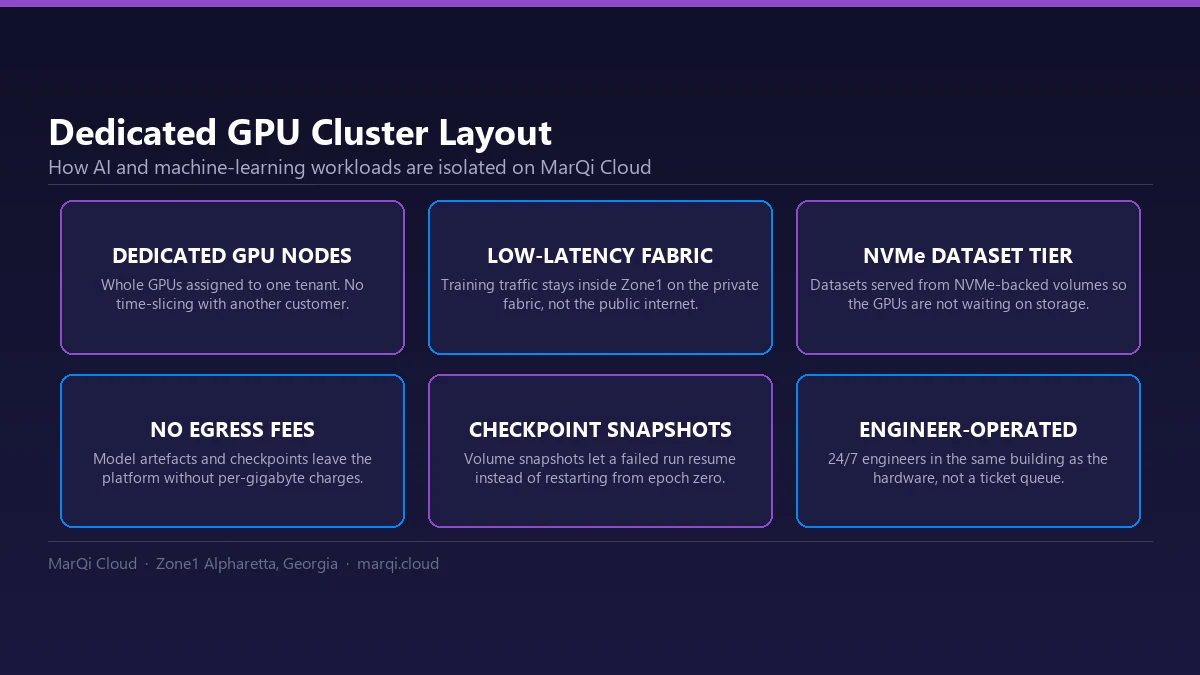
Dedicated GPU Clusters are one way to handle these heavy tasks. They use multiple GPUs together to process large amounts of data and train AI models more quickly.
Because of this, many startups are starting to invest in GPU infrastructure. It helps them improve performance and work more efficiently.
But at the same time, startups also need to think about cost. It’s important to choose a solution that offers good performance without going over budget.
Understanding Dedicated GPU Clusters
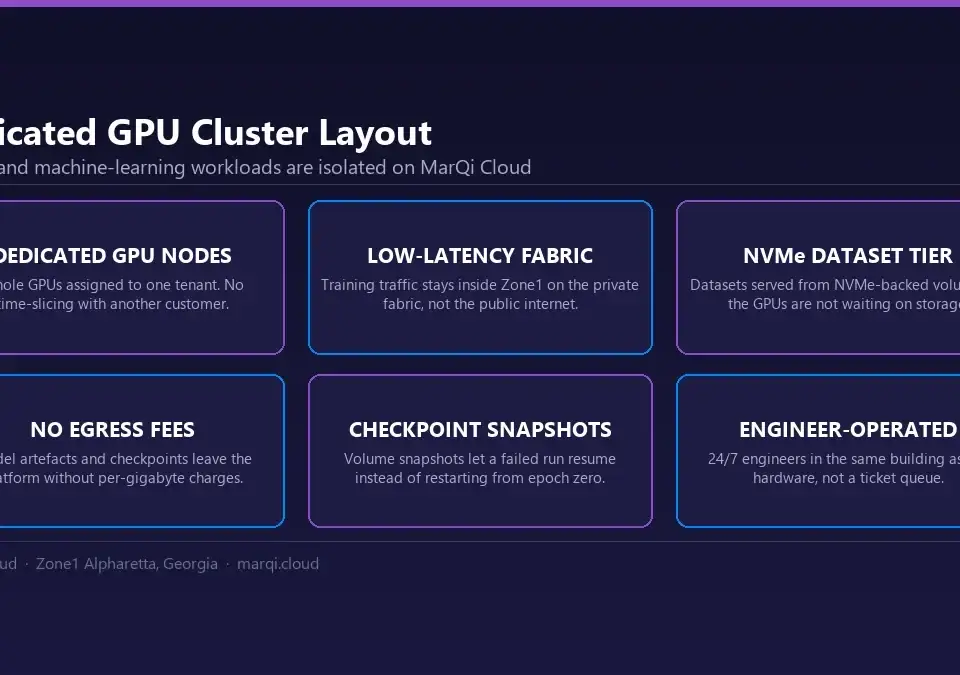
Dedicated GPU Clusters are powerful computing systems where multiple GPU-enabled servers are connected and work together as a single unit. These clusters are specially designed to handle heavy and complex tasks such as AI model training, large-scale data processing, simulations, and rendering. Since all resources are fully dedicated to one user or organization, they provide stable, reliable, and high-performance computing without interruptions or slowdowns.
Key Features
- High-speed performance: These clusters offer strong processing power, making it easier to handle large and complex workloads quickly and efficiently.
- Scalable architecture: Startups can easily expand their setup by adding more GPUs as their business grows and demands increase.
- Parallel computing: Multiple tasks can run at the same time, which improves speed and overall productivity.
- Dedicated resources: All GPU power, memory, and bandwidth are reserved for a single user, ensuring consistent performance without any interference.
Why Startups Are Choosing Dedicated GPU Clusters
Growing Need for AI and ML
As AI and machine learning continue to grow, startups need more advanced computing power to build and train their models. Faster training means quicker development, helping businesses bring their products to market in less time.
- AI-based applications require large amounts of data and processing power
- Faster model training improves efficiency and reduces development time
- Helps startups stay competitive in a fast-moving tech environment
Control and Customization
One of the key reasons startups prefer this setup is the level of control it offers. They can manage their systems based on their specific needs and optimize performance accordingly.
- Full control over hardware and configurations
- Ability to customize systems for different workloads
- Better resource management and improved efficiency
Performance Advantages
Performance is a major factor when handling complex tasks. With dedicated systems, startups can rely on consistent and smooth operations without unexpected slowdowns.
- No resource sharing, which reduces delays and performance issues
- Stable and predictable performance for long-running tasks
- Lower latency, making it ideal for real-time applications and large-scale processing
Understanding Distributed AI Training Costs
Training AI models needs a lot of computing power, which comes with high expenses called distributed AI training costs. When many GPUs work together, costs can range from a few thousand dollars for small models to hundreds of millions for top-tier models. The main expenses come from cloud GPU rentals, networking, and electricity, and these costs grow quickly as models get bigger.
Examples of Costs:
- Large Models: GPT-4 cost around $78 million, Google Gemini Ultra about $191 million, and GPT-5 could reach nearly $1 billion
- Smaller Models: Training a 7B parameter model may cost $85K–$200K, while fine-tuning can cost just a few hundred or thousand dollars
To manage distributed AI training costs, it’s important to focus on:
- Efficiency: Make sure GPUs are used fully to avoid wasting time and money
- Reliability: Use regular checkpoints to prevent losing hours of work if a system fails
- Optimization: Plan carefully when moving from small tests to full production to control costs
Other hidden costs include hardware maintenance, electricity for power and cooling, and skilled staff to manage the systems.
By understanding distributed AI training costs, startups can plan better, save money, and scale their AI projects effectively.
Open Source GPU Cluster Management
Open Source GPU Cluster Management is free software that helps organizations set up, organize, and optimize multiple GPUs across different machines. These tools make it easy to run AI training, model fine-tuning, and inference workloads efficiently while making the most of all GPU resources.
Startups and AI teams use open source GPU cluster management because it reduces costs and ensures high performance. Without proper management, GPU clusters can stay idle, wasting up to 40–60% of their computing power.
Key Benefits
- Efficient Resource Use: Combine GPUs from different vendors and locations into a single, easy-to-manage pool
- Automatic Task Scheduling: Assign AI jobs, like training large language models, across all GPUs automatically
- Cost Savings: Reduce reliance on expensive cloud GPU services by using existing hardware
- High Performance: Enable multiple GPUs to work together for faster training and inference
- Monitoring: Track GPU health, memory, and usage through dashboards like Prometheus and Grafana
- Flexibility: Supports AI training, inference, and batch processing workloads
Popular Open Source Tools
- GPUStack: Built for running large AI models and deploying from repositories like Hugging Face
- Kubernetes (K8s): Helps deploy, scale, and manage containerized AI workloads
- Slurm: Commonly used in high-performance computing to manage job queues and scheduling
- Ray: Optimized for distributing AI workloads across multiple GPUs
Using open source GPU cluster management helps organizations avoid idle hardware, improve efficiency, and keep AI projects running smoothly while saving costs.
GPU Cloud for LLM Training
A GPU Cloud for LLM Training is a cloud service that provides remote access to powerful GPUs over the internet. It allows AI developers to train, fine-tune, or run inference on large language models (LLMs) without the need to buy or maintain expensive physical hardware.
Large models like GPT, LLaMA, or Mistral need massive computing power that regular CPUs cannot handle. A GPU Cloud for LLM Training offers the performance and flexibility needed to manage these workloads efficiently.
Benefits of GPU Cloud for LLM Training
- No upfront hardware cost: Pay only for the resources you use
- Easy to scale: Add or remove GPU resources as your project grows
- Ideal for experiments: Perfect for short-term projects or testing new models
Even though cloud GPUs are convenient, dedicated GPU clusters may be better for long-term projects or large-scale training. Many teams use a mix of cloud and on-premise solutions to balance cost and performance effectively.
Hybrid Cloud AI: The Smart Solution for Startups
Hybrid Cloud AI is a modern approach that combines public clouds, private clouds, and on-premises data centers to develop, train, and deploy AI models. This setup allows businesses to use cloud resources for heavy AI workloads while keeping sensitive data secure on private systems, giving the perfect balance of performance, cost, and security.
Key Benefits of Hybrid Cloud AI
- Flexible Workloads: Choose the best environment for each AI task, whether it’s high-performance training or secure data handling.
- Data Security & Compliance: Keep sensitive data on-premises while still using cloud tools for intensive AI workloads.
- Scalable Performance: Offload large tasks like training LLMs to the cloud, while keeping latency-sensitive tasks close to the data source.
- Centralized Management: Monitor and manage all AI workloads from a single platform across cloud and on-premise systems.
Why Startups Choose Hybrid Cloud AI
- Easy Scalability: Quickly add resources as projects grow without heavy upfront investment.
- Cost-Effective: Use cloud computing only when needed to save money.
- Secure & Compliant: Protect sensitive data while still taking advantage of cloud power.
Practical Use Cases
- Training models on dedicated GPU clusters and deploying them to the cloud
- Handling peak workloads by using cloud resources
- Running AI projects like predictive analytics, generative AI, and computer vision, combining performance with secure data management
By using Hybrid Cloud AI, startups can enjoy the best of both worlds: the power and scalability of the cloud and the security and control of on-premise systems.
MarQi Cloud
MarQi Cloud is a reliable infrastructure provider designed to give startups and businesses access to powerful, high-performance GPU environments. Its independent infrastructure ensures performance, scalability, and security for demanding AI and computing workloads.
Key features of MarQi Cloud include:
- Independent Data Center: Equipped with its own storage cluster for secure and efficient data management
- Redundant Network Fabric: Ensures high availability and minimal downtime
- High Performance: Optimized GPU environments for AI training, simulations, and large-scale computations
- Scalability: Easily expand resources to meet growing workloads and project demands
- Security: Sensitive data stays protected within a controlled and monitored environment
- Reliability: Redundant systems maintain smooth operations even during peak workloads
- Startup-Friendly: Ideal for startups needing stable, powerful GPU infrastructure without the complexity of on-premise management
Conclusion
Investing in Dedicated GPU Clusters offers strong advantages such as consistent performance, full control, and predictable computing power. Startups should carefully evaluate their workload requirements, budget, and growth plans before making a decision.
Combining solutions like Hybrid Cloud AI with dedicated GPU clusters can provide flexibility, using cloud resources for peak workloads while maintaining secure, high-performance local systems.
For startups focused on long-term innovation, choosing infrastructure from a trusted provider like MarQi Cloud ensures access to reliable, scalable, and secure GPU environments that grow with their business.