Why Data Migration Integrity Testing Prevents Post-Migration Disasters
July 16, 2026
The Ultimate Guide to Migrating Email and Collaboration Systems to Cloud Infrastructure
July 17, 2026
Why is zero-downtime migration important?
Zero-downtime migration prevents service interruptions, ensuring that users can access applications without disruption, which is crucial for maintaining customer trust and satisfaction.
The Complete Guide to DNS Cutover Strategies for Zero-Downtime Cloud Migration
In the rapidly evolving world of cloud computing, ensuring a seamless transition during cloud migration is paramount for businesses. A critical component of this process is the Domain Name System (DNS) cutover strategy. This guide will delve into DNS cutover strategies for zero-downtime cloud migration, offering expert insights, practical steps, and the best practices necessary for a successful migration. By the end of this article, you will understand how to implement effective DNS strategies that minimize disruptions and maintain operational continuity.
Understanding DNS and Cloud Migration
The Domain Name System (DNS) is a fundamental component of the internet, acting as a directory that translates human-friendly domain names into IP addresses that computers use to identify each other on the network. When migrating to the cloud, understanding how DNS functions is crucial, as it directly impacts how users access your applications and services.
Cloud migration refers to moving data, applications, and other business elements from on-premise infrastructure to cloud environments. This transition can involve a single cloud or a hybrid cloud setup, which combines public and private cloud services. A well-planned DNS cutover strategy is essential in ensuring that the migration occurs with minimal disruption to the end-users.
The Importance of Zero-Downtime Migration
Zero-downtime migration is a process that allows businesses to move their systems without causing interruptions in service. This is particularly important for enterprises that rely on continuous availability for their operations, such as e-commerce platforms, financial institutions, and SaaS providers.
The implications of downtime can be significant, including loss of revenue, damage to brand reputation, and decreased customer trust. Even a single hour of downtime can cost a business thousands or even millions of dollars, depending on the size and nature of the business. Therefore, implementing effective DNS cutover strategies is crucial for ensuring zero downtime during cloud migration.
DNS Cutover Strategies
When planning a DNS cutover for cloud migration, several strategies can be employed to achieve zero-downtime. Here are the most effective methods:
1. Blue-Green Deployment
Blue-green deployment is a strategy that involves maintaining two identical environments: one active (blue) and one inactive (green). During the migration, you can switch traffic from the blue environment to the green environment without downtime. This approach allows for thorough testing of the new environment before making it live.
2. CNAME Flattening
CNAME flattening is a technique that allows a domain to point to an alias of another domain. This method is particularly useful for migrating to cloud services that require a CNAME record. By flattening the CNAME, you can redirect traffic to the new cloud infrastructure while keeping the old infrastructure operational until the transition is complete.
3. DNS Failover
DNS failover is a method that allows businesses to create redundancy in their DNS records. By configuring multiple A records with different IP addresses, you can ensure that if one server goes down, traffic is automatically rerouted to another server. This strategy provides a safety net during the cutover process.
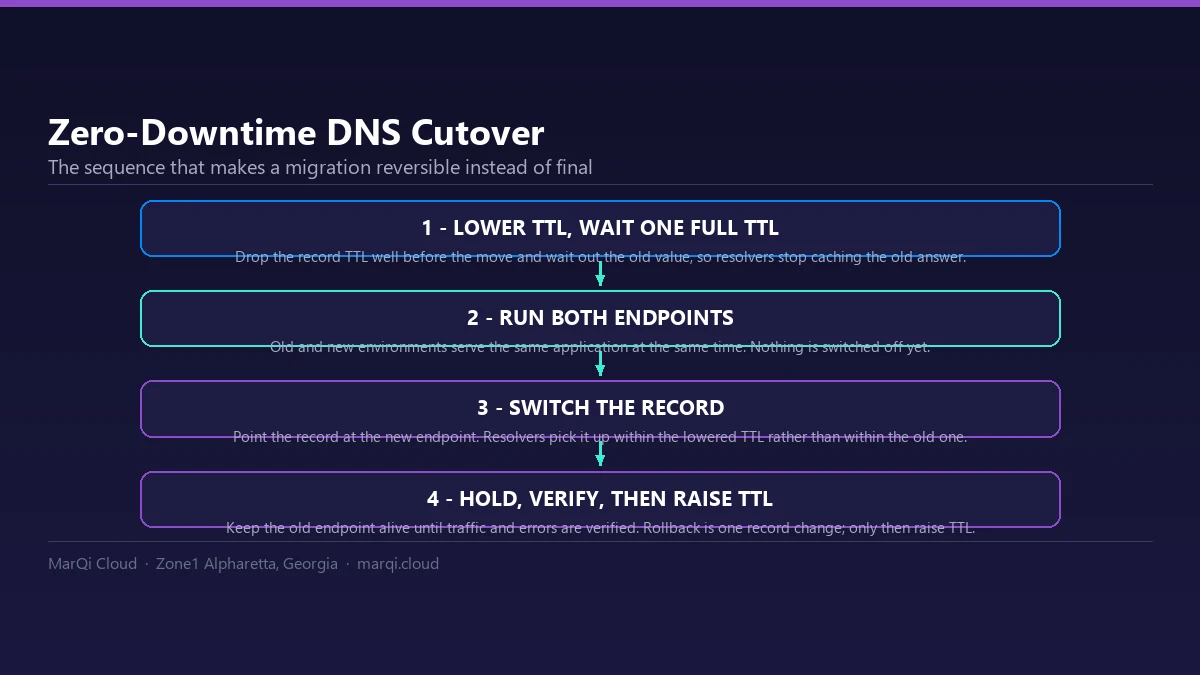
4. TTL Management
Time-to-Live (TTL) settings dictate how long DNS records are cached by resolvers. By lowering the TTL before migration, you can ensure that changes propagate quickly. This strategy minimizes downtime during the cutover process, as the new DNS records will be recognized sooner. The TTL field that controls this is part of the original DNS specification, RFC 1035, and its exact meaning was later tightened in RFC 2181.
5. DNS Load Balancing
DNS load balancing distributes incoming traffic across multiple servers, ensuring that no single server becomes overwhelmed. This method can be used during migration to gradually shift traffic from the old infrastructure to the new cloud setup, minimizing the risk of downtime.
Pre-Migration Testing
Before executing a DNS cutover, thorough testing is crucial to ensure a smooth transition. Here are key steps to conduct during the pre-migration phase:
- Environment Setup: Set up the new cloud environment and replicate the existing application and data.
- Performance Testing: Conduct performance tests to ensure the new environment can handle expected loads.
- DNS Propagation Testing: Use tools like What’s My DNS to check DNS propagation across different regions.
- Rollback Procedures: Establish clear rollback procedures in case issues arise during the cutover.
Step-by-Step DNS Cutover Process
Implementing a DNS cutover involves several key steps. Here’s a detailed guide to ensure a successful migration:
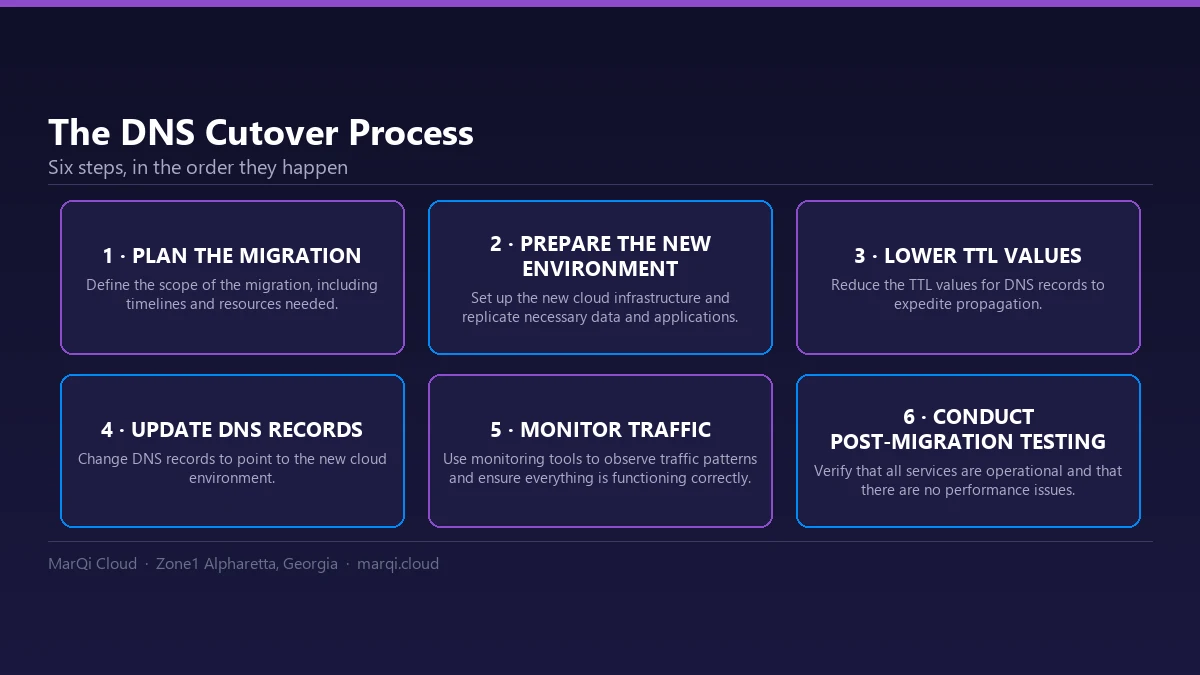
- Step 1: Plan the Migration: Define the scope of the migration, including timelines and resources needed.
- Step 2: Prepare the New Environment: Set up the new cloud infrastructure and replicate necessary data and applications.
- Step 3: Lower TTL Values: Reduce the TTL values for DNS records to expedite propagation.
- Step 4: Update DNS Records: Change DNS records to point to the new cloud environment.
- Step 5: Monitor Traffic: Use monitoring tools to observe traffic patterns and ensure everything is functioning correctly.
- Step 6: Conduct Post-Migration Testing: Verify that all services are operational and that there are no performance issues.
- Step 7: Increase TTL Values: Once confirmed, increase TTL values to normal levels.
Best Practices for DNS Cutover
To maximize the success of your DNS cutover strategy, consider the following best practices:
- Communicate with Stakeholders: Keep all stakeholders informed about the migration timeline and expected impacts.
- Document Everything: Maintain detailed documentation of the migration process, including configurations and changes made.
- Use Reliable Monitoring Tools: Employ monitoring tools to track performance and traffic during the cutover.
- Test and Validate: Conduct thorough testing at each stage of the migration to identify potential issues before they affect users.
- Have a Contingency Plan: Always have a rollback plan ready in case of unexpected issues during the cutover.
Example Scenarios
The scenarios below are illustrative examples of how organizations typically apply these practices; they do not describe specific MarQi Cloud customers or measured results.
Example Scenario 1: E-Commerce Platform
An e-commerce platform migrated its services to a hybrid cloud environment. By employing blue-green deployment and DNS failover, they ensured that their website remained operational throughout the migration process. This approach allowed them to achieve a seamless transition, resulting in zero downtime and maintaining customer trust.
Example Scenario 2: Financial Institution
A financial institution faced the challenge of migrating sensitive data to the cloud while ensuring compliance and security. By utilizing CNAME flattening and TTL management, they successfully migrated their services without disrupting customer access. This strategy not only enhanced their operational efficiency but also improved their disaster recovery capabilities.
FAQ
What is DNS cutover?
DNS cutover is the process of updating DNS records to redirect traffic from an old server to a new server during a migration.
Why is zero-downtime migration important?
Zero-downtime migration prevents service interruptions, ensuring that users can access applications without disruption, which is crucial for maintaining customer trust and satisfaction.
What strategies can be used for DNS cutover?
Effective strategies include blue-green deployment, CNAME flattening, DNS failover, TTL management, and DNS load balancing.
How can I prepare for a DNS cutover?
Preparation includes thorough testing of the new environment, lowering TTL values, and establishing rollback procedures.
What tools can help with DNS testing?
Tools like What’s My DNS and DNS Checker can help verify DNS propagation and configuration.
What are the risks of DNS cutover?
Risks include potential downtime, loss of data access, and issues with DNS propagation if not managed properly.
How long does DNS propagation take?
DNS propagation can take anywhere from a few minutes to 48 hours, depending on TTL settings and DNS caching by ISPs. Resolvers may also answer from expired data on purpose: RFC 8767 defines serving stale answers when the authoritative servers cannot be reached, which is one reason a cutover can look complete to you and not to a given user.
Can I revert my DNS cutover?
Yes, if issues arise during the cutover, having a rollback plan allows you to revert to the previous DNS settings quickly.
Conclusion
Implementing an effective DNS cutover strategy is crucial for achieving zero-downtime during cloud migration. By understanding the various strategies available and adhering to best practices, businesses can ensure a smooth transition to the cloud while maintaining service availability. For organizations looking to migrate without disruptions, MarQi Cloud offers comprehensive cloud migration services tailored to your specific needs. Contact us today to learn how we can assist you in your cloud journey.