Essential Strategies to Minimize Downtime During Enterprise Cloud Migration
July 16, 2026
The Complete Guide to DNS Cutover Strategies for Zero-Downtime Cloud Migration
July 16, 2026
Why Data Migration Integrity Testing Prevents Post-Migration Disasters
In today’s data-driven business landscape, organizations are increasingly migrating their data to cloud environments to enhance efficiency, scalability, and security. However, the process of data migration comes with its own set of challenges, particularly the risk of data integrity issues that can lead to disastrous consequences. This is where data migration integrity testing plays a crucial role. By ensuring that data is accurately and completely transferred, organizations can prevent post-migration disasters that may impact operations, compliance, and customer trust. This article will explore the significance of data migration integrity testing, the common pitfalls of data migration, and actionable strategies to ensure a seamless transition to cloud infrastructure.
Understanding Data Migration Integrity Testing
Data migration integrity testing is a systematic approach to verify that data transferred from one system to another maintains its accuracy, completeness, and consistency. This process involves a series of checks and validations to ensure that no data is lost or altered during the migration. Organizations like MarQi Cloud, recognized for their hybrid cloud solutions and cloud migration services, prioritize integrity testing to safeguard their clients’ data during transitions.
The Data Migration Process
Typically, the data migration process includes several key stages:
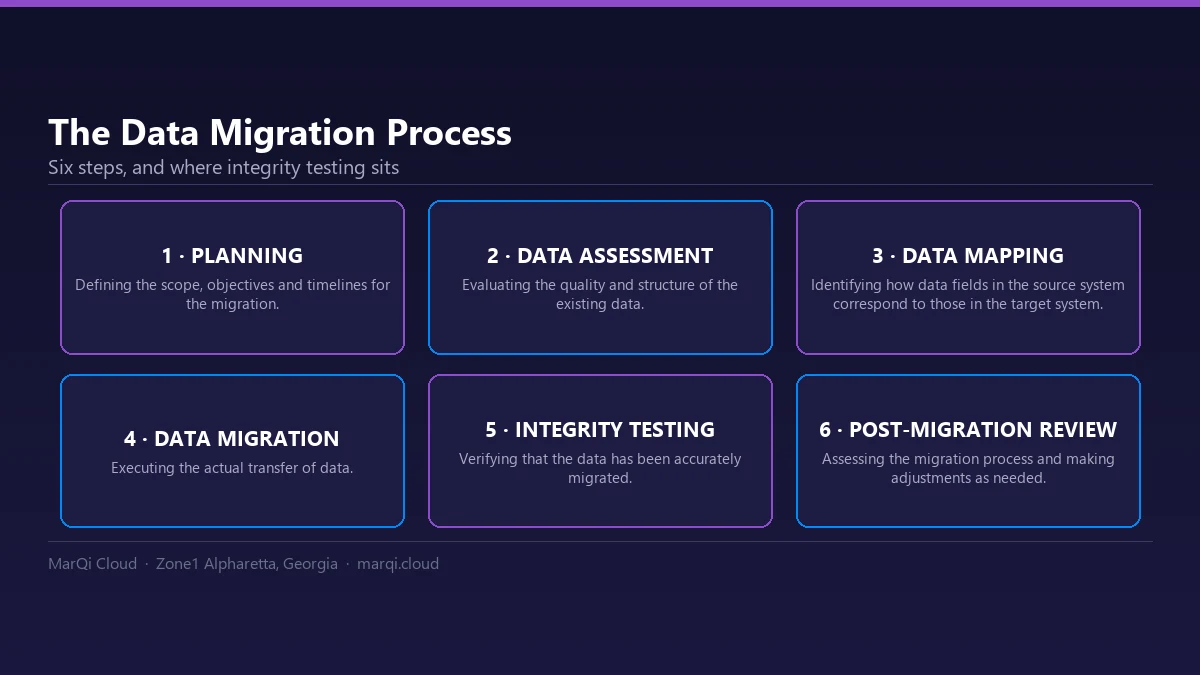
- Planning: Defining the scope, objectives, and timelines for the migration.
- Data Assessment: Evaluating the quality and structure of the existing data.
- Data Mapping: Identifying how data fields in the source system correspond to those in the target system.
- Data Migration: Executing the actual transfer of data.
- Integrity Testing: Verifying that the data has been accurately migrated.
- Post-Migration Review: Assessing the migration process and making adjustments as needed.
Common Challenges in Data Migration
Despite careful planning, organizations often encounter several challenges during data migration:
- Data Loss: Accidental deletion or corruption of data during the transfer.
- Data Inconsistency: Discrepancies between the source and target data due to format differences or mapping errors.
- Downtime: Extended periods where systems are unavailable, impacting business operations.
- Compliance Issues: Failure to adhere to regulatory standards can lead to legal complications.
The Importance of Integrity Testing
Data migration integrity testing is essential for several reasons:
- Ensures Accuracy: It verifies that data has been correctly transferred without any alterations.
- Enhances Trust: By demonstrating a commitment to data integrity, organizations build trust with customers and stakeholders.
- Mitigates Risks: Identifying and addressing potential issues before they escalate can prevent costly post-migration disasters.
- Compliance Assurance: Proper testing ensures that data migration meets industry regulations and standards.
Statistics on Data Migration Failures
Studies show that nearly 70% of data migrations fail to meet their initial objectives due to various reasons, including lack of integrity testing. Organizations that prioritize integrity checks during data migration see materially fewer post-migration issues.
Best Practices for Data Migration Integrity Testing
To ensure successful data migration integrity testing, organizations should implement the following best practices:
1. Develop a Comprehensive Testing Strategy
A well-defined testing strategy should outline the objectives, scope, and methodologies for integrity testing. This plan should include:
- Types of tests to be performed (e.g., unit tests, system tests).
- Criteria for success and failure.
- Resources required for testing.
2. Automate Testing Processes
Automation tools can streamline the testing process, reducing the risk of human error and increasing efficiency. Automated testing tools can perform data validation checks and generate reports that help identify discrepancies quickly.
3. Conduct Pre-Migration Testing
Testing data integrity before the migration begins can help identify potential issues in the source data. This step ensures that the data being migrated is of high quality and suitable for transfer.
4. Implement Post-Migration Validation
After the migration is complete, conducting post-migration validation is crucial. This involves comparing the source and target data to ensure that all records have been accurately transferred and that data integrity is maintained.
5. Document and Review Findings
Thorough documentation of testing results is essential for future reference. Regularly reviewing findings can help organizations refine their data migration processes and improve future migrations.
Example Scenarios
The scenarios below are illustrative examples of how organizations typically apply these practices; they do not describe specific MarQi Cloud customers or measured results.
Example Scenario 1: Healthcare Provider Migration
A leading healthcare provider migrated their patient records to a new electronic health record (EHR) system. By prioritizing integrity testing, they identified discrepancies in patient data early in the migration process, allowing them to correct issues before going live. As a result, they maintained full compliance with HIPAA regulations and ensured uninterrupted patient care.
Example Scenario 2: Financial Services Firm
A financial services firm migrated its customer data to a cloud-based platform. Implementing a robust integrity testing framework helped them achieve a high accuracy rate in the migrated data, significantly reducing the risk of compliance violations and enhancing customer trust.
Tools and Technologies for Integrity Testing
Various tools and technologies can assist organizations in conducting effective data migration integrity testing:
| Tool | Description | Key Features |
|---|---|---|
| Talend | A data integration tool that provides data quality and integrity testing capabilities. | Data profiling, automated testing, real-time monitoring. |
| Informatica | A comprehensive data management platform that offers robust data quality solutions. | Data validation, cleansing, and transformation. |
| Apache NiFi | An open-source tool for automating data flows and ensuring data integrity. | Data lineage, real-time tracking, and integration. |
Conclusion
Data migration integrity testing is a critical component of the data migration process. By ensuring that data is accurately and completely transferred, organizations can mitigate risks, enhance trust, and ensure compliance with industry regulations. As businesses increasingly turn to cloud solutions like those offered by MarQi Cloud, prioritizing data integrity testing will be essential for safeguarding data and preventing post-migration disasters. For more insights on cloud migration and infrastructure, visit our blog.
FAQs
1. What is data migration integrity testing?
Data migration integrity testing involves verifying that data transferred from one system to another maintains its accuracy and completeness.
2. Why is integrity testing important during data migration?
Integrity testing is important because it helps prevent data loss, inconsistencies, and compliance issues, ensuring a successful migration.
3. What are common challenges in data migration?
Common challenges include data loss, inconsistency, downtime, and compliance issues.
4. How can organizations ensure data integrity during migration?
Organizations can ensure data integrity by developing a comprehensive testing strategy, automating testing processes, and conducting pre- and post-migration validations.
5. What tools are available for data integrity testing?
Tools such as Talend, Informatica, and Apache NiFi provide capabilities for data integrity testing and validation.
6. How often should data migration integrity testing be performed?
Integrity testing should be performed at various stages of the migration process, including pre-migration, during migration, and post-migration.
7. What is the impact of data migration failures?
Data migration failures can lead to operational disruptions, compliance violations, and loss of customer trust.
8. How can organizations recover from data migration disasters?
Organizations can recover by implementing robust backup strategies, conducting thorough post-migration reviews, and learning from past mistakes to improve future migrations.