Why NVIDIA Blackwell GPUs on MarQi Cloud Change Everything for AI Teams
May 31, 2026MarQi Cloud GPU Clusters vs. Renting GPU VMs: Which Is Actually Cheaper?
June 1, 2026
How to Train a Machine Learning Model on MarQi Cloud GPU Clusters
Introduction
The rise of machine learning has revolutionized the way businesses operate, providing new insights and enhancing decision-making processes. However, training machine learning models can be resource-intensive, requiring substantial computational power. MarQi Cloud offers enterprise-grade cloud infrastructure with dedicated GPU clusters, making it an ideal platform for training machine learning models efficiently and effectively. In this article, we will explore how to train a machine learning model on MarQi Cloud’s GPU clusters, from initial setup to deployment.
Understanding GPU Clusters
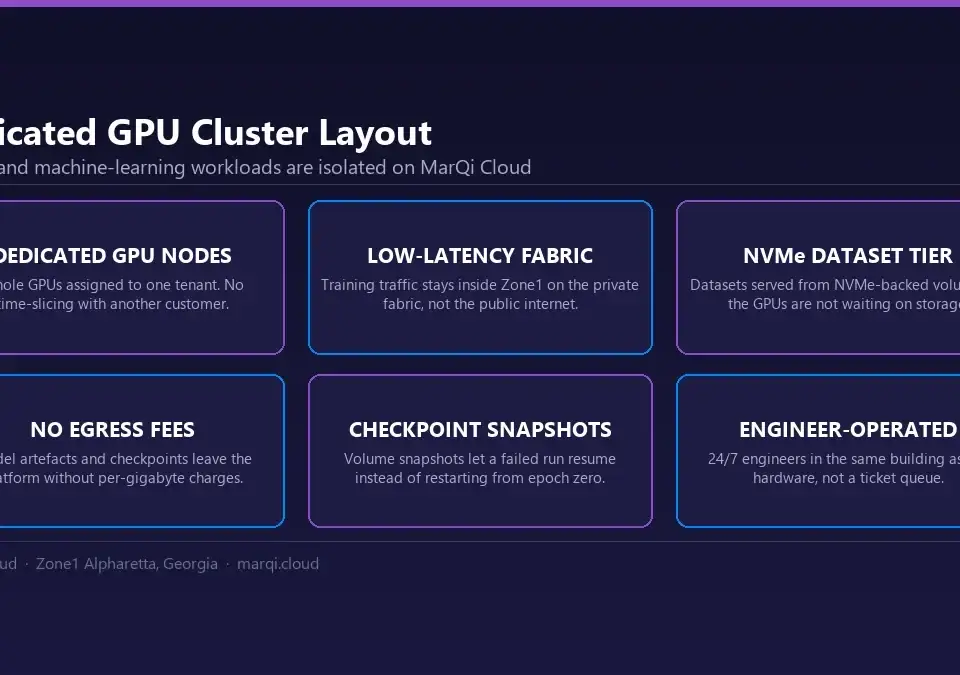
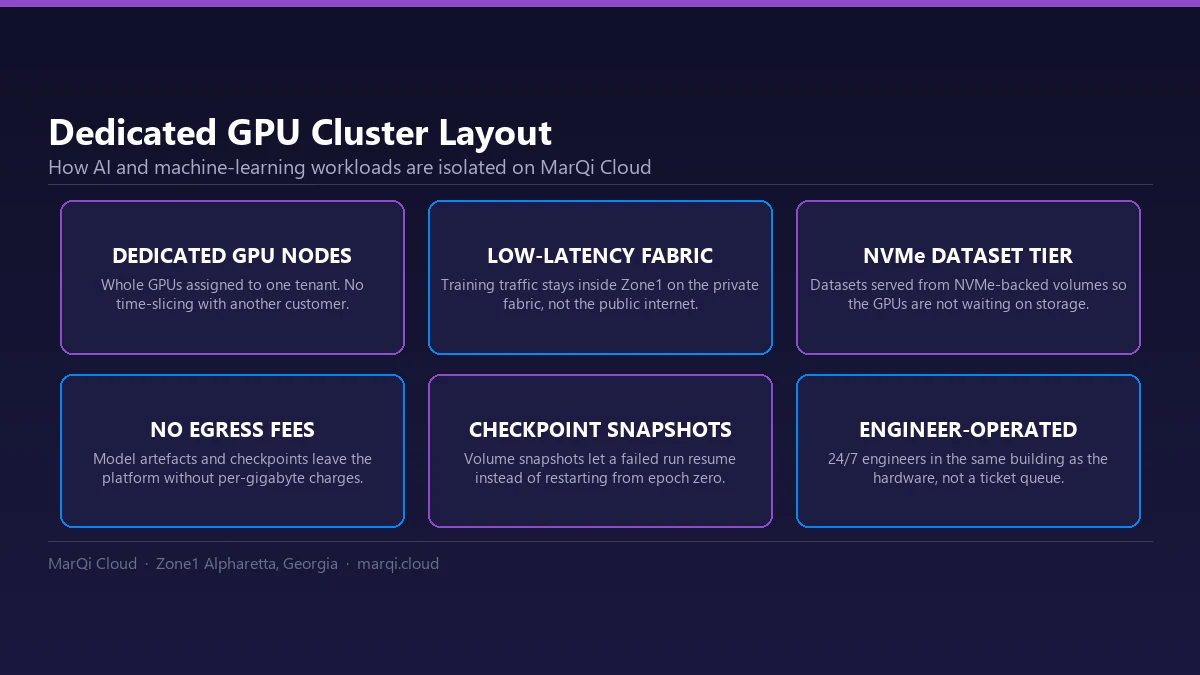
Before diving into the training process, it’s crucial to understand what GPU clusters are and how they benefit machine learning tasks. A GPU (Graphics Processing Unit) cluster consists of multiple GPUs working together to perform parallel processing tasks. This capability is particularly advantageous for machine learning, as it allows for faster computations and the handling of large datasets.
Benefits of Using GPU Clusters for Machine Learning
- Increased Speed: GPUs can perform thousands of operations simultaneously, significantly reducing the time required for model training.
- Scalability: MarQi Cloud’s infrastructure allows you to scale your compute and storage resources according to your needs.
- Cost-Effectiveness: With flexible pricing models, businesses can optimize their spending based on usage.
- Enhanced Performance: Performance-driven infrastructure design ensures that your models run efficiently.
Setting Up Your Environment on MarQi Cloud
To begin training your machine learning model on MarQi Cloud’s GPU clusters, you’ll first need to set up your environment. Follow these steps:
1. Sign Up for MarQi Cloud
If you haven’t already, sign up for an account on the MarQi Cloud platform. The sign-up process is straightforward, and you can choose a plan that suits your business requirements.
2. Choose Your GPU Cluster
Once logged in, navigate to the GPU cluster options. MarQi Cloud offers various configurations depending on your computational needs, including different GPU types and quantities. Select the cluster that best fits your machine learning project.
3. Configure Your Environment
After selecting a GPU cluster, configure your environment. This includes setting up the operating system, installing machine learning libraries (such as TensorFlow or PyTorch), and any other dependencies required for your model.
Preparing Your Data
Data preparation is a critical step in the machine learning process. Here’s how to prepare your data effectively:
1. Data Collection
Gather the data that you’ll use to train your model. This could be from various sources, including databases, APIs, or public datasets.
2. Data Cleaning
Clean your dataset to remove any inconsistencies or errors. This may involve handling missing values, removing duplicates, and normalizing data formats.
3. Data Splitting
Split your data into training, validation, and test sets. A common practice is to use 70% of the data for training, 15% for validation, and 15% for testing.
Training Your Machine Learning Model
With your environment set up and data prepared, you can now train your machine learning model on MarQi Cloud’s GPU clusters.
1. Selecting a Model
Choose a machine learning model suitable for your problem. This could range from simple linear regression to complex deep learning models like convolutional neural networks.
2. Writing the Training Script
Create a training script that outlines how your model will learn from the training data. This includes defining the loss function, optimizer, and metrics to evaluate the model’s performance.
3. Executing the Training Process
Run your training script on the GPU cluster. Monitor the training process to ensure that it’s performing as expected. MarQi Cloud provides tools to help you track resource usage and performance metrics.
Evaluating Your Model
After training your model, it’s essential to evaluate its performance to ensure that it generalizes well to new data.
1. Testing the Model
Use the test dataset to assess how well your model performs. Look at various metrics such as accuracy, precision, recall, and F1 score.
2. Hyperparameter Tuning
If the model’s performance isn’t satisfactory, consider tuning the hyperparameters. This involves adjusting settings such as learning rate, batch size, and the number of layers in your network.
Deploying Your Model
Once you are satisfied with your model’s performance, it’s time to deploy it for production use.
1. Exporting the Model
Export your trained model in a format suitable for deployment. Common formats include TensorFlow SavedModel or ONNX.
2. Setting Up the Production Environment
Configure your production environment on MarQi Cloud to host the model. This might involve setting up APIs for serving predictions or integrating with existing applications.
Ensuring Business Continuity and Disaster Recovery
MarQi Cloud provides robust business continuity and disaster recovery solutions, ensuring that your machine learning models and data are secure and accessible in the event of an outage or disaster.
1. Backup Strategies
Implement regular backup strategies to safeguard your data and models. This includes automated snapshots and off-site backups.
2. Scaling Resources
Take advantage of MarQi Cloud’s scalable resources to handle varying workloads, ensuring that your applications remain responsive and efficient.
Conclusion
Training a machine learning model on MarQi Cloud’s GPU clusters is a powerful way to leverage cloud technology for advanced analytics and AI applications. With the right setup, data preparation, and model evaluation techniques, businesses can harness the full potential of machine learning while enjoying the benefits of MarQi Cloud’s secure and scalable infrastructure.
FAQs
1. What are GPU clusters?
GPU clusters are groups of interconnected GPUs that work together to perform parallel processing tasks, ideal for compute-intensive applications like machine learning.
2. How do I sign up for MarQi Cloud?
Visit the MarQi Cloud website and follow the sign-up process to create an account.
3. What machine learning libraries are supported on MarQi Cloud?
MarQi Cloud supports popular libraries such as TensorFlow, PyTorch, and scikit-learn.
4. Can I scale my resources on MarQi Cloud?
Yes, MarQi Cloud offers scalable compute and storage resources that can be adjusted based on your needs.
5. How does MarQi Cloud ensure data security?
MarQi Cloud provides private and secure hosting environments with robust security measures to protect your data.
6. What are the pricing models offered by MarQi Cloud?
MarQi Cloud offers flexible pricing models based on usage, allowing businesses to optimize their costs.
7. How do I evaluate my machine learning model?
Evaluate your model using metrics such as accuracy, precision, recall, and F1 score, using a separate test dataset.
8. What should I do if my model’s performance is not satisfactory?
Consider tuning hyperparameters, adjusting your model architecture, or gathering more data for training.
9. What are business continuity and disaster recovery solutions?
These solutions ensure that your cloud infrastructure is resilient, allowing for quick recovery in the event of an outage or disaster.
10. How can I deploy my trained model?
Export your trained model in a suitable format and set up a production environment on MarQi Cloud to serve predictions.