How MarQi Cloud Handles Black Friday Traffic Spikes Without Breaking a Sweat
May 10, 2026
MarQi Cloud First Look: Is the Hype Around Open Source Cloud Actually Real?
May 10, 2026
What Happens When You Put a MarQi Cloud Bare Metal Server Under Full Load
In today’s digital landscape, the performance and reliability of server infrastructure play a crucial role in business operations. At MarQi Cloud, we provide enterprise-grade cloud infrastructure that includes bare metal servers designed for optimal performance. Understanding the behavior of these servers under full load is essential for businesses that rely on high availability and performance. This article will explore what happens when a MarQi Cloud bare metal server is subjected to full load, covering aspects such as performance metrics, resource management, and the benefits of utilizing our infrastructure.
Understanding Bare Metal Servers
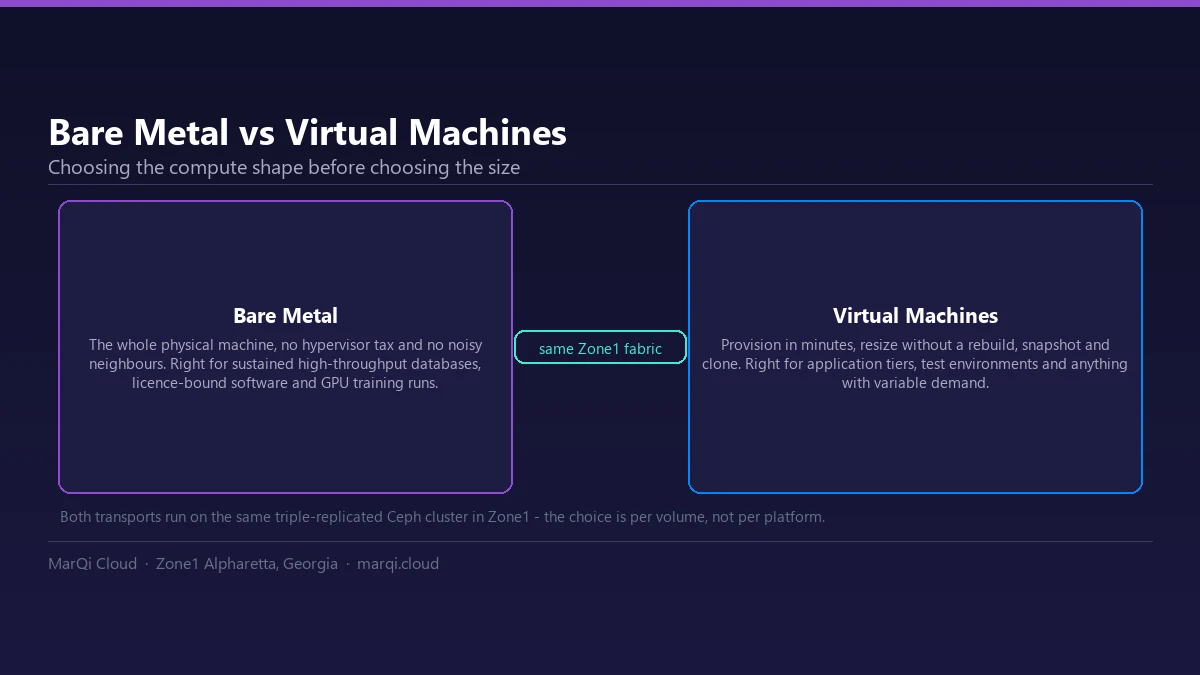
Before diving into the effects of full load, it’s important to understand what bare metal servers are. Unlike virtual servers that share resources among multiple users, bare metal servers are dedicated machines that provide exclusive access to all hardware resources. This exclusivity ensures that performance is not hindered by other tenants, making bare metal servers ideal for resource-intensive applications.
The Architecture of MarQi Cloud Bare Metal Servers
MarQi Cloud’s bare metal servers are built with high-performance components, including powerful CPUs, ample RAM, and fast SSD storage. Our infrastructure is designed to handle demanding workloads efficiently. When you deploy a bare metal server with MarQi Cloud, you benefit from:
- Enterprise-grade hardware for consistent performance
- Scalable compute and storage resources to accommodate growth
- Private and secure hosting environments to safeguard your data
What Does Full Load Mean?
Full load refers to the maximum capacity at which a server can operate. This typically means utilizing all available CPU cores, memory, and disk I/O resources. For example, running a resource-intensive application, such as a database or a high-traffic website, can push a server to its limits. Understanding how a MarQi Cloud bare metal server performs under such conditions is critical for maintaining business continuity.
Performance Metrics Under Full Load
When a bare metal server is placed under full load, several performance metrics come into play:
- CPU Utilization: The percentage of CPU resources being used. High CPU utilization can indicate that the server is performing optimally, but if it approaches 100%, it may lead to performance degradation.
- Memory Usage: The amount of RAM being used. Full load may result in increased memory usage, and if the server runs out of available memory, it could lead to swapping, which can significantly slow down performance.
- Disk I/O: The speed at which data is read from or written to the disk. Under full load, disk I/O can become a bottleneck, especially if the storage solution is not optimized for high performance.
- Network Throughput: The amount of data being transmitted over the network. High network throughput is essential for applications that require real-time data processing.
Effects of Full Load on MarQi Cloud Bare Metal Servers
When a MarQi Cloud bare metal server is pushed to full load, several effects can be observed:
1. Performance Optimization
Initially, the server may exhibit optimal performance, handling requests and processing tasks efficiently. However, as load increases, performance may begin to decline if the resources are not managed properly.
2. Resource Contention
Under full load, processes may compete for CPU, memory, and disk resources. This contention can lead to slower response times and increased latency, especially for applications that require fast data access.
3. Heat Generation
With increased CPU utilization, heat generation within the server also rises. Effective cooling solutions are essential to prevent overheating, which can cause hardware failures or reduce performance.
4. Impact on Business Continuity
For businesses relying on 24/7 availability, putting a server under full load without proper monitoring and management can lead to downtime. Implementing business continuity and disaster recovery solutions is critical to mitigate risks associated with server overload.
How MarQi Cloud Manages Full Load Situations
At MarQi Cloud, we understand the critical nature of maintaining performance during peak loads. Our infrastructure is designed to adapt to varying workloads with innovative solutions:
1. Scalable Resources
MarQi Cloud’s infrastructure allows for scalable compute and storage resources. This means that if a bare metal server approaches its limits, additional resources can be provisioned quickly to maintain performance.
2. Performance Monitoring
We provide tools for real-time performance monitoring. This enables businesses to track resource utilization and make informed decisions to optimize performance under load.
3. Load Balancing
Utilizing load balancing solutions can distribute workloads across multiple servers, ensuring that no single server is overwhelmed. This helps maintain optimal performance and reduces the risk of downtime.
4. Disaster Recovery Solutions
Our disaster recovery solutions ensure that in the event of a server failure, businesses can quickly restore operations with minimal disruption. This is essential for maintaining business continuity.
Conclusion
Understanding the implications of putting a MarQi Cloud bare metal server under full load is critical for businesses seeking to maximize efficiency and performance. By leveraging our enterprise-grade infrastructure, scalable resources, and robust support, organizations can confidently manage peak loads and maintain optimal performance. If you are interested in learning more about our bare metal server solutions, contact MarQi Cloud at +1 770-369-9321 for personalized assistance.
FAQ
1. What is a bare metal server?
A bare metal server is a dedicated physical server that provides exclusive access to all its hardware resources, unlike virtual servers that share resources among multiple tenants.
2. How does full load affect server performance?
Full load can cause resource contention, increased latency, and potential performance degradation if resources are not managed properly.
3. What monitoring tools does MarQi Cloud offer?
MarQi Cloud provides real-time performance monitoring tools to track resource utilization and optimize server performance.
4. Can I scale resources on a bare metal server?
Yes, MarQi Cloud offers scalable compute and storage resources to accommodate varying workload demands.
5. How can I ensure business continuity during peak loads?
Implementing disaster recovery solutions and load balancing can help maintain business continuity during peak loads.
6. What are the benefits of using MarQi Cloud’s infrastructure?
Benefits include enterprise-grade hardware, private hosting environments, scalable resources, and US-based infrastructure and support.
7. What kind of applications are best suited for bare metal servers?
Resource-intensive applications, such as databases, high-traffic websites, and applications requiring fast data processing, are best suited for bare metal servers.
8. How can I contact MarQi Cloud for more information?
You can contact MarQi Cloud at +1 770-369-9321 for personalized assistance and inquiries about our services.