AI Model Deployment on Bare Metal Servers: A Comprehensive Guide
March 21, 2026
Data Center Security in Atlanta: Ensuring Robust Protection for Your Digital Assets
March 22, 2026
Why AI Workloads Need Liquid Cooling: The Future of Efficient Computing
As artificial intelligence (AI) technology continues to advance at an unprecedented rate, the demand for powerful computing resources has never been higher. AI workloads, characterized by their intensive processing requirements and substantial energy consumption, are pushing traditional cooling methods to their limits. In this article, we delve into why liquid cooling is emerging as a critical solution for managing AI workloads effectively.
The Rise of AI Workloads
AI workloads involve complex computations, large datasets, and high-performance processing capabilities. Tasks like deep learning, machine learning, and neural network training demand robust computing infrastructure to handle vast amounts of data while maintaining optimal performance. However, with this increased demand comes a significant challenge: heat generation.
The Challenges of Heat Generation
As processors work harder to execute AI algorithms, they generate heat, which can lead to overheating and system failures. Traditional air cooling systems often struggle to dissipate the heat generated by high-performance computing (HPC) environments. This can result in:
- Reduced performance due to thermal throttling
- Increased energy consumption
- Shortened lifespan of hardware components
- Higher operational costs
What is Liquid Cooling?
Liquid cooling is a thermal management technique that utilizes liquid to absorb and dissipate heat from computer components. Unlike traditional air cooling, which relies on fans and air circulation, liquid cooling systems use water or specialized cooling fluids to transfer heat away from critical hardware components, such as CPUs and GPUs.
The Principles of Liquid Cooling
Liquid cooling systems operate on the principle of thermal conductivity. Liquids generally have higher thermal conductivity than air, allowing them to absorb heat more efficiently. The key components of a liquid cooling system include:
- Water Block: A metal block that sits directly on the CPU or GPU, facilitating heat transfer from the component to the liquid.
- Pump: Circulates the coolant through the system.
- Radiator: Dissipates the absorbed heat into the environment.
- Reservoir: Holds excess coolant and helps maintain system pressure.
Why Liquid Cooling is Essential for AI Workloads
Liquid cooling presents several advantages that are particularly beneficial for AI workloads:
1. Enhanced Cooling Efficiency
Liquid cooling systems are significantly more efficient than air cooling systems. They can manage higher thermal loads, making them ideal for AI workloads that demand extensive processing power.
2. Improved Performance and Reliability
By maintaining optimal operating temperatures, liquid cooling reduces the risk of thermal throttling. This ensures that AI workloads run at peak performance, resulting in faster training times and improved overall efficiency.
3. Space Optimization
Liquid cooling solutions can be more compact than traditional air cooling systems, allowing for better use of space within data centers. This is particularly valuable for organizations with limited physical space who still need to accommodate powerful hardware.
4. Noise Reduction
Liquid cooling systems produce less noise compared to conventional air cooling systems that rely on high-speed fans. This creates a more comfortable working environment for data center staff and reduces noise pollution in shared spaces.
5. Energy Efficiency
With the rising costs of energy and the increasing focus on sustainability, liquid cooling provides a more energy-efficient solution for cooling. By reducing the reliance on power-hungry fans and minimizing the overall energy consumption of AI workloads, companies can lower operational costs and their carbon footprint.
6. Scalability for Future Growth
As AI technologies evolve, so does the demand for enhanced computing capabilities. Liquid cooling systems are highly scalable, allowing organizations to expand their infrastructure without compromising on cooling efficiency. This positions businesses to adapt to future AI workloads seamlessly.
Types of Liquid Cooling Solutions
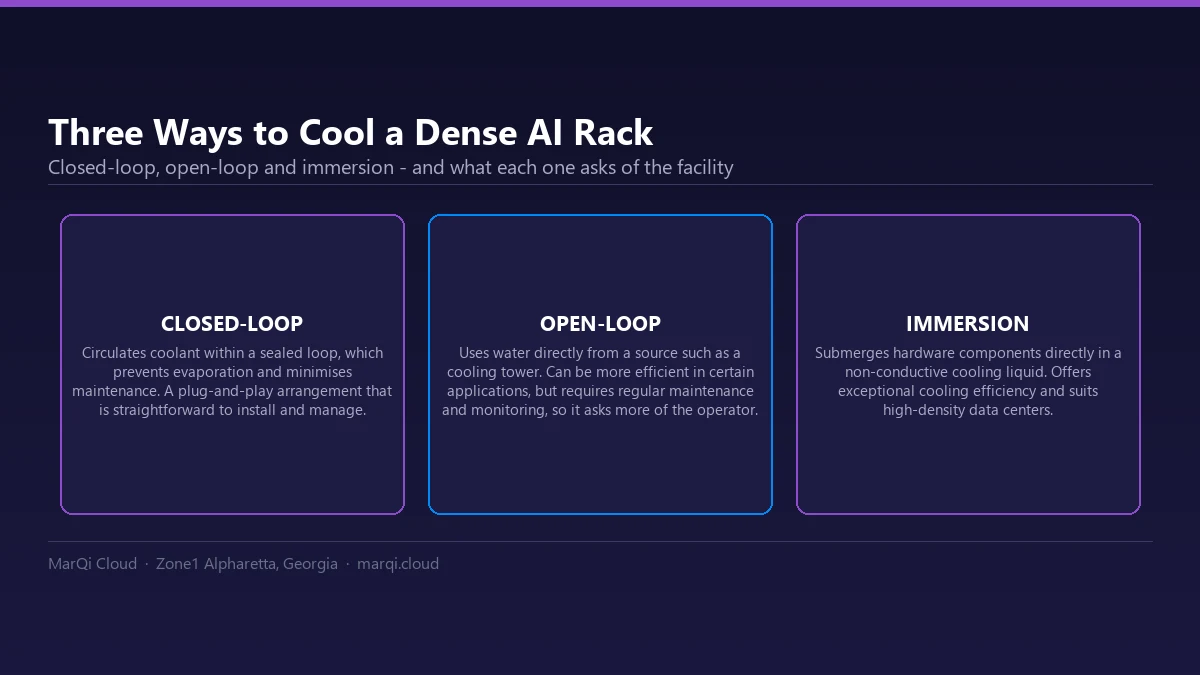
There are several liquid cooling solutions available, each with its unique benefits:
1. Closed-Loop Liquid Cooling
This system circulates coolant within a sealed loop, preventing evaporation and minimizing maintenance. It is a plug-and-play solution that is easy to install and manage.
2. Open-Loop Liquid Cooling
Open-loop systems require regular maintenance and monitoring, as they use water directly from a source, such as a cooling tower. While they can be more efficient in certain applications, they typically require more management.
3. Immersion Cooling
Immersion cooling involves submerging hardware components directly into a non-conductive cooling liquid. This method offers exceptional cooling efficiency and is ideal for high-density data centers.
Implementing Liquid Cooling Solutions
When considering the transition to liquid cooling for AI workloads, organizations should take the following steps:
1. Assess Cooling Requirements
Evaluate the thermal load generated by AI workloads and determine the cooling capacity needed. This will help in selecting the most suitable liquid cooling solution.
2. Evaluate Infrastructure Compatibility
Ensure that the existing infrastructure can accommodate liquid cooling systems. This may involve modifications to power supply, drainage, and pipework.
3. Partner with Experts
Engage with cooling specialists to design and implement a liquid cooling solution tailored to your organization’s specific needs.
4. Monitor Performance
Once implemented, continuously monitor the performance of the liquid cooling system to ensure it meets the required efficiency and reliability standards.
Conclusion
As AI workloads continue to grow in complexity and demand, the need for efficient cooling solutions becomes increasingly critical. Liquid cooling offers a powerful alternative to traditional air cooling systems, providing enhanced efficiency, performance, and scalability. By embracing liquid cooling, organizations can ensure their AI infrastructures remain robust, sustainable, and ready for the future.
FAQs
1. What are the main benefits of liquid cooling for AI workloads?
Liquid cooling provides enhanced cooling efficiency, improved performance, space optimization, noise reduction, energy efficiency, and scalability.
2. How does liquid cooling differ from traditional air cooling?
Liquid cooling uses liquid to transfer heat away from components, while air cooling relies on fans and air circulation. Liquid cooling is generally more efficient and effective in handling high thermal loads.
3. What types of liquid cooling systems are available?
There are closed-loop, open-loop, and immersion cooling systems, each with unique benefits and applications.
4. Is liquid cooling suitable for all types of AI workloads?
Liquid cooling is particularly beneficial for high-performance AI workloads that generate significant heat, making it ideal for deep learning and large-scale computations.
5. How can organizations assess their cooling requirements?
Organizations should evaluate the thermal load generated by their AI workloads and determine the necessary cooling capacity to select an appropriate liquid cooling solution.
6. What maintenance is required for liquid cooling systems?
Maintenance needs vary by system type. Closed-loop systems require minimal maintenance, while open-loop systems may need regular monitoring and water source management.
7. Can liquid cooling systems be integrated with existing infrastructure?
Yes, liquid cooling systems can be integrated with existing infrastructure, but some modifications may be needed to accommodate plumbing, drainage, and power supply.
8. How does liquid cooling contribute to energy efficiency?
Liquid cooling reduces reliance on power-hungry fans, lowers overall energy consumption, and helps organizations reduce operational costs and carbon footprints.