Key Capabilities of a Reliable Cloud-Native Development Partner
February 5, 2026
How Cloud Native App Development Improves Reliability and Performance
February 13, 2026

Why Dedicated GPU Clusters Are Powering AI Workloads in 2026
Introduction
In 2026, AI is everywhere. Businesses are using large language models and generative AI to work faster and smarter. As these technologies grow, they need robust, reliable systems to handle the heavy computational work behind them.
Many companies find that regular cloud platforms don’t always work well for AI. Shared GPUs, slow performance, and high costs can make training AI models more difficult and expensive than expected.
That’s why more businesses are choosing Dedicated GPU Clusters. They offer steady performance, better control, and clearer costs. At the same time, independent data centers are helping companies run AI more smoothly by providing powerful GPU setups, fast networks, and flexible storage made for modern AI workloads.
Dedicated GPU Clusters
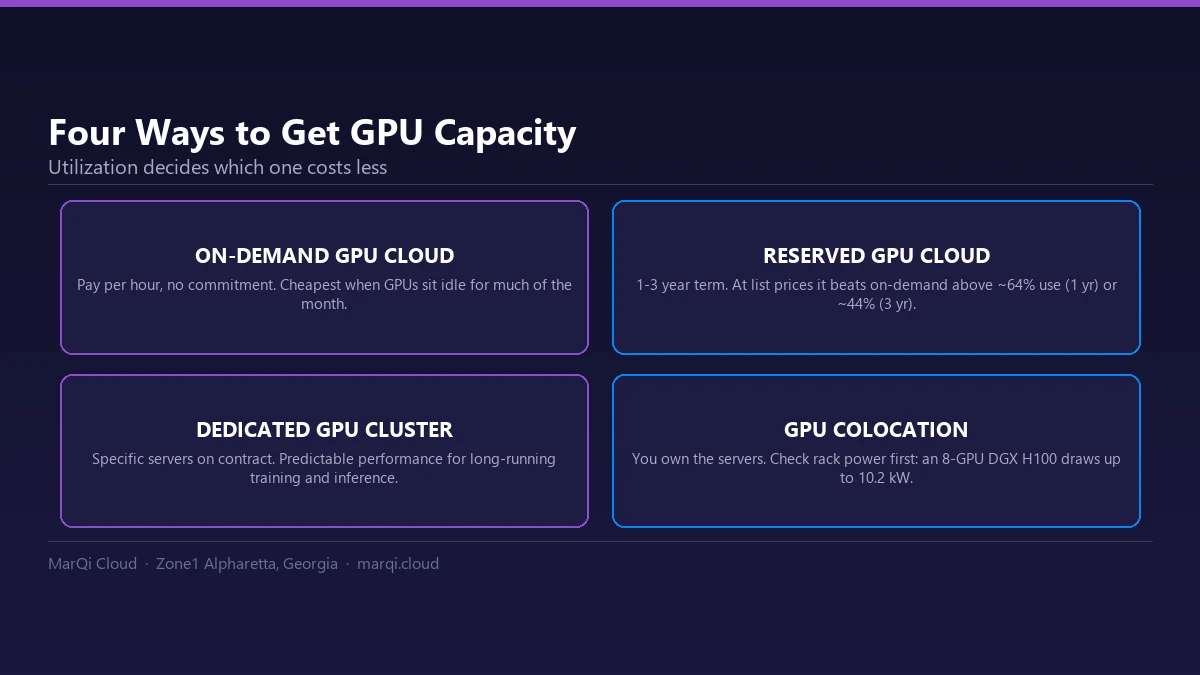
A Dedicated GPU Cluster is a high-performance setup designed to handle heavy AI workloads. It uses multiple connected servers with powerful GPUs and is reserved for a single organization, ensuring stable and reliable performance.
Key features of Dedicated GPU Clusters include:
- Exclusive access: GPU resources are not shared, giving predictable and consistent performance
- High-end GPUs: Use advanced hardware like NVIDIA A100, H100, or H200
- Fast networking: High-speed connections such as InfiniBand or NVLink allow GPUs to work together smoothly
- Bare-metal performance: Software runs directly on hardware for better speed and control
- High-performance storage: Fast storage systems ensure data reaches GPUs without delays
- Smart workload management: Tools like Kubernetes or Slurm help organize and scale AI jobs
Why are they important in 2026?
- Delivers stable performance for long-running AI workloads.
- Designed for efficient training of LLMs and generative AI models
- Improves security and supports compliance needs
- Offers better cost efficiency for continuous AI usage
Dedicated GPU Clusters provide a simple, powerful, and reliable foundation for organizations building modern AI systems at scale.
Distributed AI Training Costs Made Simple
Distributed AI training costs are the total expenses of training large AI models across many GPUs or servers. For big AI projects, these costs can reach millions of dollars because of high computing needs, advanced hardware, large datasets, and energy use.
What drives these costs:
- GPU usage: Training uses thousands of GPU-hours
- Data transfer and networking: Moving data between servers adds extra cost
- Managing workloads: Coordinating tasks across multiple GPUs takes extra tools and resources
- Inefficiency: Slow connections or underused GPUs waste time and money
How to reduce costs:
- Better GPU usage: Keep GPUs fully active with dedicated systems
- Lower overhead: Avoid hidden costs from scattered resources
- Fixed costs: Dedicated hardware gives predictable spending compared to cloud pricing
Understanding distributed AI training costs helps businesses plan AI projects smarter and save money.
Open-Source GPU Cluster Management in 2026
Open-source GPU cluster management is software that helps organizations connect multiple GPU-powered machines into a single, well-organized system. It enables teams to run AI, machine learning, and high-performance computing tasks more efficiently, without being tied to expensive or vendor-locked cloud services. By leveraging open-source tools, organizations gain flexibility, reduce costs, and maintain full control over their infrastructure.
Key Features of Open-Source GPU Cluster Management
- Resource aggregation: Pools GPUs from various machines, whether on-premises servers, workstations, or even laptops, into a single, unified system.
- Job scheduling and orchestration: Automatically assigns tasks to available GPUs, minimizing idle time and maximizing performance.
- Model deployment and inference: Makes running large language models (LLMs) easier through containerized backends like vLLM or LLaMA.cpp.
- Monitoring and observability: Offers real-time dashboards to track GPU usage, temperature, and overall performance.
- Multi-tenancy and security: Ensures multiple users can work safely with authentication, role-based access, and usage quotas.
Why Open-Source GPU Cluster Management Is Trending in 2026
- Avoids vendor lock-in, giving AI teams greater control over their hardware.
- Provides flexibility and transparency for scaling AI workloads.
- Supports popular tools like Kubernetes for GPU scheduling and open-source monitoring solutions.
By adopting open-source GPU cluster management, organizations can run distributed AI workloads more efficiently, improve GPU utilization, reduce dependence on costly cloud platforms, and retain complete control over their infrastructure.
GPU Cloud for LLM Training in 2026
GPU Cloud for LLM Training gives businesses and researchers on-demand access to powerful NVIDIA GPUs (like A100 and H100) through the cloud. This makes it easy to train or fine-tune large language models without buying expensive hardware. It provides scalable computing power, allowing teams to handle large datasets efficiently and pay only for the resources they need.
Key Features of GPU Cloud for LLM Training
- High-Performance GPUs: Use top-tier hardware like NVIDIA H100/H200 for fast parallel computations needed for LLM training and inference.
- Flexible & Cost-Effective: Scale up resources when training large models and scale down for smaller tasks, avoiding unnecessary costs.
- Top Providers: Options include AWS, Google Cloud, Azure, and specialized providers like GMI Cloud, Runpod, and NexGen Cloud.
- Fast Setup: Ideal for building AI models, research, and rapid prototyping without long installation or setup times.
- Security & Compliance: Private cloud options ensure data protection and regulatory compliance, such as GDPR.
Performance Advantages
- Better than Traditional GPU Clusters: Avoids some bottlenecks of shared environments.
- High-Speed Networking: Redundant networks help provide faster data access and smooth model synchronization for large-scale training.
Why Use GPU Cloud for LLM Training
- Efficiently train and fine-tune large models without investing in expensive hardware.
- Scale resources dynamically based on project needs.
- Maintain secure, compliant, and high-performance AI infrastructure.
Hybrid Cloud AI – Flexible, Powerful, and Secure
Hybrid Cloud AI is an approach that combines on-premises systems, private clouds, and public cloud services to run AI applications efficiently. It allows organizations to train models on large public cloud datasets while running inference locally, reducing latency, improving security, and keeping sensitive data private.
Key Advantages of Hybrid Cloud AI
- Flexibility and Control: Keep sensitive data secure on private infrastructure while leveraging the computing power of public cloud GPUs.
- Better Performance: Move AI workloads between local and cloud environments to optimize for speed, cost, and security.
- Industry Use Cases: Perfect for healthcare, finance, and other sectors with strict data compliance requirements.
- Unified Management: Tools enable centralized orchestration of AI models across different environments.
How It Works
- Combines dedicated on-prem GPU clusters with public cloud services for training, testing, and deployment.
- Core training can remain on private infrastructure while public clouds handle burst workloads or global scaling.
Security and Compliance
- Protect sensitive datasets, proprietary models, and intellectual property.
- Dedicated GPU clusters give full control over storage, networking, and access.
- Reduces risks from shared cloud environments and ensures regulatory compliance.
Hybrid Cloud AI allows organizations to enjoy the scalability and power of the cloud while keeping critical workloads secure and efficient—making it the ideal solution for modern AI projects.
Why MarQi Cloud Is Perfect for AI Workloads in 2026
MarQi Cloud is built to handle the growing demands of modern AI, including large language models (LLMs) and generative AI. Its infrastructure is designed for speed, reliability, and flexibility, making it ideal for AI research, enterprise projects, and hybrid cloud strategies.
Independent Data Center Advantage
- Operates a fully independent data center with its own storage cluster, giving organizations complete control.
- Features a redundant, high-performance network designed specifically for heavy AI workloads.
- Ensures fast, low-latency access to GPUs and storage for demanding AI tasks.
Purpose-Built Dedicated GPU Clusters
- Optimized for LLM training, fine-tuning, and inference.
- Supports open-source GPU cluster management for flexible and efficient workload orchestration.
- Provides a strong foundation for hybrid cloud AI strategies, letting organizations mix on-premises and cloud resources seamlessly.
MarQi Cloud offers secure, scalable, and high-performance infrastructure, giving AI teams the tools they need to train models faster, deploy reliably, and scale efficiently in 2026.
Conclusion
In 2026, Dedicated GPU Clusters are powering the next generation of AI workloads. They deliver consistent performance, high scalability, strong security, and cost efficiency, making them essential for training large language models and running complex AI applications.
Partnering with an independent infrastructure provider like MarQi Cloud gives organizations access to purpose-built GPU clusters, fast networking, and advanced management tools. This combination allows businesses to innovate confidently, deploy AI efficiently, and build sustainable, future-ready AI solutions.
Frequently Asked Questions
What do dedicated GPU clusters provide for large-scale AI?
Dedicated GPU Clusters provide a simple, powerful, and reliable foundation for organizations building modern AI systems at scale.
What does open-source GPU cluster management make possible?
By adopting open-source GPU cluster management, organizations can run distributed AI workloads more efficiently, improve GPU utilization, reduce dependence on costly cloud platforms, and retain complete control over their infrastructure.